Some of the links in this post are affiliate links. This means we may earn a small commission if you make a purchase through these links—at no extra cost to you. We only recommend products and tools that we genuinely believe will help you with your Rottweiler.
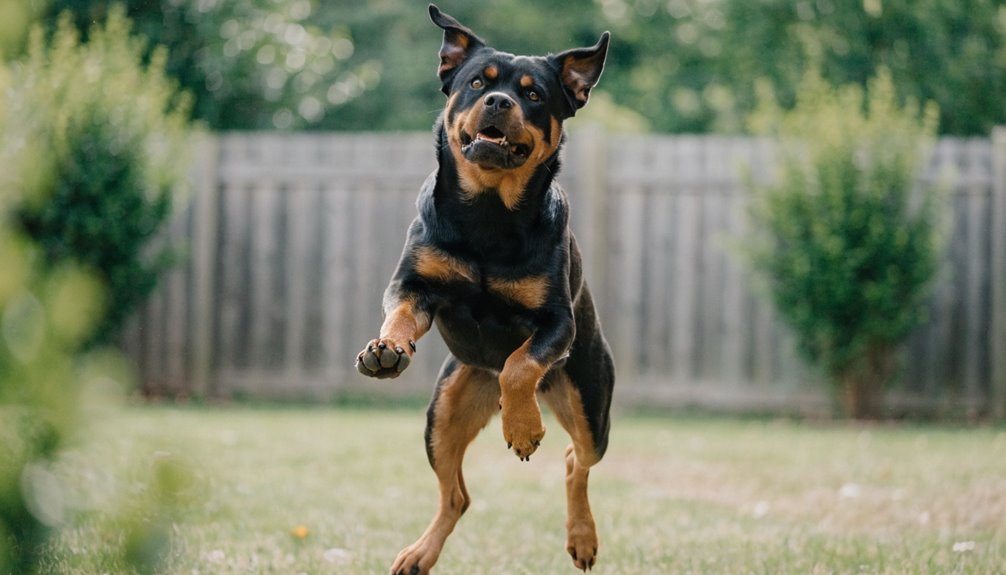
Your Rottweiler jumps because her size and muscular build make it an efficient way to reach your face, and she’s learned that jumping gets attention—whether you’re pushing her away or petting her. You can stop this early by managing her environment with crates and leashes, teaching sit as an incompatible behavior, and ensuring everyone responds consistently by ignoring jumps and rewarding only calm, grounded interactions. The key is preventing rehearsal while building a reliable alternative response.
- Key Takeaways
- Why Your Rottweiler Jumps (And What It Means)
- Manage the Environment Before Training Begins
- Get Everyone on the Same Page
- Teach Your Dog to Sit as an Incompatible Behavior
- Master the Greeting Technique That Works
- Practice With Staged Arrivals and Real Guests
- Stop Jumping on Walks and Unexpected Encounters
- Fix Training Plateaus: When Progress Stalls
- Frequently Asked Questions
- Conclusion
Key Takeaways
- Teach “sit” as an incompatible behavior—dogs cannot jump while sitting; reward all four paws on ground consistently.
- Prevent jumping rehearsal by using crates, gates, or leashes before guests arrive to interrupt the behavior cycle.
- Establish household protocol: all family members must consistently ignore jumps and only reward calm, seated behavior.
- Practice staged arrivals with guests starting 6–10 feet away, advancing only after 3–5 seconds of seated calm.
- Keep daily training sessions to 5–10 minutes, at least three times weekly, to build reliable responses and prevent plateaus.
Why Your Rottweiler Jumps (And What It Means)
Because Rottweilers are large, muscular dogs with an upright build, jumping often becomes their most efficient way to reach your face and seek attention or greetings.
Large, muscular Rottweilers often jump as their most efficient way to reach your face and seek attention or greetings.
Your dog jumps to communicate excitement, request access to resources, or initiate play, especially during adolescence when energy and metabolism peak around six to eighteen months old.
Understanding that dogs jump for specific reasons—not out of misbehavior—helps you respond effectively.
The problem intensifies when you inadvertently reinforce jumping through any reaction: pushing away, scolding, or even petting rewards the behavior and encourages repetition.
Tips to help include recognizing that inconsistent responses confuse your Rottweiler about what you expect.
Addressing jumping requires consistency, structure, and positive reinforcement of alternative behaviors, which ultimately teaches your dog better ways to greet you.
Manage the Environment Before Training Begins
Before you begin formal training, you’ll need to prevent your Rottweiler from practicing jumping by using management tools like crates, baby gates, or confining him to another room during guest arrivals, which stops the behavior from getting reinforced while you build new skills. Leashing your dog at the door gives you direct control during those high-excitement moments when guests enter, allowing you to guide him into a sit or calm position before he’s the chance to jump. Setting up these environmental barriers and management strategies now creates the structure you need to train consistently, since every jumping episode without correction teaches your dog that jumping works.
Crating and Confinement Options
Managing your Rottweiler’s environment through strategic confinement is one of the most effective ways to prevent jumping before formal training even begins, because you’re stopping the behavior from being rehearsed rather than trying to undo it later. You have several confinement tools at your disposal, and rotating between them during practice sessions teaches your dog calm behavior across different settings rather than only when crated.
| Confinement Tool | Best Use | Duration | Enrichment |
|---|---|---|---|
| Crate | Short intervals, supervised periods | 4–6 hours max for adults | KONG with food |
| Exercise pen | Slightly longer containment | 2–3 hours | Chew toys |
| Separate room | Controlled environment | Variable | Puzzle toys |
| Baby gate | Doorway management | During guest arrival | Treats |
| Tether/leash | Supervised calm practice | 30–60 minutes | Interactive toys |
Always pair confinement with enrichment so your dog associates calmness with reward, improving cooperation. This approach certainly is the case for preventing jumping rehearsal. For more information, please review our privacy policy; all rights reserved.
Leashing During Guest Arrivals
While crates and pens give you control over your dog’s space, you’ll also need a strategy for the moments when guests actually arrive—and that’s where leashing becomes your most direct tool for preventing jumping before it starts. Use a short leash between three and six feet, held at your side so you can step between your dog and the guest or guide them into a sit.
Tether your Rottweiler to a heavy-duty indoor anchor or secure tie-out before guests arrive, preventing lunging and maintaining control over proximity. Keep the dog leashed until they’ve remained calm for several minutes after someone enters, which often requires patience as excitement settles. This structure lets you interrupt the jumping sequence before it develops.
Get Everyone on the Same Page
Since your Rottweiler learns through patterns and repetition, inconsistent responses from different people will confuse him and slow his progress—one person might reward jumping with attention while another ignores it, which teaches him that jumping sometimes works and sometimes doesn’t.
Rottweilers learn through patterns and repetition, so inconsistent responses from different people will confuse him and slow his progress.
To prevent this, establish a written protocol posted near entryways that outlines exactly what everyone does: turn away with no eye contact or touch when he jumps, then cue him to sit, and reward only the sitting.
Schedule training sessions when household members and regular caregivers can practice together, reinforcing identical timing and rewards.
Assign one person to lead sessions initially, and coordinate management rules about crating, leashing, and door procedures so your Rottweiler receives uniform consequences and consistent opportunities to succeed.
Teach Your Dog to Sit as an Incompatible Behavior
The most effective way to stop jumping is to teach your Rottweiler that sitting gets him what he wants—attention, access, and rewards—while jumping shuts those things down entirely. Since a dog can’t sit and jump simultaneously, sitting becomes an incompatible behavior that naturally replaces the unwanted jumping.
Start this training with these steps:
- Have your dog on leash near the door and ask for a sit before any greeting occurs
- Only allow the person to approach or offer attention when all four paws remain on the floor
- If your dog breaks the sit and stands or lunges, the greeter immediately stops and turns away
- Resume interaction only when your dog settles into a sit again
This consistent pattern teaches your dog that sitting reliably opens access to what he values, making the behavior automatic during real arrivals.
Master the Greeting Technique That Works
By controlling your dog’s initial arousal level at the door, you’ll set up the conditions for sitting to succeed, since a calm Rottweiler is far more capable of holding a sit than one who’s already bouncing with excitement.
A calm dog is better equipped to sit on command than one already overwhelmed by excitement—control arousal first, success follows.
Start each greeting by having your guest pause outside for several minutes, allowing your dog to settle naturally. This delay breaks the cycle of escalating energy that typically happens when someone arrives.
Once calm, ask your Rottweiler to sit on-leash before the greeter enters. The guest moves forward only when all four paws stay planted on the floor. If your dog rises, the greeter immediately steps back and stops all interaction.
Repeat these brief, staged arrivals until consistency emerges.
Practice With Staged Arrivals and Real Guests
With consistent practice across multiple sessions, you’ll build the foundation that transforms your Rottweiler’s greeting behavior from chaotic jumping to reliable sitting, and staged arrivals with real guests provide the structure needed to make this shift stick.
Real guests create authentic excitement that training alone can’t replicate, allowing you to practice under conditions that mirror actual visits:
- Have friends or neighbors approach 10–15 times per session, with each person ignoring jumping and stepping back until all four paws touch the floor
- Start greeters 6–10 feet outside the door, advancing only when your dog remains seated for 3–5 seconds
- Practice with individual dogs first before adding household Rottweilers, preventing energy from cascading between animals
- Film sessions weekly and review progress against your roadmap-to-success cues, stopping before over-excitement peaks
This structured repetition cements calm greeting patterns through genuine reinforcement.
Stop Jumping on Walks and Unexpected Encounters
You’ll find that walks present unique jumping challenges because your Rottweiler encounters unpredictable strangers in an environment where excitement builds naturally, so you need to establish sitting as the automatic response by keeping your dog on a short leash, cueing sit before each person approaches, and rewarding all four paws on the ground within 1–2 seconds.
Consistency matters across all strangers—whether you can control the approaching person or not—because your dog learns that calm behavior, not forward lunging, creates access to attention and treats.
Practice this structure regularly with friends during short 5–10 minute drills where you gradually increase unpredictability, teaching your dog that sitting works reliably in real encounters on the street.
Preventing Jumping During Walks
Most jumping incidents happen during walks because your Rottweiler’s arousal level spikes when encountering people, and strangers often unintentionally reward the behavior by talking to or petting an excited dog. You can prevent this by managing your dog’s state before and during walks through consistent structure and clear boundaries.
- Practice a 3–5 minute calm-down routine before leaving home, using sit/stay or leash focus exercises to lower arousal
- Keep your dog on a short leash at your side, asking for sit when passing others to create an incompatible behavior
- Step between your dog and approaching strangers, turning your body away while cueing sit and rewarding within 1–2 seconds
- Instruct people not to interact with your dog unless all four paws remain on the ground for at least 2–3 seconds
This structure removes reinforcement for jumping while building reliable responses to common triggers.
Managing Unexpected Encounters
Even when you’ve prepared your Rottweiler with calm-down routines and practiced sits during predictable walks, unexpected encounters will still happen—a neighbor rounds a corner, a delivery person approaches suddenly, or an off-leash dog appears without warning—and these moments test whether your dog’s training holds under real pressure. Your immediate response determines whether jumping gets reinforced or interrupted.
Turn your dog’s body away and step directly between them and the approaching person, physically blocking forward momentum before your Rottweiler can lunge. This prevents the jumping behavior and signals that forward movement ends the encounter.
Ask approaching people to ignore your dog completely—no petting, talking, or eye contact—until your dog settles into a sit. Only then does interaction begin. This structure teaches your Rottweiler that calmness, not jumping, opens social opportunities.
Consistency With Strangers
Consistency across every person your Rottweiler meets is the foundation that transforms isolated training sessions into reliable behavior, because dogs don’t generalize rules from one stranger to the next—they learn that jumping works with some people and fails with others, which creates confusion and unpredictable jumping.
To establish uniformity, you’ll need to coordinate with everyone who interacts with your dog:
- Brief all handlers on ignoring jumps completely and only petting when all four paws stay grounded
- Demonstrate the sit-and-reward sequence so they understand the exact protocol
- make certain they withhold attention during jumping, removing the primary reinforcer
- Follow up after interactions to reinforce what worked
This structured approach prevents mixed signals and builds reliable behavior across all encounters.
Fix Training Plateaus: When Progress Stalls
After weeks of steady improvement, you may notice your Rottweiler’s jumping behavior stops getting better, or even slides backward—and that stall usually signals a shift in your training routine rather than a failure in method. Plateaus happen most often when practice frequency drops below three sessions per week, allowing the behavior to resurface. You’ll spot patterns by logging each session: date, duration, who participated, and success rate. Review your logs for regression tied to specific people or situations, since different handlers or strangers often trigger renewed jumping. Tighten your criteria by requiring longer calm behavior before rewarding, and switch to high-value treats if petting’s become routine. Resume consistent five to ten-minute daily sessions to restart momentum and rebuild your dog’s reliable response.
| Common Plateau Causes | What You’ll Notice |
|---|---|
| Sessions drop below 3× weekly | Jumping returns within days |
| Inconsistent reinforcement | Dog responds only to certain people |
| Criteria never increase | Progress caps at baseline improvement |
| Group energy in multi-dog homes | One dog’s excitement triggers others |
Frequently Asked Questions
How to Stop a Rottweiler From Jumping Up?
You’ll stop jumping by turning away when your Rottweiler lifts a paw, rewarding sits with high-value treats, and practicing staged arrivals daily. Manage opportunities by crating or tethering, ensuring all household members consistently ignore jumping behavior.
What Is the 7 7 7 Rule for Dogs?
You wait 7 seconds before approaching, pause 7 seconds while evaluating calmness, then interact for 7 seconds if your dog stays calm. You’ll repeat this sequence to reinforce that composure, not jumping, earns attention.
At What Age Do Puppies Stop Jumping Up?
Your puppy’s jumping is a firework of adolescent energy that typically fades between 12–18 months. You’ll see natural improvement as your pup matures, though consistent training accelerates the process markedly.
What Is a Red Flag Behavior in Puppies?
You should watch for escalating jumping patterns that intensify despite corrections. If your puppy can’t sit when guests arrive or shows nipping and growling when restrained, you’re seeing impulse-control deficits requiring immediate intervention.
Conclusion
You’ve learned why your rottweiler jumps, how you’ll manage the environment, and what techniques you’ll use to redirect that behavior. You’ll teach incompatible actions, you’ll practice with staged arrivals, and you’ll maintain consistency across every interaction. You’ll address plateaus by adjusting your approach, and you’ll stay committed to reinforcement. Your dedication to structure and patience will reshape your dog’s habits, creating the calm, grounded companion you’re working toward.