Some of the links in this post are affiliate links. This means we may earn a small commission if you make a purchase through these links—at no extra cost to you. We only recommend products and tools that we genuinely believe will help you with your Rottweiler.
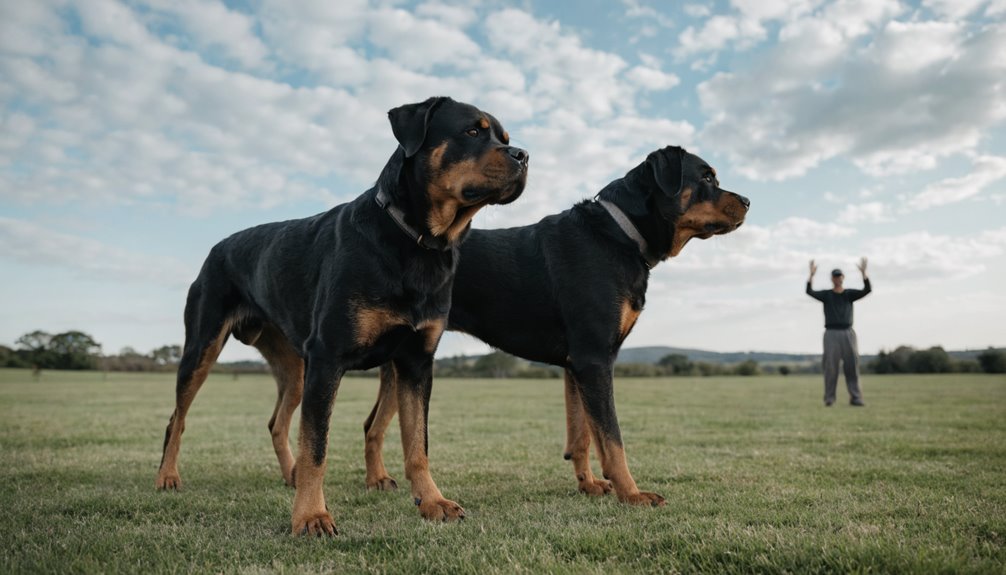
Your Rottweiler’s guarding instincts and power create safety risks if she charges toward distractions instead of holding position. Distance training teaches her to stay put reliably, even when you’re far away. Start with rock-solid sits and downs at arm’s reach using consistent rewards, then gradually expand distance in small 1–2 meter increments while anchoring her with a long line and back-tie. Progress only after achieving 8–9 out of 10 reliable responses, layering minor distractions once distance mastery solidifies, ensuring your commands work when it matters most.
- Key Takeaways
- Why Rottweilers Need Distance Training
- Start Close, Build Reliability at Short Range
- Increase Distance Stepwise While Maintaining Control
- Long Lines and Safety Gear for Distance Training Outdoors
- Movement and Angles: Advanced Distance Proofing
- Introducing Minor Distractions After Distance Mastery
- Why Your Rottweiler Follows You: Distance Training Troubleshooting
- High-Value Rewards: Motivation at Every Distance
- Release Cues: Signaling “You’re Done” Without Confusion
- Frequently Asked Questions
- Conclusion
Key Takeaways
- Start distance training at 8–9 feet with rock-solid sit/down/stay before progressively extending to 20–50 feet using long lines.
- Rottweilers’ size and guarding instincts require anchored setups (back-tie or short leash) to prevent forward movement toward distractions.
- Build release consistency with a single cue like “Break,” delivered only when the dog holds steady, paired with immediate rewards.
- Increase distance incrementally by 1–2 meters while maintaining 8–9 out of 10 reliability; revert if position breaks.
- Use high-value rewards (cooked chicken, real cheese) scaled by distance to counterbalance temptations as difficulty increases.
Why Rottweilers Need Distance Training
Because Rottweilers possess strong guarding and herding instincts, they’re naturally inclined to move toward a handler, a perceived threat, or anything that captures their attention, which is why distance training becomes essential for teaching them to hold their position reliably rather than approach.
Your Rottweiler’s size and power make this training distance work particularly critical for safety. Without consistent distance training, their instinct to move forward during guarding moments can create unpredictable situations on streets, in yards, or around other animals.
Building reliable distance commands gives you control when you need it most. Through structured training distance protocols using long lines and back-tie setups, you’ll develop the consistency and reinforcement patterns that allow your dog to stay calm and stationary, even when distractions intensify or you move away from them.
Start Close, Build Reliability at Short Range
You’ll establish a solid foundation by working your Rottweiler at close range—around 8 to 9 feet or less—until they respond reliably to your command with minimal distractions, which typically means success rates of 8 to 9 times out of 10.
This early phase matters because consistent reward timing at short distances trains your dog’s brain to associate the behavior with reinforcement, creating the neural pathways that’ll support longer distances later.
Once you’ve built this reliability, you’re ready to gradually extend distance, knowing your dog understands what you’re asking and will respond predictably when you ask it from farther away.
Foundation Before Distance
Before you move your Rottweiler away from you during command training, that foundation work—the sit, down, and stay—needs to be rock-solid at close range, ideally reaching 8 or 9 out of 10 reliability within arm’s reach. This consistency prevents you from reinforcing proximity-dependent responses, where your dog only obeys when you’re nearby.
When you anchor the dog’s position with a back-tie or short leash before distance training begins, you stop the dog from drifting toward you during work. This setup teaches the actual cue rather than rewarding your dog for approaching.
Skipping this foundation step often leads to confusion later, making distance training frustratingly slow. Build that reliable close-range performance first, and you’ll establish the structure necessary for successful distance work.
Reward Consistency Matters
The foundation you’ve built at close range only becomes truly useful when you reinforce it heavily and consistently, cementing your Rottweiler’s understanding before you ask for distance.
During the first 20–30 repetitions at short range, deliver a treat after every successful sit or down stay, establishing a high-rate reward schedule that your dog clearly understands.
This consistency creates a strong reinforcement history, which means your Rottweiler develops reliable expectations about what happens when they hold position.
When you later increase distance, you’ll drop duration back to one second and maintain that same high-rate, consistent delivery using tossed treats or remote dispensers.
This approach prevents confusion and regression, ensuring your dog stays confident as you gradually ask for more.
Increase Distance Stepwise While Maintaining Control
Once your Rottweiler reliably holds a sit or down for 1–2 seconds right in front of you across 8–9 out of 10 repetitions, you’re ready to gradually move farther away while keeping control intact.
Once your Rottweiler reliably holds sit or down for 1–2 seconds across 8–9 out of 10 repetitions, you’re ready to gradually increase distance.
Set up a long line and back-tie so your dog remains anchored while you increase distance incrementally, moving back just 1–2 steps after consistent performance.
This structure prevents your Rottweiler from breaking position to follow you, which would reinforce the exact behavior you’re trying to eliminate.
Add distance in small, measurable increments—roughly 1–2 meters at a time.
If your dog breaks position, return to a shorter distance where success is certain, then rebuild one second of steadiness before advancing again.
Long Lines and Safety Gear for Distance Training Outdoors
As you expand distance in your training, a long line becomes your essential tool for maintaining control while your Rottweiler works far from you, and you’ll want to invest in quality gear that protects both dog and handler.
Choose a 20–50 ft nylon or biothane long line, then attach it to a flat buckle or quick-release harness rather than a collar, which distributes force evenly and prevents neck injury when your dog bolts suddenly.
At the right time during each session, use a sturdy locked carabiner or reinforced swivel snap to connect the long line, preventing hardware failure and twisting during powerful pulls.
For evening work, wear high-visibility clothing and add reflective tape to your long line.
Train in open, low-traffic areas with soft footing to minimize injury risk if your dog runs.
Movement and Angles: Advanced Distance Proofing
You’ll now strengthen your Rottweiler’s distance obedience by systematically introducing handler movement and directional angles, which challenge the dog’s ability to hold position when you’re no longer stationary.
Start with predictable patterns—moving front, 45° to the side, fully to the side, and behind—while your dog maintains the stay for 1–2 seconds at short distances, then gradually extend both the duration and your distance as the dog reliably holds 8–9 times out of 10 at each angle.
This structured progression prevents confusion and frustration by isolating one variable at a time, so your Rottweiler learns that staying put matters regardless of where you move, not just when you’re standing still.
Handler Movement Patterns
Handler movement patterns challenge your Rottweiler to hold a command despite the distraction of your body shifting, turning, or walking away—a critical proof that the dog’s response is tied to the cue itself, not your stationary position.
Start by walking away slowly, then circling at 45°–90° angles, and gradually turning your back while your dog maintains position. Always return to distance your dog and deliver the reward directly, preventing anticipatory following.
These structured patterns teach your Rottweiler that handler movement patterns don’t signal release or permission to break command. Introduce each variation separately, ensuring consistency before combining them, so your dog learns the command remains constant regardless of your motion, angle, or direction.
Directional Angle Adjustments
Once your Rottweiler reliably holds a command regardless of your movement patterns, you’re ready to layer in directional angle adjustments—the next proof that distance obedience isn’t tied to your position relative to the dog, but to the command itself.
Start with small lateral shifts of 45° left or right at short distances of 3–5 feet, using a long line for safety. Only progress to 90° angles after achieving 8–9/10 reliability on the base command.
Practice one-second holds at each new angle, increasing duration by one-second increments as consistency improves. Reward from the new angle with high-value treats tossed to the dog’s chest.
If your Rottweiler breaks position, revert immediately to the last reliable angle and rehearse that step before reintroducing incremental progression.
Introducing Minor Distractions After Distance Mastery
After your Rottweiler demonstrates 8–9/10 reliability at progressively longer ranges—moving steadily from 1 meter to 5 meters to 10 meters—the next phase involves gradually layering in minor distractions so the dog learns to maintain the distance command despite competing stimuli in the environment.
Start with controlled, low-intensity distractions like a quiet toy dropped 3–4 meters away, a brief door knock, or a helper standing quietly 6–8 meters off. Keep the hold duration short—1–3 seconds—and use high-value rewards to counterbalance the new temptation.
Only increase distraction intensity after your dog maintains the distance command reliably three times consecutively. If your Rottweiler breaks position, immediately reduce the distraction level and shorten distance or duration to rebuild consistency before progressing again.
Why Your Rottweiler Follows You: Distance Training Troubleshooting
One common setback during distance training is when your Rottweiler follows you instead of holding position, and this problem usually signals that proximity was rewarded too often during the early stages of teaching Sit or Down. When you’ve inadvertently reinforced movement toward you, your dog learns that following produces rewards, creating a strong habit that undermines distance work.
To fix this, stop moving toward your dog immediately after commands. Instead, anchor their location using a back-tie or leash, then return to them before giving the final reward. Reduce distance D at a time back to one step or one second of reliable success, rebuilding gradually in small increments.
Over-assisting by repeatedly approaching to complete exercises teaches your dog to anticipate your movement. Use remote reinforcement and vary your handler position to build genuine distance compliance and consistency.
High-Value Rewards: Motivation at Every Distance
Distance training relies heavily on reward value, since your Rottweiler must find it worthwhile to hold position when you’re steps or yards away and distractions compete for their attention. Use high-value rewards like cooked chicken, real cheese, or liver treats—items at least 5–10× more enticing than everyday kibble.
Increase reward value as distance your dog travels grows: kibble works close by, semi-soft treats for mid-range, and ultra-high-value items like hot dog for off-leash or street-level work.
Break rewards into tiny pieces and deliver intermittently every 5–15 seconds during long holds to sustain focus without overfeeding. Reserve your highest-value rewards for real-life high-distraction scenarios, ensuring reliable motivation when safety matters most.
Release Cues: Signaling “You’re Done” Without Confusion
Your Rottweiler’s reward strategy keeps them motivated across distance, but without a clear signal marking the end of a hold, your dog will struggle to know when they’re actually finished, and confusion breeds unreliable obedience.
Choose a single, short release cue—”Break,” “Free,” or a click—and use it consistently so your dog learns that exact sound signals the end of the command. Give the cue from your position, never while approaching, and only when your Rottweiler’s holding steady. Pair the release with an immediate reward for the first several hundred repetitions, strengthening the connection between the cue and consequence.
Time to Start Training by avoiding accidental releases; inconsistent signals weaken reliability. If anticipation develops, reset to shorter durations and rebuild progressively before increasing difficulty.
Frequently Asked Questions
What Is the 3-3-3 Rule for Dog Training?
You practice a new command in three different locations, doing three sets each session, with three seconds of hold time initially. This builds reliable distance behaviors before you increase difficulty.
What Is the Hardest Command to Teach a Dog?
You’d think basic obedience’s hardest—but you’re wrong. Reliable long-distance recall truly challenges you because you’re simultaneously mastering distance, distractions, and motivation. Your dog must choose you over everything.
What Is the 7 7 7 Rule for Puppies?
You’ll spend 7 minutes per session, 7 sessions daily, for 7 weeks introducing basic training. You’re keeping sessions focused and reward-rich to match your puppy’s short attention span and maximize learning retention.
What Is the Best Training Method for a Rottweiler?
You’ll succeed with your Rottweiler by building foundation obedience close-range first, progressing distance gradually, training each “D” separately, and using high-value rewards to maintain motivation throughout.
Conclusion
You’ve now built a solid foundation for distance training your Rottweiler, planting seeds that’ll grow into reliable obedience across any environment. Consistency with your rewards, clear release cues, and gradual progression keep your dog’s training from crumbling under pressure. You’ll find that maintaining these principles throughout your dog’s life guarantees lasting control, whether you’re working in your backyard or maneuvering unpredictable outdoor settings where distractions compete for attention.