Some of the links in this post are affiliate links. This means we may earn a small commission if you make a purchase through these links—at no extra cost to you. We only recommend products and tools that we genuinely believe will help you with your Rottweiler.
Trust with your Rottweiler builds through predictable routines, not big gestures. Feed at consistent times, exercise daily, and use identical training cues so your dog learns you’re reliable and safe to follow. Set clear boundaries around furniture, doors, and meals—enforce them every day to prevent confusion. Use high-value treats immediately after obedience, then shift to intermittent rewards as performance improves. Gentle handling during socialization teaches that touch signals safety. Practice graduated departures to prevent separation anxiety. Each consistent action compounds trust over time, and understanding how structure deepens your bond reveals why some Rottweilers become unshakeable partners.
- Key Takeaways
- Start With Daily Routines Your Rottweiler Can Trust
- Set Clear Boundaries So Your Dog Knows What to Expect
- Master Gentle Handling to Build Physical Trust
- Reward Obedience to Build Trust Early and Often
- Socialize at Your Rottweiler’s Pace With New People
- Build Trust Through Structured Interactive Play
- Understand Separation Anxiety and Practice Gradual Desensitization
- Address Behavioral Blocks to Trust Early
- Stay Consistent: Predictability Deepens Mutual Respect
- Frequently Asked Questions
- Conclusion
Key Takeaways
- Establish consistent daily routines with fixed feeding times, exercise sessions, and training to create emotional stability and demonstrate reliable leadership.
- Set clear boundaries and enforce rules consistently across furniture access, door behavior, and meal waiting to establish your guidance role.
- Use high-value treats immediately after desired behaviors, then transition to intermittent reinforcement as performance improves for sustained motivation.
- Socialize gently during the 8–16 week window with brief, positive exposures to people and environments, monitoring comfort signals closely.
- Practice predictable calm-down routines after training and play sessions to teach impulse control and transform trust into lived experience.
Start With Daily Routines Your Rottweiler Can Trust
The foundation of a strong bond with your Rottweiler rests on predictability, and you’ll build that predictability through consistent daily routines that your dog can rely on.
Feed twice daily at the same times—such as 8:00 AM and 6:00 PM—to reduce bloat risk while establishing trust through structure.
Establish a morning and evening exercise routine lasting 20–30 minutes, using walks, fetch, or training to meet energy needs and reinforce your leadership role.
Incorporate consistent training into these sessions with identical cues, rewards, and timing so your Rottweiler learns what to expect.
Finally, maintain a clear departure/arrival ritual involving five-minute graduated departures and calm greetings without excitement, preventing separation anxiety.
These interlocking routines create emotional stability and demonstrate that you’re a reliable leader your dog can depend on.
Set Clear Boundaries So Your Dog Knows What to Expect
While your daily routines create the structure your Rottweiler needs, clear and consistent boundaries teach him what behavior you’ll accept and what you won’t, reducing the confusion that can lead to dominance-related problems.
Establish consistent rules about furniture access, door behavior, and meal timing, then enforce them every single day so your dog understands expectations clearly. This predictable structure builds trust because your Rottweiler knows exactly where he stands.
Set specific guidelines—no furniture unless invited, sitting before doors, waiting calmly for food—and stick to them without exception. When you maintain routine timing alongside these consistent rules, your dog learns that you’re reliable and in control, which naturally strengthens your bond and encourages him to look to you for guidance rather than assume leadership himself.
Master Gentle Handling to Build Physical Trust
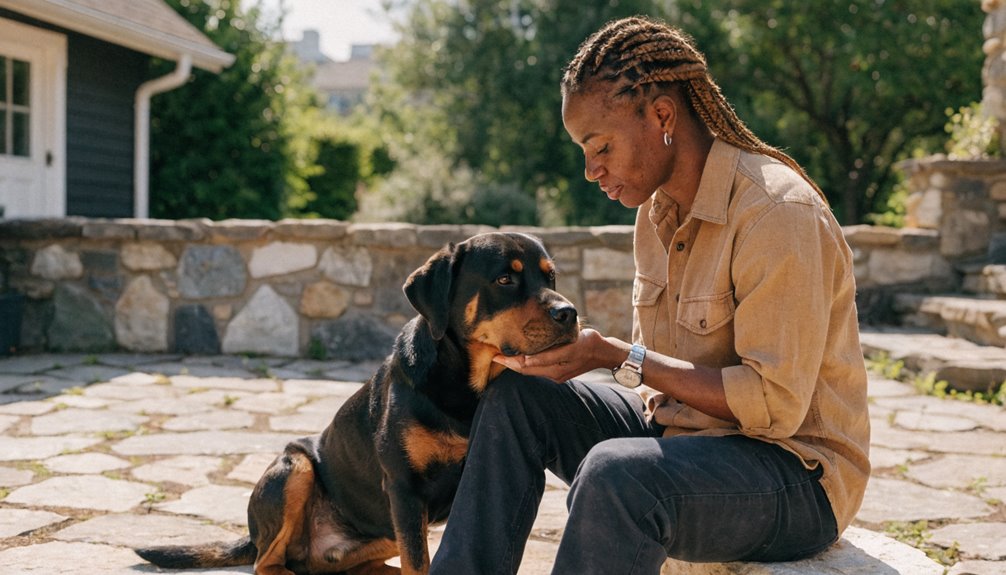
Physical trust forms the foundation of your bond with your Rottweiler because it teaches him that your touch means safety rather than threat, especially during vulnerable moments like vet exams or grooming.
You’ll build this trust through gentle handling during his 8–16 week socialization window, starting with brief 3–5 minute sessions that gradually increase as he relaxes.
Use high-value treats and calm praise immediately after touching sensitive areas like paws, ears, and muzzle to reinforce positive associations.
Progressive desensitization works best for grooming: move through touch, hold, simulate trim, then actual trim across several days.
For adult Rottweilers, maintain this connection with weekly health checks paired with treats, creating predictable routine and consistency that makes veterinary visits less stressful and builds confidence in necessary handling.
Reward Obedience to Build Trust Early and Often
You’ll build trust faster when you reward obedience consistently, because your Rottweiler learns exactly which behaviors earn positive outcomes and begins to see you as predictable and reliable.
High-value treats—small, calorie-dense training bits that don’t exceed 10% of daily intake—keep motivation sharp during repeated practice sessions, while praise and occasional play reinforce the emotional bond beyond food alone.
Start rewards immediately within one second of the desired behavior, then gradually shift toward variable reinforcement (praise mixed with treats) as your dog’s reliability reaches 80–90%, which teaches her that following commands matters regardless of whether a treat appears every time.
Consistency Builds Reliable Behavior
Predictable patterns and immediate rewards form the foundation of obedience in Rottweilers, and this consistency teaches your dog that following commands reliably leads to positive outcomes. You’ll strengthen your bond by using the same consistent cue-word and hand signal every time, so your Rottweiler learns to predict what happens next. Short 5–10 minute sessions twice daily create structure your dog can depend on, making learning feel manageable and predictable rather than confusing.
| Training Element | Week 1–4 | Week 5–8 | Week 9–12 | Ongoing |
|---|---|---|---|---|
| Reward Type | High-value treats | Treats + play | Intermittent reinforcement | Variable rewards |
| Session Length | 5 minutes | 7–8 minutes | 10 minutes | 10 minutes |
| Reward Timing | 1–2 seconds | 1–2 seconds | Occasional delay | Delayed rewards |
| Consistency Focus | Perfect repetition | Pattern building | Behavior reliability | Maintenance |
As performance improves, shift to intermittent reinforcement by rewarding every 2–5th correct response, which maintains obedience without treat dependency. Always end training on a successful behavior to close sessions positively.
High-Value Treats Matter Most
Building trust with your Rottweiler relies on choosing treats that genuinely excite them, because a reward that doesn’t capture their attention won’t reinforce the behavior you’re trying to teach. High-value treats like cooked chicken, freeze-dried liver, and low-sodium turkey work best during critical training sessions, especially during the 8–16 week socialization window when your dog encounters unfamiliar people and environments.
- Break treats into 1/4–1/2 inch pieces so your Rottweiler consumes them quickly without filling up
- Deliver rewards within one second of desired behavior to strengthen the obedience-reward connection
- Reserve meat and cheese for challenging commands during socialization phases
- Rotate treat varieties weekly to prevent habituation and maintain excitement
Once behaviors become reliable, shift to lower-calorie kibble or praise, keeping daily calories within 2,100–2,500 kcal for adult maintenance while reinforcing good habits consistently.
Praise Reinforces Emotional Bonds
Praise and physical affection work alongside treats to create emotional bonds because they signal to your Rottweiler that you’re genuinely pleased with their choices, not just offering food. When you reward calm behavior with verbal markers like “yes,” gentle petting, and enthusiastic positive praise, you’re building multi-sensory associations that deepen trust beyond simple food motivation.
Short training sessions of 5–10 minutes allow you to maintain meaningful praise throughout, preventing it from losing impact through repetition or fatigue. Consistency matters here—pairing your voice, touch, and words creates reinforcement patterns your dog recognizes and values. This structure teaches your Rottweiler that trust develops through your genuine emotional acknowledgment, making obedience feel rewarding at a deeper level than treats alone can achieve.
Socialize at Your Rottweiler’s Pace With New People
Successfully introducing your Rottweiler to new people depends on respecting their individual comfort level and introducing them gradually during their critical socialization window—those formative weeks between 8 and 16 weeks of age when they’re most receptive to new experiences.
Early socialization requires structure and patience. Keep initial sessions brief, 2–5 minutes daily, then gradually increase exposure as your puppy builds confidence. Watch body language constantly: soft eyes, relaxed mouth, and wagging tail signal comfort, while lip lifts, stiff posture, or whale-eye indicate you should pause and reduce intensity.
Use high-value treats generously during encounters to reinforce positive associations with new people. Start in neutral low-distraction settings like your front yard or quiet park before progressing to busier environments. Space sessions every 1–2 days, allowing your Rottweiler time to process each interaction.
- Observe soft eyes and relaxed posture as green lights to continue
- Recognize stiff body tension as signals requiring immediate pause
- Reward calm behavior at 4–6 treats per minute
- Progress from quiet yards to pet-friendly stores gradually
Build Trust Through Structured Interactive Play
You’ll build trust with your Rottweiler by establishing yourself as a predictable leader through structured play sessions where you control the start, flow, and end of each game, signaling that fun comes through your direction rather than chaos.
This consistency teaches your dog that following your cues—whether during tug, fetch, or obedience drills—creates positive outcomes, which gradually shifts their perception of you from an unpredictable figure to a reliable source of engagement and reward.
Play As Leadership Practice
Play sessions offer one of the most direct ways to establish yourself as a calm, consistent leader while simultaneously meeting your Rottweiler’s physical and mental needs, and this leadership happens not through dominance but through structure and predictability.
You’ll control when play begins and ends, teaching your dog that rewards follow compliance rather than demand.
- Start each session with a clear cue and require calm eye contact before engagement
- Incorporate trade exercises to reduce resource guarding and build trust through predictable exchanges
- Vary play types weekly—tug, fetch, scent games—to prevent boredom and demonstrate leadership across contexts
- End with a reliable calm-down routine to show you control shifts and teach impulse control
This consistent approach reinforces that you’re dependable, which strengthens your bond markedly.
Purposeful Games Build Confidence
Because Rottweilers respond powerfully to structure and clear expectations, intentionally designed games become a direct channel for building both their confidence and your bond, transforming play from simple exercise into a trust-building tool that strengthens their decision-making skills and emotional security.
You can rotate interactive toys weekly and limit free access so play remains novel and rewarding, reducing boredom-related reactivity.
Find-it scent games hidden around your yard engage their intelligence while rewarding calm, confident searching over 10–15 minutes.
Controlled tug sessions with clear start/stop rules and a “drop it” cue teach impulse control while honoring their strength.
Short 5–7 minute training-play intervals combining obedience cues with play rewards reinforce focus and predictability, matching their attention span and building the consistency they need.
Interactive Bonding Through Structure
Structured interactive play forms the foundation of trust with your Rottweiler because it combines the purposeful activity they crave with the predictability and clear rules that shape their confidence, moving beyond simple games into a system where every session reinforces your leadership and deepens their emotional security.
Routine helps your dog understand expectations, while physical and mental stimulation through play prevents frustration and strengthens your bond. Schedule two daily 20–30 minute sessions that weave obedience training into play:
- Sit before ball release to teach impulse control
- Down for tug to reinforce calm focus
- Scent work hide-and-seek games twice weekly
- Cool-down grooming for 5–7 minutes to associate structure with relaxation
This approach builds consistent communication, demonstrating that you provide direction, purpose, and reward—the elements your Rottweiler needs to trust you completely.
Understand Separation Anxiety and Practice Gradual Desensitization
When you leave your Rottweiler alone, their distress often stems from a learned pattern: they’ve come to associate your departure cues—grabbing keys, putting on shoes, heading toward the door—with your absence, and that absence triggers anxiety that builds over minutes or hours.
Breaking this cycle requires gradual desensitization paired with counterconditioning. Start by practicing these cues without actually leaving, repeating them daily until they lose their predictive power.
Next, leave for just one to five minutes, then increase time by no more than ten to twenty percent each day.
During departures, deliver high-value frozen Kongs or stuffed mats that redirect focus for extended periods.
Building independence happens through structured alone-time sessions indoors, progressing from visible separation to out-of-sight periods over weeks, establishing consistency and reinforcement throughout.
Address Behavioral Blocks to Trust Early
Trust doesn’t develop automatically in Rottweilers; it builds when your dog learns that you’re consistent, predictable, and safe across different situations. Early behavioral blocks—resource guarding, separation anxiety, and fear responses—undermine bonding if left unaddressed, so you’ll want to tackle them proactively during puppyhood.
Socialization is crucial during weeks 8–16, and you should expose your pup to varied people, surfaces, and noises through short, positive encounters. Predictable routines reduce uncertainty that triggers protective responses. Address resource guarding immediately by trading higher-value treats for toys or food during multiple daily reps until your dog willingly relinquishes items. Practice graduated departures starting at five minutes to prevent separation anxiety, using puzzle feeders to occupy your dog during absences. Monitor for medical issues like hip dysplasia and maintain ideal body weight, since pain erodes trust and disrupts training progress.
Stay Consistent: Predictability Deepens Mutual Respect
Because your Rottweiler’s brain thrives on patterns, you’ll deepen mutual respect by establishing routines so reliable that your dog can predict what comes next—and therefore trust that you’ll follow through. Feed your dog at the same times each day, maintain consistent cues during training sessions, and schedule daily walks with similar timing so your dog learns to anticipate these events. This predictability reduces anxiety and reinforces that you’re dependable.
When you enforce household rules consistently—same expectation every time—your dog understands boundaries without confusion. Practice graduated departures to prevent separation anxiety, gradually extending absences so your dog builds confidence in your return.
This reliable routine transforms trust from abstract concept into lived experience, cementing the bond between you and your Rottweiler through actions, not promises.
Frequently Asked Questions
What Is the 7 7 7 Rule for Dogs?
You wait 7 minutes before making eye contact, 7 more before offering your hand, and 7 additional minutes before touching. This gradual approach lets the dog assess you and build trust without feeling overwhelmed.
How Do I Say “I Love You” in Dog Language?
You say “I love you” through consistent routines, calm predictability, and rewarding your dog’s attention. Make eye contact, offer gentle touches on their chest, and use a soft voice during greetings—you’re communicating safety and affection.
What Is the 3-3-3 Rule for Dog Anxiety?
You’ll experience three phases: expect shock and clinginess for three days, then routine-building and testing behaviors through three weeks, and finally fear periods or developmental changes around three months.
Do Rottweilers Get Attached to Their Owners?
Yes—while they’re often misunderstood as aggressive, Rottweilers actually form incredibly deep, lasting bonds with you. Your consistent daily routines and meaningful interaction intensify that loyalty, making them fiercely protective of your family.
Conclusion
You’ve now learned that building trust with your Rottweiler works like constructing a bridge—each plank you lay through consistency, clear boundaries, and gentle handling creates a stronger foundation. A dog who knows what to expect from you doesn’t waste energy worrying; instead, that energy goes toward connection. Your next step is choosing one technique from this guide, then practicing it daily until it becomes routine for both of you.