Some of the links in this post are affiliate links. This means we may earn a small commission if you make a purchase through these links—at no extra cost to you. We only recommend products and tools that we genuinely believe will help you with your Rottweiler.
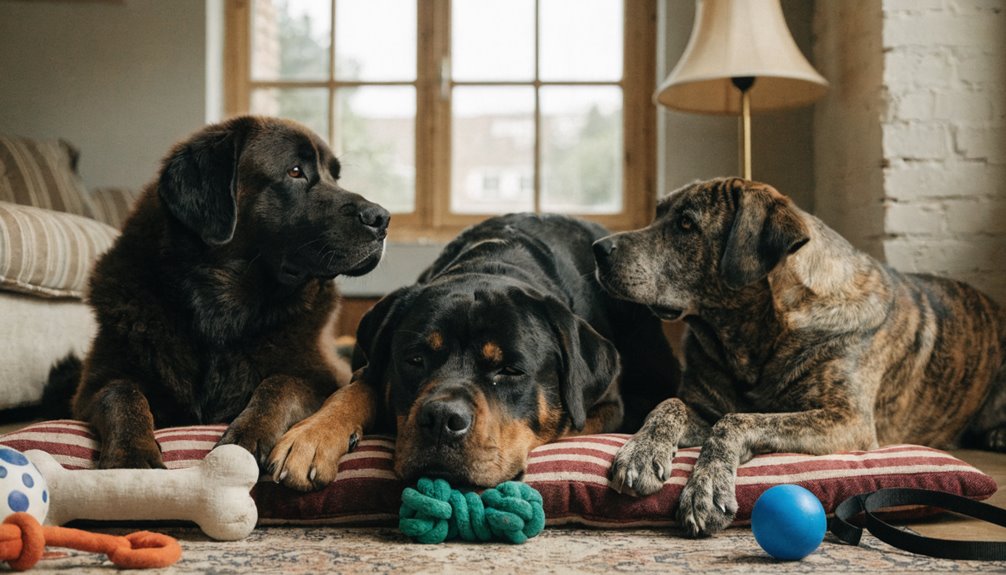
You can’t prevent fighting by ignoring a Rottweiler’s bred-in guarding instincts and low tolerance for repeated harassment from housemates. Instead, feed dogs separately in closed spaces, train each one daily to build impulse control and reliable recalls, and watch for early warning signs like stiffened posture and hard stares. Design your home with wider doorways and separate resource zones to minimize territorial friction, and interrupt escalation within seconds using high-value treats. Understanding why conflicts start—and stopping them before they turn physical—requires consistent structure across feeding, training, and management.
- Key Takeaways
- Why Rottweilers Change Multi-Dog Household Dynamics
- Assess Compatibility Before Adding a Rottweiler to Your Pack
- Separate Feeding Times to Eliminate Resource Competition
- Train Each Dog Separately to Build Confidence and Obedience
- Read Body Language: Spotting Escalation Before Fighting Starts
- Interrupt Tension in Seconds With Recalls and High-Value Treats
- Design Your Home to Prevent Collisions and Territorial Friction
- Reduce Cumulative Stress: Managing Guests, Noise, and Overstimulation
- When to Call a Professional Trainer: Red Flags You Can’t Ignore
- Frequently Asked Questions
- Conclusion
Key Takeaways
- Rottweilers bred for guarding have natural dominance and resource-guarding instincts that require careful management and prevention systems.
- Feed dogs in completely separate spaces using closed doors, baby gates, or crates to prevent resource-guarding conflicts.
- Match Rottweiler exercise needs (60–90 minutes daily) with compatible dogs; avoid pairing with dogs needing under 30 minutes.
- Train reliable recall to 80–90% success from 10–30 feet to interrupt escalating tension within seconds during conflicts.
- Watch for stiffened posture, hard stares, raised hackles, and increased vocalization as critical early warning signs of aggression.
Why Rottweilers Change Multi-Dog Household Dynamics
When a Rottweiler joins a multi-dog household, the dynamics shift in ways that smaller or less assertive breeds rarely trigger, and understanding why matters for preventing serious conflict.
Rottweilers were bred as working and guarding dogs, which means they carry natural instincts toward dominance and resource guarding that surface around food, beds, toys, and human attention.
Their size and strength amplify what might be minor tension with a smaller dog into a serious physical confrontation.
Because Rottweilers often show lower tolerance for repeated harassment from housemates, conflicts can escalate quickly.
Same-sex pairings, particularly males near the same age, face higher risk of chronic disputes.
Recognizing these breed-specific tendencies allows you to build management systems and household structure that prevent competition from triggering fights.
Assess Compatibility Before Adding a Rottweiler to Your Pack
Before you bring a Rottweiler into your home, you’ll need to assess how well your current dogs’ temperament, energy level, and size match with this breed’s powerful build and working-dog intensity, since mismatches in these areas often trigger conflict or unsafe play dynamics.
Consider your existing dogs’ prior socialization history alongside the Rottweiler’s background—dogs with limited exposure to other animals or a history of reactivity typically struggle to coexist peacefully with a large guardian breed, while well-socialized dogs with calm dispositions tend to adapt more smoothly.
Your honest evaluation of each dog’s personality, exercise needs, and past behavior will guide whether a Rottweiler fits into your pack or whether the risk of serious conflict outweighs the benefits.
Temperament And Energy Levels
As a medium-high energy working dog, the Rottweiler typically requires 60–90 minutes of daily physical activity and mental work, which means you’ll want to match them with dogs whose exercise needs align closely with theirs. Mismatched dog energy levels create frustration and tension that can escalate into dog aggression, so pairing a high-drive Rottweiler with a low-energy companion often backfires. Consider these compatibility factors:
| Factor | High Match | Poor Match |
|---|---|---|
| Exercise Needs | 60+ min daily | Under 30 min daily |
| Play Style | Exuberant, tolerant | Anxious, reactive |
| Age Range | Similar or 4+ years apart | Same age, same sex |
| Temperament | Confident, low-reactivity | Nervous, threshold-sensitive |
You’ll also assess whether your Rottweiler’s guarding instincts align with your existing dog’s tolerance for resource sharing and social boundaries.
Size And Strength Matching
Choosing a companion dog for your Rottweiler requires careful attention to physical compatibility, since a size mismatch between large, powerful dogs can turn minor scuffles into serious injuries.
When you’re deciding whether to add one dog to your household, avoid pairing your Rottweiler with much smaller dogs under 40 pounds, as the strength difference creates real danger during play or conflict.
Instead, match your Rottweiler with calm, confident large breeds like Labradors, Golden Retrievers, or Mastiff-sized dogs that can hold their own physically and temperamentally.
If you already have two dogs, make sure the new addition fits this size range.
Proper size matching, combined with calm temperaments and supervised interactions, greatly reduces injury risk and creates safer multi-dog dynamics in your home.
Prior Socialization History
A Rottweiler’s past experiences with other dogs matter far more than breed reputation alone, since prior aggression or poor socialization creates patterns that’ll likely repeat in your home. Review documented fights, frequency of positive play interactions, and specific reactions to same-sex or similar-size dogs, as these patterns predict future conflict.
Ask the breeder or current owner detailed questions about the dog’s history, not just general statements. Observe how the Rottweiler behaves around unfamiliar dogs during a neutral-territory meeting, watching for play bows, role reversals, and self-handicapping over 15–30 minutes.
Dogs with consistent positive socialization show relaxed body language and cooperative play, while those with poor socialization display stiffness, avoidance, or escalating tension, signaling incompatibility with your household.
Separate Feeding Times to Eliminate Resource Competition
One of the most effective ways to prevent resource guarding and feeding-related conflicts is to feed your Rottweiler and any other dogs in completely separate spaces, using closed doors, baby gates, or crates to eliminate visual access during meals. This separation removes the primary food-guarding triggers that escalate tension between dogs.
Establish set feeding times and remove bowls after 10–15 minutes to prevent scavenging and post-meal disputes. If you have a slower-eating dog, supervise its meal separately or use elevated stations to prevent faster dogs from stealing food.
For dogs with established guarding histories, crates provide secure containment during feeding. Pair separation with positive cues like closing the door or using a mat command, helping your Rottweiler develop calm mealtime routines through consistent reinforcement and structure.
Train Each Dog Separately to Build Confidence and Obedience
You’ll build each dog’s confidence and obedience by running separate 10–15 minute training sessions daily, practicing sit, down, recall, and leave-it commands with reward rates of 3–5 treats per minute to lock in focus and impulse control.
When your Rottweiler learns commands reliably in a one-on-one setting without competition or distraction, it develops a stronger handler relationship and reduces the arousal that often triggers resource guarding or conflict with other dogs.
Track each dog’s success rate in a simple log, aiming for roughly 70% compliance or higher, so you’ll catch training setbacks early and adjust your approach before behavioral patterns solidify.
Individual Obedience Commands
Building obedience in each dog separately is essential to preventing dog fights, because it removes the competition and distraction that can trigger defensive or aggressive behavior when multiple dogs train together.
When you train individually, your Rottweiler and housemates learn to respond to you without jockeying for treats, attention, or status.
Short, focused sessions—10 to 15 minutes, two to three times daily—create structure and consistency that dogs rely on.
Critical commands to prioritize:
- Teach strong recall using high-value treats until reliable at 20+ feet around mild distractions
- Train a solid “leave it” with progressive proofing involving food, toys, and other dogs nearby
- Build impulse control through duration-based sits and downs, starting at 5–10 seconds
- Practice door and gate exits requiring individual sit-and-release sequences
- Reward calm behavior consistently to reduce high-arousal incidents
Independent obedience prevents resource competition and allows rapid separation during tension.
Building Confidence Through Training
Separate training sessions create the foundation for genuine confidence because your Rottweiler learns to succeed without competing for your attention or resources, which removes the pressure that often triggers defensive reactions around other dogs.
When you train each dog individually for 10–20 minute sessions twice daily, you build reliable obedience in sit, down, recall, and leave it commands. Even dogs that struggle with focus improve when distractions are controlled and rewards are high-value treats or favorite toys.
Aim for 60–80% success rates before increasing difficulty, which signals to your dog that learning is achievable. This dog training approach prevents co-dependent behavior and gives your Rottweiler consistent opportunities to practice impulse control, establishing the confidence that makes shared spaces safer for everyone.
Read Body Language: Spotting Escalation Before Fighting Starts
Because dogs communicate through body language long before they resort to physical aggression, learning to read these signals gives you a critical window to intervene and prevent a fight.
Your Rottweiler’s stiffened posture, rigid stance, and hard stare indicate escalating tension that demands immediate action, while displacement signals like yawning, lip-licking, and turning away reveal underlying stress you can’t ignore.
Watch for these critical warning signs:
- Repeated direct stares combined with raised hackles and fixed forward head position
- Sudden increases in vocalization, from low growls to continuous barking
- Consistent pinning, exit blocking, or preventing the other dog from leaving
- Tense tail carriage without wagging and forced mouth contact
- Stiff pacing with mounting momentum building toward confrontation
Creating distance when you notice these patterns stops trigger-stacking before dog fights escalate.
Interrupt Tension in Seconds With Recalls and High-Value Treats
Once you’ve spotted the early warning signs of escalating tension—the stiffened posture, raised hackles, and hard stare—you have only seconds to intervene before physical aggression takes over, which is why a reliable recall is your most practical tool for stopping a fight before it starts.
Spotting stiffened posture and hard stares means seconds remain—a reliable recall is your best defense against escalating dog aggression.
Train each dog separately to achieve 80–90% success from 10–30 feet in distracting environments using high-value treats like diced chicken or freeze-dried liver, then practice short daily drills to interrupt tension within 1–3 seconds.
Keep pre-portioned treats in your pocket near high-risk areas like entryways and feeding zones.
When one dog’s attention locks onto the other, use a two-stage recall: an attention-getting cue followed immediately by movement-based redirection plus treat delivery.
Consider working with a trainer to help refine timing and treat value for faster compliance.
Design Your Home to Prevent Collisions and Territorial Friction
Physical layout matters as much as training when you’re managing a Rottweiler alongside another dog, because unplanned collisions and bottlenecks in your home create the exact conditions that trigger defensive reactions and escalate minor bumps into real conflict. You’ll reduce friction by eliminating the architectural triggers that make dogs defensive.
- Keep doorways and hallways at least 3–4 feet wide so both dogs pass without pressure or crowding
- Remove low furniture creating tight zones where accidental bumping escalates into growling
- Cover slick flooring with non-slip rugs to prevent sliding collisions that startle dogs
- Separate resource zones across different rooms to minimize resource-guarding over beds and food
- Install pet gates to create controlled thresholds where dogs learn sit-and-wait manners instead of high-arousal scrambling
Reduce Cumulative Stress: Managing Guests, Noise, and Overstimulation
While your home’s physical layout prevents collisions and friction, managing the stressors that accumulate throughout your day—guests, noise, and overstimulation—prevents the arousal spikes that turn minor tensions into real fights. Your Rottweiler’s stress bucket fills gradually, and you control the rate.
| Stressor | Problem | Solution |
|---|---|---|
| Guest arrivals | Simultaneous rushing triggers scuffles | Train “sit-and-wait” cues; separate dogs into different rooms for 10–20 minutes |
| Noise events | Cortisol spikes during parties or storms | Create a quiet safe room with sound-dampening and white noise or classical music |
| Cumulative arousal | Overflow leads to conflict | Limit high-drive activities to one or two sessions; insert 20–30 minute low-arousal breaks with chewing puzzles |
Schedule visits during low-activity times, ask guests to enter calmly without high-pitched greetings, and proactively separate access to high-value resources when visitors arrive with distractions like babies or other dogs.
When to Call a Professional Trainer: Red Flags You Can’t Ignore
Even when you’ve managed your home’s layout and reduced daily stressors, some warning signs tell you that professional help isn’t optional—it’s necessary. You can’t manage escalating aggression alone, and delays increase the risk of serious injury. A professional trainer or veterinary behaviorist identifies underlying causes—pain, medical conditions, or learned patterns—that you might miss.
Recognize these critical red flags:
- Your Rottweiler or housemate has inflicted a bite that breaks skin, indicating communication has escalated beyond normal boundaries
- One dog consistently produces stiffening, prolonged lunges, or pinning episodes rather than brief snaps
- Sudden changes appear: increased food guarding, reluctance to enter rooms, or avoidance behaviors
- Trigger-stacking occurs alongside rising squabble frequency and intensity following household stress
- You can’t reliably interrupt escalating interactions or lack safe separation equipment
Don’t wait for another dog fight.
Frequently Asked Questions
What Is the 7 7 7 Rule With Dogs?
You pause for 7 seconds at a doorway, wait 7 steps before releasing your dog, then reward calm behavior for 7 seconds. It’s a threshold management technique that breaks impulsive bolting and reduces high-arousal reactions at gates and exits.
Are Rottweilers Good With Other Dogs in the Home?
You can successfully keep Rottweilers with other dogs when you prioritize individual temperament, early socialization, and consistent training. You’ll want to pair them with opposite-sex dogs and manage resources carefully.
How to Stop Multiple Dogs From Fighting?
You’re literally playing canine referee every single day. Stop fights by separating resources dramatically, supervising interactions obsessively, redesigning your space ruthlessly, establishing rigid routines, and calling in professional trainers immediately after any serious incident.
What Is a Red Flag Puppy’s Behavior?
You should watch for stiff posture, hard staring, raised hackles, resource guarding, intense chasing that corners other dogs, sudden aggression over minor triggers, and chronic avoidance behaviors indicating stress or bullying.
Conclusion
You’ve now learned that preventing fights isn’t about hoping your dogs get along, but rather about systematically removing the conditions that create conflict. The irony is that you’ll actually reduce tension by being more controlling—establishing routines, managing space, and intervening early. This structure, which might seem restrictive, paradoxically gives your dogs freedom to coexist peacefully, proving that harmony requires deliberate planning, not luck.