Some of the links in this post are affiliate links. This means we may earn a small commission if you make a purchase through these links—at no extra cost to you. We only recommend products and tools that we genuinely believe will help you with your Rottweiler.
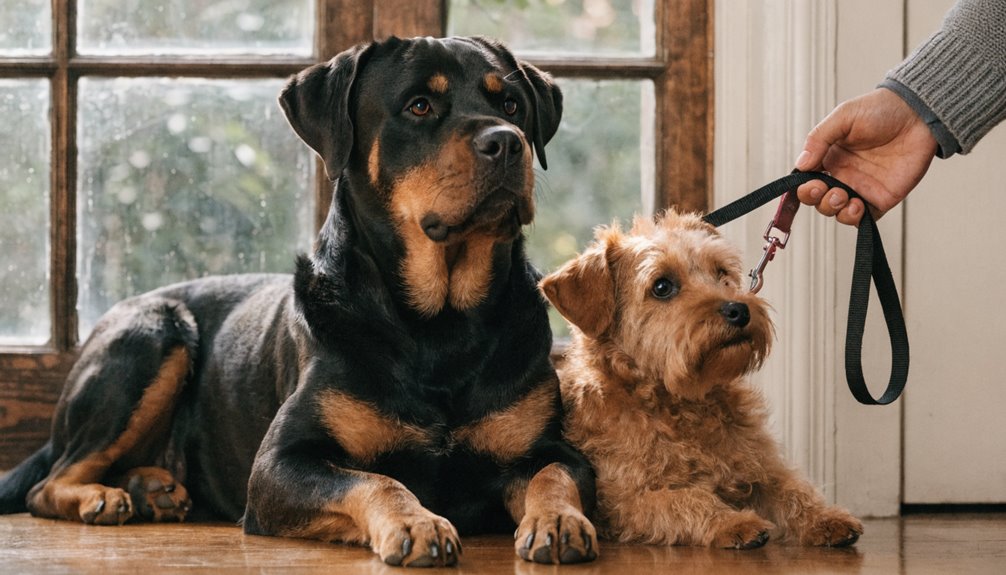
You can raise a Rottweiler and small dog together, but you’ll need to manage their conflicting instincts—the Rottweiler’s prey drive and protective nature against the small dog’s vulnerability. Start with early obedience training, controlled scent and sight introductions through barriers, and separate feeding spaces to prevent resource guarding. Establish consistent routines, rotate toys, and watch for warning signs like stiff posture or hard stares. Understanding the specific triggers and management strategies that work for your dogs’ individual temperaments will determine whether they coexist peacefully.
- Key Takeaways
- Why Rottweilers and Small Dogs Can Clash: Temperament and Prey Drive
- Essential Training Before You Introduce Them
- How to Introduce Them Safely
- Prevent Resource Conflicts Over Food and Toys
- Spot Warning Signs Before Problems Escalate
- Daily Routines That Sustain Harmony
- Safe Spaces for Rottweilers and Small Dogs
- When to Call a Professional
- Frequently Asked Questions
- Conclusion
Key Takeaways
- Start early socialization during the critical 11–16 week window with calm, friendly small dogs in controlled settings.
- Establish separate feeding spaces using crates, gates, or rooms to eliminate resource competition and guarding behavior.
- Teach reliable recall, Leave It, and Drop It commands through daily short training sessions before cohabitation.
- Use neutral-ground parallel walks 6–10 feet apart, progressing only when calm body language is consistently observed.
- Provide secure individual safe spaces with baby gates and elevated refuges allowing small dogs safe escape routes.
Why Rottweilers and Small Dogs Can Clash: Temperament and Prey Drive
Because Rottweilers were originally bred as herding and guard dogs, they possess a strong prey drive—an instinctive urge to chase and pursue smaller, fast-moving animals—that can be triggered without warning by the quick movements, high-pitched barking, or squeaky toys that small dogs naturally produce. Their calm, confident nature masks a protective instinct that translates into vigilant guarding behavior, which can escalate into resource guarding or chasing.
However, individual factors—including lineage, early socialization, sex, and prior experience—strongly shape whether your Rottweiler views a small dog as a companion or potential prey. Insufficient physical and mental exercise amplifies prey drive expression through problematic chasing and fixation. Early, repeated positive socialization with calm small dogs combined with consistent impulse-control training markedly reduces conflict and establishes long-term coexistence.
Essential Training Before You Introduce Them
Understanding your Rottweiler’s prey drive and protective instincts is the first step, but recognizing those tendencies isn’t enough—you’ll need to build a foundation of obedience, impulse control, and controlled socialization before your dog ever meets a small companion.
Understanding prey drive is just the beginning—obedience, impulse control, and controlled socialization must come first.
Start obedience training with your Rottweiler puppy at 8–10 weeks, focusing on sit, stay, come, Leave It, and Drop It through daily short sessions.
During the critical 11–16 week window, expose your socialized Rottweiler to calm, friendly small dogs in controlled settings like puppy classes.
Teach strong recall and reliable Leave It using high-value treats at increasing distances.
Train acceptance of management tools—crates, gates, harnesses—so initial introductions remain safe and predictable.
How to Introduce Them Safely
You’ll want to start with scent and sight-only exposure by letting both dogs smell each other under a door or through a baby gate for several days, which builds familiarity without the risk of physical confrontation.
Once they’re comfortable with each other’s presence, you can move to neutral-ground parallel walks on-leash where you reward calm behavior with high-value treats, gradually strengthening positive associations through consistency and reinforcement.
After you’ve observed reliable calm signals like loose bodies and soft eyes during these walks, introduce brief barrier sessions with treats placed on opposite sides of a sturdy gate, keeping interactions short and controlled until you’re confident they’re ready for supervised face-to-face contact.
Separate Spaces and Scent
Before your Rottweiler and small dog ever make eye contact, they’ll benefit from several days of scent-based introduction through closed doors and barriers, which allows both animals to gather information about each other in a calm, controlled way without the stress of physical presence or visual confrontation.
This foundation prevents defensive reactions and builds positive associations before face-to-face meetings.
- Keep them in separate rooms initially, allowing sniffing under closed doors or through baby gates for several days
- Swap bedding between spaces multiple times daily so each dog investigates the other’s scent repeatedly
- Rub one dog with a towel and place it with the other to encourage scent exchanges
- Maintain this structure consistently for at least one week before progressing to neutral-ground interactions
This gradual approach through separate rooms establishes comfort and reduces tension markedly.
Neutral Ground Meetings
Shifting from scent-based bonding to face-to-face meetings requires moving both dogs to unfamiliar territory where neither animal feels the need to defend their space, and a quiet park or empty field serves this purpose well because it removes the Rottweiler’s instinct to guard home territory and the small dog’s tendency to feel cornered. You’ll keep both dogs on loose leashes, positioned 6–10 feet apart while walking parallel to each other, which allows observation without pressure.
| Timing | Distance | Duration |
|---|---|---|
| First session | 10 feet apart | 5–10 minutes |
| Sessions 2–3 | 8 feet apart | 5–10 minutes |
| Sessions 4+ | 6 feet apart | 5–10 minutes |
Reward calm focused behavior every 5–10 seconds with high-value treats, establishing positive associations with proximity and reinforcing relaxed interactions before decreasing distance further.
Barrier Introductions With Treats
Once your dogs show calm parallel walking at closer distances, a physical barrier becomes your next tool for building positive associations without the risk of direct contact, and this step bridges the gap between observation and eventual free interaction.
- Feed high-value treats simultaneously on opposite sides of a sturdy baby gate, creating positive reinforcement linked to each dog’s presence
- Keep sessions brief—three to five minutes repeated throughout the day—rewarding relaxed posture, soft eyes, and loose body language
- Choose neutral locations away from resting spots or food bowls to reduce territorial responses during barrier work
- Progress gradually by moving both dogs on low-distraction leashes closer to the gate only when calm body language remains consistent and no growling occurs
Consistency and patience determine success here, allowing both dogs to associate good things with proximity before removing the barrier entirely.
Prevent Resource Conflicts Over Food and Toys
You’ll need to establish separate feeding spaces and manage toys carefully because competition over resources can trigger guarding behaviors in Rottweilers, especially when small dogs are present and perceived as threats to access.
Start by feeding your dogs in different areas—using crates, separate rooms, or baby gates—and supervise every meal for several weeks after introduction, watching for early warning signs like stiffening, hard stares, or lip lifts that signal discomfort.
Rotate toys frequently and remove high-value items when you can’t watch both dogs, then teach “drop it” and “trade” cues through short, repeated training sessions so your Rottweiler learns that releasing items on command leads to even better rewards.
Separate Feeding Spaces
Because dogs fed side-by-side show higher rates of resource-guarding and fights—especially during high-value meal situations—separate feeding spaces form the foundation of safe coexistence between a Rottweiler and a small dog.
You’ll prevent competition and tension by establishing clear boundaries around food:
- Feed your dogs in separate rooms or crates with solid barriers between them
- Use staggered feeding times so meals don’t overlap, reducing visual triggers
- Place slow-feed bowls in each dog’s enclosed space to extend meal duration
- Remove bowls only after both dogs finish eating, maintaining predictable routines
This structure reinforces that each dog has their own secure feeding area, eliminating the pressure to guard resources.
Consistency in these practices markedly reduces conflict escalation over time, creating a calmer household dynamic where both dogs feel secure during meals.
Resource Guarding Prevention
Resource guarding—the tendency for a dog to control access to valued items like food, toys, or bones—emerges from a dog’s instinct to protect what matters, and it intensifies when two dogs of different sizes share the same living space without clear management structures in place.
You’ll prevent this behavior by removing high-value items from shared spaces when you’re not supervising, rotating toys so possessions aren’t constantly available, and feeding separately to eliminate competition.
Teach “Leave It” through short daily sessions using high-value treats until your dogs respond reliably, then practice during real mealtimes.
Watch for early warning signs like stiff posture or growling, then calmly separate your dogs and increase management immediately.
Consistency stops guarding before it escalates.
Toy Management Strategies
Toys trigger more resource guarding conflicts than most owners expect, especially when a large Rottweiler and a small dog compete for the same objects without clear management in place.
Effective toy management removes temptation and reduces tension during unsupervised time, while structured play sessions build positive associations. You’ll notice guarding behaviors decrease when competition disappears through thoughtful rotation and separation strategies.
Implement these toy management practices:
- Store all toys away when dogs are unsupervised, rotating only a small selection during supervised sessions to keep valued items scarce
- Remove toys that trigger hard play or resource guarding, such as tug ropes and squeaky stuffed toys
- Provide duplicate low-value toys alongside structured, separate play routines for each dog
- Favor non-competitive enrichment like puzzle feeders and individual snuffle mats that eliminate direct competition
This consistency reinforces calm behavior around resources, preventing escalation patterns before they develop.
Spot Warning Signs Before Problems Escalate
When you understand the early signals that tension is building between your Rottweiler and small dog, you’re able to intervene before minor friction becomes a serious incident.
Watch for stiff body posture, fixed stares, raised hackles, or slow hard approaches from your Rottweiler—these are early aggression-warning signs that often precede lunges or growls. Meanwhile, notice your small dog’s stress cues: repeated yawning, lip-licking, tail tucking, shaking, or hiding.
Monitor resource-related tension around bowls, toys, or your attention; any growling, snapping, or stiff guarding requires immediate separation.
Track escalation patterns like repeated chasing or intensifying nips. Keep detailed logs noting time, triggers, proximity, and your actions so you can identify patterns and share specific data with a certified trainer if problems persist.
Daily Routines That Sustain Harmony
Consistency in how you structure your Rottweiler’s and small dog’s days is one of the most effective ways to prevent conflict, because predictable routines lower stress, reduce competition for resources and attention, and give both dogs clear expectations about what happens next.
Consistent daily routines lower stress, reduce resource competition, and establish clear expectations for both dogs.
Parallel controlled routines eliminate the jealousy and tension that arise when dogs feel they’re competing for your focus or resources.
- Feed dogs separately in crates or behind gates, removing all toys during meals to prevent resource-guarding incidents
- Schedule individual leash walks at different times so each dog receives undivided attention and exercise appropriate to their size
- Conduct Rottweiler training sessions during the small dog’s quiet time, reinforcing “Leave It” and “Drop It” commands
- Arrange supervised timed free-interactions with escape routes available, allowing both dogs to coexist without constant tension
Safe Spaces for Rottweilers and Small Dogs
While predictable routines lower stress and set clear expectations for both dogs, you’ll find that physical safe spaces are equally important because they give each dog a genuine refuge when stress peaks or when their size difference creates risk.
You’ll want to provide each dog with its own secure crate sized appropriately—roughly 42–48 inches for your Rottweiler and 24–30 inches for your small dog—where feeding and resting happen separately.
Install baby gates with small gaps closed so your smaller companion can access escape routes without the Rottweiler pushing through.
Designate elevated refuges like cat trees or raised beds where your small dog retreats safely.
Keep high-value items in individual safe spaces, removing shared toys when unsupervised, so competition stays minimal and each dog respects the other’s territory.
When to Call a Professional
Despite your best efforts at management and training, you may reach a point where professional guidance becomes necessary—and recognizing that threshold early can prevent escalation and keep both dogs safe.
Contact a professional dog trainer or behaviorist when you notice:
- Repeated hard stares, growling, snapping, or bites between your dogs despite consistent management
- Persistent stress signals in either dog, such as tucking, shaking, hiding, or lip-licking
- Your Rottweiler chasing, cornering, or guarding resources in ways you can’t safely control
- Unreliable obedience under real-life distractions after several weeks of focused training sessions
Seek immediate consultation from a certified behaviorist if interventions escalate or injuries occur.
Verify your professional’s credentials, experience with large-breed and small-dog introductions, and their use of force-free, evidence-based methods before hiring.
Frequently Asked Questions
Can Rottweilers Get Along With Small Dogs?
Yes, you can raise your Rottweiler harmoniously with small dogs through early socialization, consistent obedience training, and proper management. You’ll need daily exercise, gradual introductions, and strict supervision to guarantee their safety together.
What Is the 7 7 7 Rule With Dogs?
Studies show 40% of dog-dog incidents occur during introductions. You’d apply the 7-7-7 rule by allowing seven seconds of sniffing, interrupting for seven seconds, then repeating this cycle up to seven times total.
How Do I Say “I Love You” in Dog Language?
You say “I love you” by kneeling to your dog’s level, offering slow chest pets, using soft praise with their name, and respecting their space when they’re stressed. You’re building trust through calm consistency.
What Is the 3 Second Rule for Dogs?
You’ve got a three-second window—a lightning bolt of opportunity—to interrupt your dog’s problematic behavior before it escalates. Calmly redirect with a verbal cue, leash correction, or high-value treat to break the stimulus-response loop.
Conclusion
You’ve now got the foundation for peaceful coexistence between your rottweiler and small dog. Think of their relationship like a bridge you’re building together—it requires consistent reinforcement from both ends. One owner reported her initially tense pair became playmates after six months of structured routines and patience. You’ll find that your commitment to training, boundaries, and supervision pays off in a household where both dogs actually relax around each other, not just tolerate each other.