Some of the links in this post are affiliate links. This means we may earn a small commission if you make a purchase through these links—at no extra cost to you. We only recommend products and tools that we genuinely believe will help you with your Rottweiler.
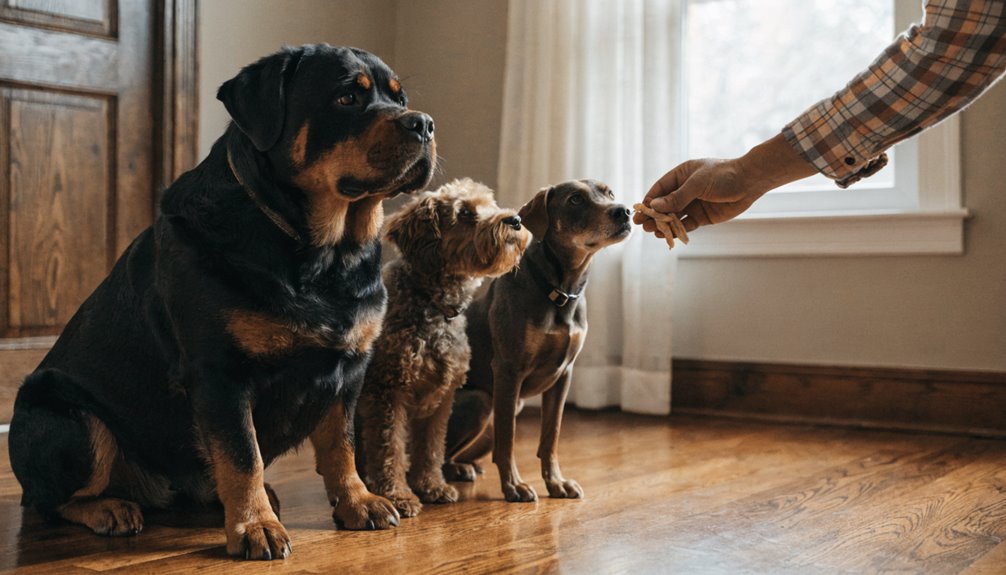
Train one dog at a time in a separate space to build focus and prevent distractions, keeping sessions under ten minutes with frequent rewards. Establish name recognition and foundational cues—sit, down, stay—before introducing group work. Once each dog masters individual skills at 80–90% reliability, layer in multi-dog training using leashes and stations to manage the Rottweiler’s resource drive. Feed separately, control doorways, and watch for warning signs like stiff posture or fixed stares that signal rising tension. Structure and consistency prevent conflict; understanding the specific strategies for your household setup will guide you further.
- Key Takeaways
- Work With One Dog at a Time to Build Foundation Skills
- Teach Strong Name Recognition So Dogs Respond Under Distraction
- Train “Place” and “Settle” Cues for Calm, Independent Behavior
- Introduce Group Training Only After Individual Mastery
- Manage Meals, Doors, and Attention to Prevent Conflict
- Use Leashes and Station Training for Shared Spaces
- Recognize Warning Signs and Intervene Before Escalation
- Frequently Asked Questions
- Conclusion
Key Takeaways
- Train one dog at a time in a separate room with sessions under 10 minutes to maintain focus and control.
- Anchor the Rottweiler with a leash or tether during training to prevent treat-stealing and rushing behaviors.
- Use high-value treats paired with each dog’s name across 50–100 trials to build name recognition and selective attention.
- Establish Place and Settle training separately for each dog before introducing multi-dog distractions and group dynamics.
- Monitor warning signs like stiff posture, fixed stares, and raised hackles to intervene quickly and prevent conflicts.
Work With One Dog at a Time to Build Foundation Skills
Working with one dog at a time is often the most efficient way to build solid foundation skills in a multi-dog household, because individual attention eliminates the distractions and competition that slow learning. When you work with one dog in a separate room or crate, you control the environment completely, allowing you to deliver precisely timed rewards that reinforce exactly what you want.
This focused structure matters most during early skill acquisition for foundational cues like sit, down, stay, and loose-leash walking. Keep sessions under ten minutes and frequent, rotating through each dog so your Rottweiler receives concentrated, repeatable practice without competing for your attention or rewards.
Use a leash, tether, or helper when separation isn’t possible to prevent other dogs from interrupting the learning process and creating confusion.
Teach Strong Name Recognition So Dogs Respond Under Distraction
In a multi-dog household, consistently teaching each dog to recognize and respond to their own name is one of the most important tools you’ll develop, because it gives you a reliable way to direct attention to one dog even when competing distractions—other dogs, movement, food, or visitors—are present.
Start by pairing each dog’s individual name with high-value treats and immediate rewards over 50–100 short trials per session until your Rottweiler turns and looks reliably within 1–2 seconds. Progressively add distraction levels, from light room noise to another calm dog nearby to active movement, requiring 1–2 seconds of eye contact before rewarding.
Advance only when your dog succeeds at approximately 90% reliability. Use distinct group and individual names with unique release words during combined drills, calling one dog by name while rewarding, then immediately cueing another dog, training selective attention and preventing cross-responding.
Train “Place” and “Settle” Cues for Calm, Independent Behavior
You’ll build reliable “Place” and “Settle” responses in your Rottweiler by training each cue separately in a calm environment, marking the exact moment he shows the desired behavior (all four paws on the mat or his body lowering), and rewarding heavily with high-value treats to create strong associations.
Once he responds consistently to the verbal cue, you’ll gradually increase both the distance you stand from him and the duration he stays in position, working in small 30–60 second increments across multiple short sessions daily to prevent frustration and maintain focus.
Managing multi-dog station behavior means practicing these cues with other dogs out of the room initially, then systematically introducing them as quiet, tethered distractions, so your Rottweiler learns to hold his position despite the presence of housemates and can eventually settle calmly while others move around.
Station Training For Rottweilers
Station training teaches your Rottweilers to settle calmly on a designated mat or bed independent of what’s happening around them, which is essential in a multi-dog household where chaos can easily spread from one excited dog to the next.
You’ll build this skill through two foundational cues that work together:
- Place — Guide each dog to the mat, mark the moment all four feet land with a click, and reward heavily with high-value treats, gradually increasing distance and duration in short increments.
- Settle — Reward calm behavior like soft eyes and relaxed posture immediately on the mat, progressively shaping longer relaxed periods before fading food to praise.
- Generalization — Practice Place and Settle during mealtimes, at doorways, and before greetings, building reliable independent calm behavior across different contexts and distractions.
Building Duration And Distance
Once your Rottweiler settles reliably on the mat for 10–20 seconds in a quiet, controlled environment, you’re ready to gradually extend both the time spent calm and the distance between you and the dog, because duration and distance are the two variables that will ultimately determine whether place and settle hold up during the chaos of a multi-dog household.
Start by stepping back just 1–2 paces only after your dog maintains a 30–60 second calm interval consistently. Use a long line during one-on-one training to prevent escape while you build distance, marking and rewarding immediate calm returns.
Keep your Rottweiler on a loose leash initially, then remove it once reliability reaches 80–90% at each stage, doubling duration progressively before introducing any distractions.
Managing Multi-Dog Station Behavior
Teaching your dogs to hold “Place” and “Settle” cues independently—while other dogs are moving, playing, or receiving attention—requires that you build reliability in each dog separately first, then layer in the distractions of a multi-dog environment in small, manageable steps.
Once your Rottweiler and companion dog respond consistently to both cues under low-distraction conditions, you’re ready to combine them in structured practice sessions.
- Position one dog on “Place” while you cue the other to “Settle,” using distinct release words and rewarding the stationed dog every 15–30 seconds initially
- Introduce the second dog within 10–15 feet, using crates or tethers to prevent interference and manage arousal
- Gradually stretch reward intervals as calm behavior becomes durable, monitoring for stress signs that signal you need to return to easier steps
Introduce Group Training Only After Individual Mastery
Before you bring multiple Rottweilers together for training, each dog must demonstrate reliable mastery of core cues in controlled, low-distraction settings—because group dynamics introduce variables that’ll expose gaps in individual foundation work and undermine progress for everyone involved.
Run short, focused individual dog training sessions daily, rotating dogs so each gets multiple solo successes before combining them. Require 80–90% success rates on sit, down, stay, and name recall across 3–5 consecutive training sessions in quiet environments first. Build duration, distance, and distraction separately, increasing only one variable at a time.
Once your individual dog shows solid impulse control and consistent loose-leash walking on varied routes, you’ll have the foundation necessary for successful group work that builds rather than disrupts established behaviors.
Manage Meals, Doors, and Attention to Prevent Conflict
Individual mastery gives you the foundation, but real-world living with multiple Rottweilers demands you manage the high-stakes moments that trigger conflict—meals, doorways, and attention—because these are the situations where resource guarding, impulse control failures, and competition for your focus converge.
- Feed separately in different rooms or crates on a predictable schedule, removing bowls immediately after eating to eliminate competition triggers and reinforce calm consumption habits.
- Practice door control by requiring a sit and calm wait from each dog, releasing them one at a time using distinct cues, until you achieve 90% compliance in low-distraction settings.
- Enforce turn-taking during petting and play by explicitly announcing which dog receives attention, calmly removing the other on leash, and rotating daily so each receives focused one-on-one time.
Use Leashes and Station Training for Shared Spaces
When you train a Rottweiler in a multi-dog home, you’ll need to use leashes and designated stations to maintain control and prevent competition over treats and attention, which happen naturally when multiple dogs occupy the same space.
Leash management gives you the precision to reward the right dog at the right moment, while station training—teaching your Rottweiler to stay calm on a mat or bed—builds the structure that lets you work with one dog without the other constantly interfering.
Together, these tools create clear turn-taking and reduce the resource conflicts that emerge when dogs aren’t physically separated during learning.
Leash Management For Control
Keeping each dog on its own leash or tether during training in shared spaces gives you the immediate control you need to prevent interference and manage multiple dogs at once, which is nearly impossible without physical separation.
Short training leads of 4–6 feet work best for close control indoors, allowing you to keep an eye on your Rottweiler’s behavior while preventing other dogs from disrupting focus or stealing rewards.
- Clip the leash of whichever dog earned the reward, keeping the noncompliant dog tethered to prevent food stealing or bolting through doors.
- Make sure you have a handler manage one leash per dog during multi-dog drills so you can deliver precise, timely reinforcement to your Rottweiler.
- Unclip only after calm behavior is confirmed, establishing consistency in your training structure.
Station Training Benefits
Establishing distinct stations for each dog creates the structure you need to deliver precise reinforcement without interference, since you can manage timing and rewards individually while one dog works and the others remain stationary. You’ll teach each dog a distinct “place”—a bed or mat—and use leashes or tethers to anchor your Rottweiler during training sessions. This prevents treat-stealing and rushing while you focus on the working dog’s progress.
| Duration | Reward Frequency | Dog Status | Session Length | Next Step |
|---|---|---|---|---|
| 3–5 min | Every 10–20 sec | Stationed | Under 10 min | Increase duration |
| Week 1 | High-value treats | Calm lying | Short sessions | Build reliability |
| Gradual | Heavy reinforcement | Leashed nearby | Consistent timing | Rotate working dog |
Rotation ensures fairness and prevents frustration while enrichment items like stuffed Kongs reduce fussing at stations.
Preventing Resource Conflicts
Station training gives you the foundation to manage one dog’s learning without interruption, and now you’ll extend that structure to protect the resources—treats, toys, meals—that trigger competition in multi-dog homes.
Resource conflicts escalate quickly when two dogs lack clear turn-taking rules, so you’ll use leashes and separation to enforce calm waiting.
- Place each dog on a leash during high-value moments, then release only the compliant dog to the resource on your cue (“OK”), teaching waiting their turn.
- Separate dogs into different rooms for meals and chews when supervision isn’t possible, removing the trigger entirely.
- Clip the leash of whichever dog didn’t obey, rewarding the other dog’s restraint immediately.
Consistency prevents resource guarding and builds reliable shared-space manners.
Recognize Warning Signs and Intervene Before Escalation
Before tension between your dogs escalates into a fight, you’ll notice a series of physical and behavioral signals that give you a window to intervene safely. Your Rottweiler’s body language—stiffened posture, fixed stare, raised hackles, closed mouth, and hard tail—signals rising aggression and often precedes lunging or snapping. When you spot these signs, interrupt immediately by calling your dog’s name and asking them to sit within one to two seconds, redirecting focus before tension builds.
| Signal | What It Means | Your Action |
|---|---|---|
| Stiff body posture | Tension rising | Call name, ask to sit |
| Fixed stare | Focus intensifying | Create distance immediately |
| Raised hackles | Arousal increasing | Separate dogs with barrier |
| Closed mouth | Restraint breaking down | Use leash, move to stations |
| Hard tail | Sustained focus | Consult behaviorist if repeated |
Repetitive resource-focused behaviors—stalking bowls, circling toys—demand immediate management through distance, leashes, or separate feeding stations, preventing fight risk escalation.
Frequently Asked Questions
What Is the 7 7 7 Rule With Dogs?
You use 7 seconds to mark rewards, perform 7 correct repetitions per session, and repeat across 7 consecutive training sessions. This builds reliable behavior through consistent, quality-focused practice without overwhelming your dog.
Are Rottweilers Good With Other Dogs in the Home?
You can successfully keep Rottweilers with other dogs when you’ve properly socialized them early, matched them with compatible housemates, and established strict management routines like separate feeding and supervised interactions.
How to Train a Rottweiler to Be a Family Dog?
You’ll reap what you sow with consistent training. Start with daily obedience sessions, teaching name response and sit. Socialize gradually to people and children through controlled introductions, then reinforce calm behavior with immediate rewards and household rules.
How Do You Say “I Love You” in Dog Speak?
You say “I love you” by soft-petting your Rottweiler’s chest, maintaining calm eye contact, using their name during praise, providing predictable resources, respecting their boundaries, and consistently rewarding calm behaviors.
Conclusion
You’re building a multi-dog household like constructing a strong foundation before raising walls, where individual training creates the bedrock for group harmony. By establishing clear boundaries, consistent routines, and practiced skills with each dog separately, you’re preventing conflicts before they start. Your patience with this structured approach now pays dividends later, transforming potential chaos into a household where multiple dogs coexist calmly and safely under your reliable leadership.