Some of the links in this post are affiliate links. This means we may earn a small commission if you make a purchase through these links—at no extra cost to you. We only recommend products and tools that we genuinely believe will help you with your Rottweiler.
Your rescue Rottweiler’s intense reactivity—lunging, barking, straining—stems from breeding history, physical power, and likely under-socialization. Before tackling triggers, you’ll need solid leash obedience with a front-clip harness and consistent commands like “watch me” in low-distraction settings. Once your dog reliably responds at 90%, you can gradually introduce counter-conditioning at safe distances, pairing calm behavior with high-value treats. If progress stalls after weeks, professional assessment helps differentiate fear-based reactivity from aggression and provides the structured framework for lasting change.
Key Takeaways
- Rottweilers’ breeding history and size amplify reactive responses; under-socialization intensifies guarded, territorial behavior on walks.
- Recognize early warning signs: rigid stance, intense staring, raised hackles, and body stiffening before escalation occurs.
- Establish 90% reliable leash obedience (heel, sit, watch me, leave-it, recall) in low-distraction settings before real-world exposure.
- Counter-condition triggers by delivering high-value treats at safe distance while redirecting focus with “watch me” cue consistently.
- Seek professional help if lunging, barking, or straining persist after weeks of training to differentiate fear from aggression.
Why Your Rottweiler Reacts Harder Than Other Dogs
Because Rottweilers were historically bred for guarding livestock and property, they carry strong territorial instincts and possess a large, powerful frame that amplifies their reactive responses in ways smaller breeds simply can’t match.
When fear or frustration triggers a reaction, their size and strength mean lunging, barking, and potential physical consequences escalate quickly and look more intense than in smaller dogs.
Under-socialization during puppyhood compounds this pattern, turning natural confidence into guarded behavior when your Rottweiler hasn’t experienced positive early exposures to people, dogs, and environments.
Leash reactivity becomes especially pronounced because restraint frustrates their instinct to create distance, leading to loud vocalizing and grabbing.
Management strategies like front-clip harnesses, longer distances, and counter-conditioning from safe distances prevent dangerous situations before they develop.
Spot Early Signs of Rottweiler Reactivity
Early signs of reactivity in your Rottweiler often show up in predictable ways if you know what to watch for, and catching these signals before they escalate gives you the best chance to redirect the behavior.
Your reactive dog’s body language reveals what’s happening before actions follow, so you’ll notice rigid stances, intense staring, raised hackles, or attempts to hide behind your legs. Watch for lunging, barking, growling, or snarling during walks, which indicate your dog’s guardian instincts are activating.
Leash frustration appears when your Rottweiler remains calm off-leash but becomes frantic when restrained, pulling hard or bouncing intensely.
Key warning signs include:
- Repeated snapping or nipping at other dogs
- Escalation signals like grabbing and shaking clothing
- Body stiffening before an outburst
- Intense eye contact with other dogs or people
- Frantic leash behavior in specific locations or times
Build Solid Leash Obedience First
Once you’ve identified your Rottweiler’s reactive triggers and warning signs, you’ll need to build a foundation of reliable leash obedience before attempting to manage those triggers in real-world situations.
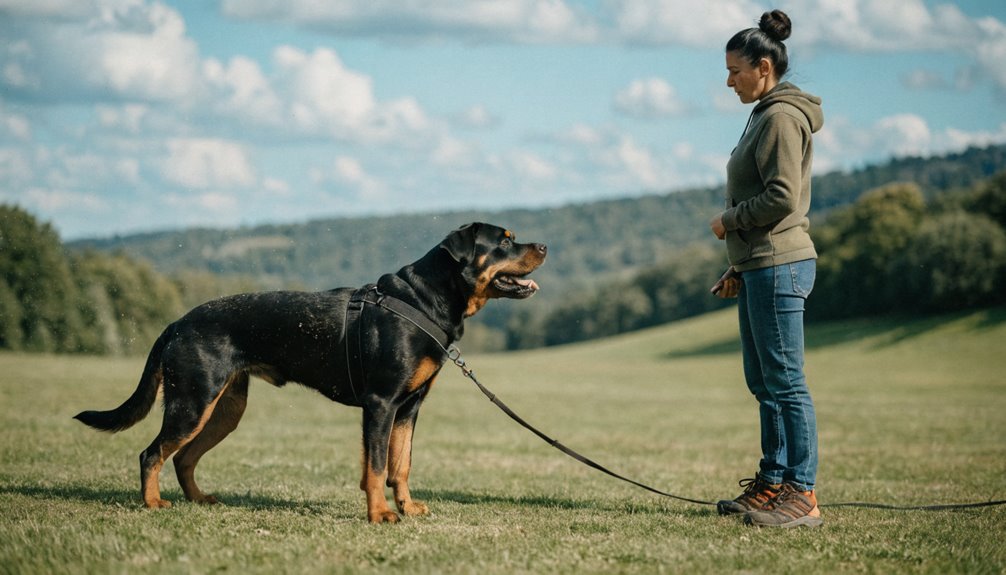
Start with basic commands—heel, sit, watch me, leave-it, and recall—in low-distraction settings at home and during quiet walks, aiming for 90% reliability. Use a front-clip harness with a short 4–6 ft leash to reduce pulling leverage and increase your control. These tools let you manage your dog on a walk without fighting against constant pressure.
Once your Rottweiler responds consistently to commands, you’ll introduce distance-based desensitization, gradually closing the gap between your dog and triggers like another dog. This structure creates the consistency and reinforcement necessary before addressing reactive behavior head-on.
Counter-Condition Your Reactive Rottweiler’s Triggers
Counter-conditioning your Rottweiler’s triggers works by teaching your dog that the arrival of a trigger predicts something good—treats, attention, and calm—rather than an opportunity to react. You’ll start at a distance where your dog stays below threshold, typically 2–3 times farther than the trigger itself, then gradually narrow the gap as calm behavior increases.
Counter-conditioning teaches your Rottweiler that triggers predict positive outcomes, not threats, starting at safe distances and gradually progressing closer.
Use high-value treats like soft meat or cheese, delivering one every 2–3 seconds while your dog notices the trigger without reacting. Pair a clear cue like “watch me” with the trigger’s arrival, so your Rottweiler learns to focus on you instead of lunging. Progress through controlled setups such as parallel walks with calm helper dogs at increasing proximities.
- Your dog learns that triggers signal positive outcomes, not threats
- Consistent reinforcement replaces reactivity with anticipation of rewards
- Controlled distance prevents overwhelming your dog’s nervous system
- Building calm responses creates lasting behavioral change
- Tracking progress guarantees you’re advancing at the right pace
When DIY Training Hits a Wall and You Need a Professional
Even with weeks of consistent reward-based training, management strategies, and reliable “watch me” cues, some reactive Rottweilers continue to lunge, bark, or strain against the leash when triggers appear—and that persistent reactivity signals that you’ve likely reached the limits of what DIY methods can address.
At this point, booking a professional assessment becomes essential rather than optional. A qualified trainer experienced with large guardian breeds can differentiate fear-based reactivity from dog-directed aggression, a distinction that fundamentally shapes your intervention strategy.
They’ll evaluate whether your reactive dog needs structured desensitization, behavior modification, or specialized tools like a prong collar used within an all-encompassing plan. Whether exploring board and train programs or service dog-level training, professionals provide the expertise, consistency, and tailored structure that transforms persistent reactivity into manageable behavior.
Frequently Asked Questions
How to Train a Reactive Rottweiler?
You’ll start by managing distance with off-peak walks and a front-clip harness. Build a strong “watch me” cue using high-value treats, then gradually desensitize your Rottweiler through parallel walks with calm dogs.
What Is the 7 7 7 Rule for Puppies?
You’ll introduce experiences in three bite-sized stages that feel like they’re a million miles long: observe for 7 seconds, interact calmly for 7 seconds, then step back for 7 seconds of processing.
What Is the 3-3-3 Rule for Dog Training?
You’ll experience three critical phases: 3 days of stress adjustment, 3 weeks of habit formation and basic training gains, and 3 months of deeper behavioral change where you’ll see reliable cue generalization.
What Not to Do With Reactive Dogs?
Don’t yell at lunging, don’t jerk during barking, don’t force close encounters. You’ll escalate fear, worsen reactivity, and reinforce the exact behaviors you’re trying to change. Stay consistent instead.
Conclusion
You’ve now built the foundation for your Rottweiler’s success, much like constructing a house room by room—each stage essential before moving forward. Your consistency with leash work, trigger counter-conditioning, and professional guidance when needed creates the structure your reactive dog requires. Remember, progress isn’t linear, yet your commitment to these proven methods will gradually reshape your Rottweiler’s responses, transforming reactive patterns into reliable behavior.