Some of the links in this post are affiliate links. This means we may earn a small commission if you make a purchase through these links—at no extra cost to you. We only recommend products and tools that we genuinely believe will help you with your Rottweiler.
Training Your Rottweiler Puppy: Start Strong You’re raising a loyal guardian—so establish clear boundaries from day one. Begin with crate training using positive associations, then socialize extensively during weeks 6–7 to reduce stranger aggression. Create consistent daily routines for feeding, potty breaks, and training sessions. Teach foundational commands like “sit” and “drop” using food rewards. Watch for red flags: aggression, extreme fearfulness, or dominance behaviors warrant professional help. Your consistency and patience now shape a well-mannered, confident companion. Stick around to discover exactly how each stage builds your puppy’s success.
- Key Takeaways
- What Makes Rottweilers Unique: Loyalty, Protectiveness, and Working Drive
- Prepare Your Home: Puppy-Proofing and Setting Up Safe Zones
- Build a Safe Crate: Your Puppy’s First Home
- Early Socialization Foundation: Weeks 6–7
- Set Up Routines and Boundaries: Weeks 8–9
- Train Your Rottweiler Puppy to Know Its Name
- Teach Your Puppy to Sit: Food Lure Method
- Train the Drop Command: Essential for Rottweiler Safety
- Start Leash Walking: Collar Comfort First
- Housebreak Your Puppy: Routine and Crate Strategy
- Stop Nipping and Jumping: Redirect Herding Instincts
- Use Treats, Praise, and Play to Reward Good Behavior
- Introducing Other Dogs: Wait Until Vaccination Is Complete
- Know When Your Puppy Is Ready for Obedience Class
- Build a Daily Training Routine That Actually Works
- Earn Your Puppy’s AKC S.T.A.R. Puppy Badge
- Red Flags: When to Hire a Professional Trainer
- Frequently Asked Questions
- Conclusion
Key Takeaways
- Start early socialization at weeks 6-7 through controlled visitor meetings, sound exposure, and handling to build confidence and reduce stranger aggression.
- Establish consistent daily routines including feeding, potty breaks, training sessions, and crate time to build trust and predictability in your puppy.
- Use positive reinforcement techniques like food lures for sit commands, reward calm behavior, and make crate training enjoyable with food-stuffed toys.
- Practice housebreaking by taking your puppy outside every two hours and after meals, play, or naps while monitoring elimination signals.
- Seek professional help if you notice aggression, extreme fearfulness, persistent disobedience, or dominance behaviors that you cannot manage independently.
What Makes Rottweilers Unique: Loyalty, Protectiveness, and Working Drive
Here’s what you’re really getting: a devoted guardian who forms unbreakable bonds with family.
They’re reserved around strangers yet affectionate with loved ones. That combination makes them excellent companions and capable service dogs—if you invest in proper training.
Prepare Your Home: Puppy-Proofing and Setting Up Safe Zones
Before your Rottweiler puppy arrives, you’ll transform your home into a safe haven—one that establishes clear boundaries while protecting your curious explorer from danger.
You’ve got to create designated zones for eating, sleeping, bathroom breaks, and playtime; this structure helps your puppy understand expectations and builds confidence fast.
Strategic hazard removal, baby gates blocking off risky areas, and thoughtful space setup mean your pup can investigate freely without risking injury or developing bad habits.
Essential Space Setup
Creating the right environment for your new Rottweiler puppy is just as important as selecting quality food or scheduling vet appointments.
Your space setup directly impacts good behavior and early socialization success. You’ll establish distinct zones that reduce stress during the critical adjustment period:
- Eating area: Designate one spot for meals to establish routine
- Sleeping zone: Place the crate nearby—your puppy feels secure close to you
- Bathroom station: Consistent location accelerates housebreaking
- Play space: Separate area prevents destructive behavior
- Safe containment: Use baby gates blocking hazardous plants and furniture
Keep a light leash on your puppy during initial management, but never leave them unattended wearing it—accidental injuries happen fast.
Stock the crate with food-stuffed toys. This positive association transforms the crate into a comfort zone, not a cage.
Your organized space becomes your training foundation.
Hazard Removal And Boundaries
While your Rottweiler puppy’s curiosity drives exploration and learning, that same instinct makes them vulnerable to household dangers you might overlook. At their young age, puppies lack impulse control—their brains won’t fully develop until around three years old.
Critical Hazard Removal:
- Secure electrical cords and small objects that pose choking risks
- Lock cleaning supplies, medications, and human food in cabinets
- Remove or block tempting plants and furniture
Strategic Boundaries:
Establish designated zones using baby gates for eating, sleeping, and playing. These boundaries create structure while preventing access to unsafe areas.
Build a Safe Crate: Your Puppy’s First Home
Your Rottweiler puppy’s crate isn’t a cage—it’s their den, their safe haven, their personal retreat. This step lays the foundation for successful house training and emotional security. Make sure you choose appropriately—too large invites bathroom corners; too small causes stress.
Setting Up Success
- Select a crate allowing standing, turning, and comfortable lying down.
- Position it in quiet yet active family areas for security.
- Make it inviting through meals and treat-stuffed toys.
- Start with 10-30 second intervals, gradually increasing duration.
- Supervise initially and never attach leashes inside.
Your puppy’s crate becomes their sanctuary when introduced positively. Feed them inside. Offer rewards. Let them explore freely without pressure.
This psychological safety space—mimicking wolves’ natural den instincts—reduces anxiety considerably. Short, incremental sessions build confidence faster than forcing extended confinement.
You’re creating belonging, not imprisonment.
Early Socialization Foundation: Weeks 6–7
Between weeks six and seven, something remarkable happens in your Rottweiler puppy’s brain—they’re shifting from littermate dependency to wider world awareness. This critical period shapes your puppy’s future temperament and protective instincts.
| Socialization Activity | Week | Benefit |
|---|---|---|
| Controlled visitor meetings | 6–7 | Reduces aggression towards strangers |
| Sound exposure | 6–7 | Builds confidence |
| Handling practice | 6–7 | Establishes trust |
You’ll want to invite carefully screened visitors—particularly children—to meet your puppy. This exposure prevents aggression towards unfamiliar people later. Screen all guests thoroughly to block viruses like Parvo, which devastate young pups.
Keep littermates together until week seven. This bonding prevents behavioral problems. Your early socialization foundation now determines whether your Rottweiler becomes a confident, well-adjusted companion or develops fear-based aggression.
Set Up Routines and Boundaries: Weeks 8–9
By week 8–9, your Rottweiler puppy’s brain is developing rapidly—they’re ready to learn structure, not just socialization.
You’ll establish consistent daily routines, create clear household boundaries, and build crate training foundations that’ll shape their behavior for life.
Think of this phase as laying the groundwork: without it, you’re basically teaching your pup to improvise instead of thrive.
Establish Consistent Daily Routines
The foundation of a well-behaved Rottweiler starts now—during these critical early weeks. Your consistent daily routines create predictability. This predictability reduces anxiety and builds trust. A solid dog training foundation relies on structure, especially with your Rottweiler puppy.
Your Crucial Daily Schedule:
- Feeding times: Offer meals at the same hours each day
- Potty breaks: Take your puppy outside after eating, playing, and napping
- Training sessions: Conduct five-minute lessons introducing basic commands
- Playtime: Schedule structured activities to burn energy safely
- Crate time: Use designated rest periods for comfort and security
Consistency transforms chaotic puppyhood into manageable development. Your Rottweiler puppy learns what you expect.
Regular schedules help with potty training success dramatically. These routines—maintained daily without exception—establish behavioral expectations early.
You’re fundamentally teaching your puppy’s brain to anticipate what comes next.
Create Clear Household Boundaries
Use baby gates strategically. Block access to tempting zones: houseplants, furniture, electrical cords. Rottweilers are intelligent and will exploit opportunities—so remove them proactively.
Keep a lightweight leash attached indoors during adjustment periods. This simple tool prevents unwanted behaviors while facilitating quick redirection. Think of it as an invisible boundary-setter.
Introduce the crate immediately as a sanctuary, not a punishment space. Feed meals inside it. Place comfort items within. Positive associations develop rapidly—Rottweilers instinctively seek den-like spaces.
Clear boundaries mean fewer accidents, less destruction, and a confident puppy.
Build Crate Training Foundations
Your puppy’s crate transforms from a containment tool into a den—a safe retreat where she chooses to rest.
It’s time to start laying the foundation for crate training, which helps prevent destructive behaviors and anxiety.
Position Your Crate Strategically
Place the crate in high-traffic areas near family activity. This builds positive associations with comfort and safety.
Create Consistency Through Routine
- Incorporate regular feeding times inside the crate
- Schedule designated play periods throughout the day
- Establish quiet time blocks for rest
- Use treats and praise during entries
- Gradually extend duration from 10–30 seconds
Make It Rewarding
Stuff toys with food and provide chew items.
Your Rottweiler learns the crate equals enjoyment, not punishment.
Short, positive experiences build lasting comfort and reduce anxiety considerably.
Train Your Rottweiler Puppy to Know Its Name
One of the most fundamental skills you’ll teach your Rottweiler puppy is recognizing its own name.
Start Early and Often
Begin using your puppy’s name consistently in various environments from a young age. Say it cheerfully during feeding and playtime—these positive moments create strong associations.
Start using your puppy’s name consistently in positive environments from a young age to create strong associations.
You’re building neural pathways that connect the sound to rewarding experiences.
Reinforce Every Step
Use the name frequently during training sessions and commands. Pair it with treats or enthusiastic praise whenever your puppy responds.
This reward system strengthens recognition across different scenarios and with various people.
Maintain Consistency
Keep your tone identical each time. Avoid using the name during corrections—negative associations weaken response reliability.
Your Rottweiler needs to trust that hearing their name means something good’s coming.
Teach Your Puppy to Sit: Food Lure Method
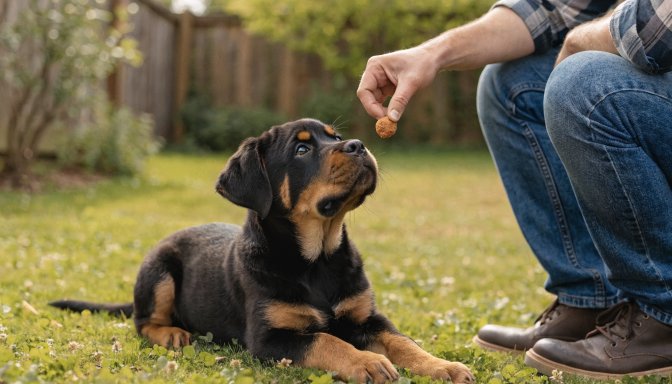
You’ll start by holding a high-value treat—something your Rottweiler puppy genuinely loves—close to their nose to grab their attention immediately.
Slowly move that treat upward and back over their head, and here’s the magic: as their nose follows the lure, their rear naturally lowers into a sitting position.
The moment their bottom touches the ground, you say “sit” sharply, then reward them right away—this timing teaches their brain to connect the word with the action.
Hold Lure Above Nose
Grab a small treat—something your puppy genuinely loves—and you’re ready to begin one of the most fundamental obedience commands. This next step builds the foundation your pup’ll need later in life, whether they’re meeting new friends or traversing public spaces after they come home from the breeder.
Positioning for Success
Here’s exactly what you’ll do:
- Hold the treat close to your puppy’s nose
- Move it slowly upward and slightly backward
- Watch their head naturally follow the lure
- Notice their rear end lowering toward the ground
- Stay patient—don’t rush the motion
Your Rottweiler’s body mechanics work naturally here. Their spine’s flexibility and weight distribution naturally create the sitting position. You’re simply guiding—not forcing—their instinctive response.
Keep movements smooth and deliberate. Quick jerks confuse puppies and break focus.
Guide Motion Toward Head
Smooth, upward movements create the magic—transform that treat from nose-level to head-height and watch your puppy’s sitting position emerge naturally. You’re not forcing anything here; you’re simply guiding their body into position through the treat’s trajectory.
The Science Behind the Movement
Dogs naturally follow food with their eyes and nose. When you gradually lift the treat upward and slightly backward, your puppy’s head follows. Their hindquarters naturally lower to maintain balance—it’s pure instinct, not obedience yet.
Key Steps
- Move slowly and deliberately over two to three seconds
- Keep the treat close enough to maintain focus
- Angle slightly backward toward their ears
- Watch for bottom-to-ground contact
This method works because you’re working with your puppy’s natural body mechanics, not against them. The result? A sit that emerges effortlessly and feels rewarding for both of you.
Mark and Reward Success
Now comes the game-changer—capturing that perfect moment when your puppy’s bottom hits the ground.
The Timing Trick
You’ve got milliseconds to create magic here. Your brain’s reward system—and your puppy’s—works through immediate feedback. That’s neuroscience, not luck.
Your Action Plan:
- Mark the exact moment their bottom touches the ground by saying “sit” in a clear, upbeat tone
- Immediately follow with the treat—don’t delay, even by a second
- Keep your voice consistent every time you mark the behavior
- Deliver the reward right at their nose level to keep them engaged
This precise timing is what locks in the learning. Your puppy begins to understand: bottom down = word “sit” = reward. That’s the connection you’re building.
Consistency Is Everything
Repeat this process several times in short sessions—about 5 to 10 repetitions—then take a break. Puppies learn best in quick, positive bursts, not long drills.
If your puppy doesn’t sit right away, don’t repeat the command. Instead, reset gently and try the lure again. Remember, at this stage, you’re teaching the action first—then attaching the word.
As your puppy starts to anticipate the movement, you’ll notice they sit faster. That’s your cue to gradually say “sit” just before their bottom hits the ground, helping them associate the command with the behavior more clearly.
Fade the Lure Over Time
Once your puppy is reliably sitting with the treat, begin reducing how obvious the lure is:
- Use the same hand motion but without a treat visible
- Reward from your other hand after they sit
- Gradually rely more on the verbal cue “sit”
This transition is crucial—it prevents your puppy from only responding when food is present.
Keep It Positive and Fun
Always end on a success, even if it’s a small one. Praise, rewards, and a bit of playtime go a long way in reinforcing good behavior.
With consistency and patience, your Rottweiler puppy will not only learn to sit—but will do so eagerly, confidently, and on command.
Train the Drop Command: Essential for Rottweiler Safety
Your Rottweiler’s size and strength make this command essential for safety. A 135-pound adult can cause serious injury without proper impulse control.
The Training Method
Say “drop” once—clearly, calmly. Nothing more. Excessive repeating creates confusion and teaches your pup to ignore you. The moment your Rottweiler releases the item, mark that success instantly. Use words like “yes!” to pinpoint exactly what earned the reward.
Building Consistency
High-value treats work best—chicken, cheese, special toys. Rotate rewards to maintain enthusiasm. Keep sessions brief; ten minutes prevents boredom and frustration.
Avoid treating this as bribery. You’re teaching decision-making, not demanding obedience through negotiation.
Start Leash Walking: Collar Comfort First
You’re about to tackle one of the most important foundational skills in Rottweiler training—leash walking—but here’s the thing: your puppy can’t learn to walk properly if they’re uncomfortable wearing their collar in the first place.
Before you even think about attaching that leash, you’ll need to build your puppy’s confidence by letting them get used to the collar’s sensation through short, daily wearing sessions.
This gradual approach sets you up for success, transforming what could be a stressful experience into a positive stepping stone toward confident, controlled walks.
Collar Comfort And Fit
The foundation of leash training rests on one simple truth: a comfortable collar makes all the difference.
Your Rottweiler puppy’s neck is delicate—especially during growth phases. Here’s how to get the fit just right:
- Use the two-finger test: Place two fingers between collar and neck for proper comfort.
- Choose lightweight materials: Avoid heavy collars that cause neck strain or discomfort.
- Check regularly: Puppies grow fast—reassess fit weekly to prevent rubbing.
- Monitor for irritation: Red marks or hair loss signal adjustment time.
- Reward positive associations: Praise and treats make collar-wearing enjoyable.
Start with short wearing periods. Let your puppy adjust gradually before attaching the leash.
This patience builds confidence and prevents fear-based resistance later. A well-fitted collar isn’t tight—it’s secure yet comfortable, allowing natural movement while preventing escape.
Introducing The Leash Gradually
Patience—not speed—builds confident leash walkers.
Your Rottweiler puppy needs time adjusting to new equipment. Here’s your progressive approach:
The Drag Phase
Attach the leash to the collar and let your puppy drag it around indoors. This desensitization technique—borrowed from professional trainers—reduces anxiety about the constraint. Your puppy explores freely while acclimating to the leash’s weight and sensation.
Active Guidance
Once comfortable, gently hold the leash. Encourage following you with light pressure and enthusiastic praise. Short 5-minute sessions prevent frustration and maintain engagement. Rottweilers—originally bred for cattle herding—respond well to consistent, confident direction.
Reward Calmness
Every quiet step earns praise. This reinforcement builds positive associations with leash walking, establishing solid manners early. You’re not forcing compliance; you’re creating partnership through encouragement and reward.
Building Positive Walking Habits
Now that your puppy drags the leash confidently indoors, it’s time to move outside—but there’s a critical first step many trainers skip.
Starting Strong Outside
You’ll want to pick a quiet, enclosed space first. Your puppy’s nervous system—specifically their amygdala, the brain’s fear center—needs gradual exposure to new stimuli.
Here’s your winning formula:
- Use light leash pressure to guide, never yank
- Reward every positive step with immediate praise or treats
- Keep initial sessions around five minutes maximum
- Let your puppy lead exploration while you supervise
- Gradually increase duration as confidence builds
Why This Matters
Rottweilers, originally bred as cattle herders in 1800s Germany, possess strong prey drives. Early positive walks establish you as a trustworthy leader.
Short sessions prevent frustration and fatigue—keeping your puppy’s tail wagging, not drooping. Ready to transform walks into bonding time?
Housebreak Your Puppy: Routine and Crate Strategy
You’ll take your puppy outside every two hours—and after meals, playtime, or naps. Why? Puppies’ bladders fill predictably. This timing prevents accidents while building confidence.
| Trigger | Action | Reward |
|---|---|---|
| After eating | Take outside immediately | Praise + treat |
| During play | Watch for sniffing/circling | Celebrate success outdoors |
| After napping | Rush to designated spot | Enthusiastic acknowledgment |
Crate Training Benefits
Dogs instinctively avoid soiling their sleeping area—it’s biological. Create a comfortable, safe den with food-stuffed toys. Start with short periods, gradually increasing duration.
Supervision Matters
Close monitoring catches pre-elimination signs. You’ll spot sniffing, circling, whining. Rush outside immediately. Reward outdoor elimination promptly with praise.
Consistency wins. Your puppy learns quickly when routines remain predictable and rewards follow immediately.
Stop Nipping and Jumping: Redirect Herding Instincts
Nipping and jumping aren’t misbehavior—they’re biology. Your Rottweiler puppy’s instincts stem from their herding ancestry, dating back centuries to Bavarian cattle dogs. They’re channeling natural energy, not testing you.
Nipping and jumping stem from Rottweiler herding ancestry—natural instincts, not misbehavior or dominance testing.
Redirect Energy Effectively:
- Reward calm behavior with treats and praise immediately
- Teach “sit” and “down” commands for alternative responses
- Provide appropriate chew toys during high-energy moments
- Schedule regular physical exercise like leash walks or agility drills
- Correct nipping consistently to prevent lifelong habits
Structured training sessions transform herding impulses into productive activities.
Your consistent approach—combining correction with rewarding good choices—breaks the nipping cycle fast.
Think of it this way: you’re not stopping instinct; you’re guiding it.
Regular playtime plus positive reinforcement creates a well-adjusted adult dog who knows exactly where to direct that powerful Rottweiler energy.
Use Treats, Praise, and Play to Reward Good Behavior
Treats, praise, and play aren’t just nice additions to training—they’re essential fuel for your Rottweiler’s brain. Your puppy’s neural pathways strengthen when rewards follow desired behaviors immediately. This timing matters tremendously.
Why Variety Works:
- High-value treats (small, tasty pieces) motivate quick learning
- Verbal praise and affection build your bond
- Playtime keeps sessions fun and engaging
The Consistency Secret:
Reward good behavior *instantly*—within seconds. Your puppy connects the action directly to the reward.
Rotating between treats, praise, and play prevents boredom and maintains enthusiasm.
Rottweilers are keen learners when properly motivated. They’ll work harder for varied rewards than monotonous ones.
Mix it up. Stay enthusiastic. Watch your puppy’s motivation soar as training becomes their favorite activity.
Introducing Other Dogs: Wait Until Vaccination Is Complete
While treats and play build your bond with your puppy, meeting other dogs requires a different kind of preparation—one that safeguards their health first.
Your Rottweiler puppy needs complete vaccination protection before socializing. Here’s why timing matters:
Your Rottweiler puppy needs complete vaccination protection before socializing with other dogs.
- Wait until 16 weeks old for full vaccination coverage against Parvo and contagious diseases.
- Monitor all interactions closely to guarantee safe, appropriate behavior during development.
- Gradually introduce well-vaccinated dogs after vaccinations complete to prevent health risks.
- Enroll in puppy classes once protected to safely meet multiple breeds and personalities.
- Maintain structured routines during introductions to build your puppy’s confidence.
This deliberate approach isn’t overcautious—it’s smart. Your puppy’s immune system needs time to develop antibodies.
Once vaccinated, you’ll access positive social experiences that shape their temperament.
Ready to help your Rottweiler become a confident, well-adjusted companion?
Know When Your Puppy Is Ready for Obedience Class
| Readiness Factor | Age | Status | Action | Priority |
|---|---|---|---|---|
| Vaccinations | 16 weeks | Complete | Enroll safely | Critical |
| Socialization | 8-16 weeks | Ongoing | Expose broadly | High |
| Basic commands | Pre-class | Home-trained | Sit, stay, come | Essential |
| Routine consistency | Daily | Established | Structure matters | High |
| Professional assessment | Before class | Evaluate temperament | Discuss needs | Important |
By this age, your puppy’s already experienced various people, animals, and environments—building real confidence. You’ve practiced basic commands at home: sit, stay, and come. That foundation matters tremendously.
Now’s when consistency truly shines. Obedience class solidifies everything you’ve taught while expanding their skills dramatically. Chat with a professional trainer about your pup’s unique personality first.
Build a Daily Training Routine That Actually Works
Since consistency shapes a puppy’s brain more than intensity ever will, you’ll want to create a predictable training schedule your Rottweiler can count on.
Your Daily Training Blueprint
Short sessions work best. Here’s why:
- Five-minute increments prevent mental fatigue and keep focus sharp
- Multiple sessions daily reinforce learning without overwhelming your puppy
- Consistent timing (same hours each day) builds anticipation and readiness
- Routine integration during meals and walks makes training feel natural
- Flexibility adjustments based on your puppy’s responses guarantee sustained engagement
Your puppy’s developing brain—specifically the prefrontal cortex responsible for impulse control—thrives on repetition and predictability.
Rather than marathon training sessions, frequent brief interactions create stronger neural pathways. Pair commands like sit, stay, and come with immediate rewards.
This approach transforms training from a chore into your daily bonding ritual, strengthening your relationship while building obedience skills that’ll last a lifetime.
Earn Your Puppy’s AKC S.T.A.R. Puppy Badge
Taking your Rottweiler’s training to the next level means pursuing the AKC S.T.A.R. Puppy badge—a prestigious achievement recognizing responsible ownership. You’ll enroll in a structured class emphasizing essential commands: sit, down, and come.
| Key Requirement | Your Commitment |
|---|---|
| Master Basic Commands | Consistent daily practice |
| Positive Reinforcement | Treats and enthusiastic praise |
| Socialization Activities | Regular community engagement |
Success demands dedication. You’ll practice these skills repeatedly, reinforcing them until they’re second nature. Positive reinforcement—rewarding good behavior immediately—builds trust while strengthening your bond. Your Rottweiler’s keen-to-please nature makes this achievable.
The badge represents more than obedience. It demonstrates your commitment to raising a well-mannered, socialized companion. Ready to earn it?
Red Flags: When to Hire a Professional Trainer
When does your Rottweiler’s behavior signal you need expert help? Sometimes your puppy needs more support than you can provide alone. Here’s what to watch for:
- Aggression toward people or animals — Professional trainers address these instincts effectively
- Disobedience despite consistent effort — Uncorrected basic commands need specialized guidance
- Extreme fearfulness or anxiety — Tailored strategies build confidence during socialization
- Dominance behaviors — Resource guarding and refusal to listen require intervention
- Inconsistent training results — Structured programs reinforce your goals better
Your Rottweiler’s strong temperament—bred historically for protection work—means early intervention matters.
A professional trainer provides the consistency and expertise you need. Don’t hesitate when behavior escalates. Expert help transforms challenging puppies into confident, well-mannered companions.
Frequently Asked Questions
Are Rottweiler Puppies Hard to Train?
No, you’ll find Rottweiler puppies aren’t hard to train. They’re intelligent and enthusiastic to please, so you’ll succeed using consistent positive reinforcement methods. You’ll need patience, routine, and short training sessions to maintain their attention.
What Is the 7 7 7 Rule for Puppies?
You’re planting seeds during your puppy’s first seven weeks—the 7-7-7 rule means keeping them with their mother for seven weeks, spending seven days establishing routines at home, and exposing them to seven different experiences for confident development.
What Not to Do With a Rottweiler Puppy?
You shouldn’t use harsh punishment, skip socialization between 8-12 weeks, allow biting without correction, expose them to other dogs before vaccinations, or maintain inconsistent training routines with your Rottweiler puppy.
What Is the Hardest Month of a Puppy?
You’ll find months four to five the toughest as your puppy surges with energy and curiosity. They’ll test boundaries and assert independence, so you’ll need consistent training and management to prevent bad habits from forming.
Conclusion
You’re building a loyal guardian, not just a pet. Did you know? Rottweilers rank in the top 8 most popular breeds because they’re incredibly trainable when you start early. Your consistency, patience, and clear boundaries—combined with socialization—transform puppies into confident, well-behaved adults. You’re investing in years of companionship. Trust the process, stay committed, and watch your pup flourish into the remarkable dog you’ve always wanted.