Some of the links in this post are affiliate links. This means we may earn a small commission if you make a purchase through these links—at no extra cost to you. We only recommend products and tools that we genuinely believe will help you with your Rottweiler.
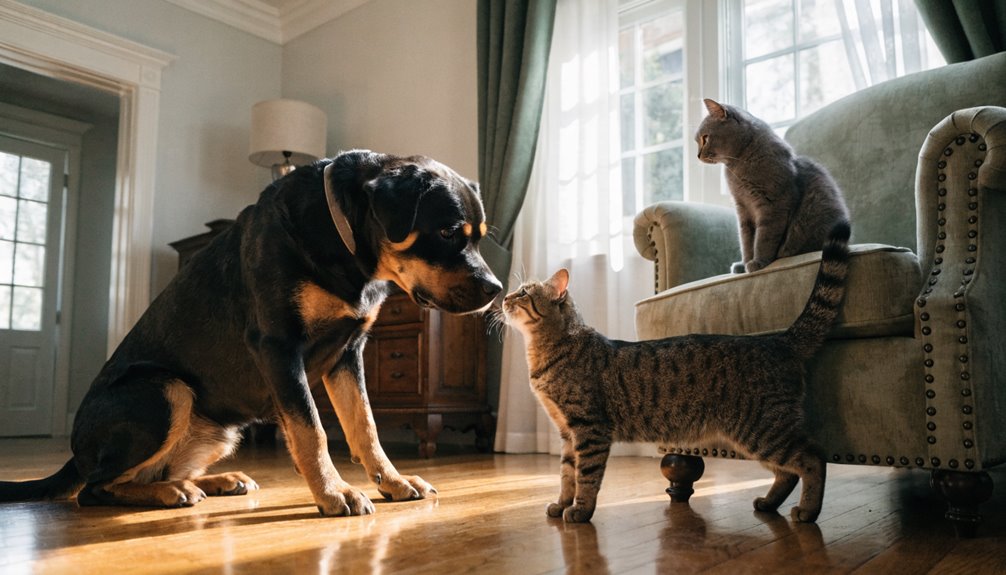
You can introduce your Rottweiler to cats successfully by following a structured progression: scent exchange, visual contact through barriers, and leashed meetings paired with treats and praise. Individual temperament matters more than breed, so watch for red flags like fixation or lunging and adjust your pace accordingly. Early socialization—especially before 12 weeks—makes integration easier, though adult dogs can learn with patience and consistency. Your cat needs elevated safe zones and escape routes throughout your home to feel secure during this process.
- Key Takeaways
- Can Rottweilers and Cats Live Together Safely? The Real Answer
- What Makes Some Rottweilers Natural With Cats
- Which Rottweilers Shouldn’t Live With Cats (Red Flags)
- Puppies vs. Adult Dogs: Why Timing Changes Everything
- Step 1: Start With Scent-How to Begin Introductions
- Step 2: Visual Contact Through a Barrier (What to Expect)
- Step 3: The First Leashed Meeting-Supervised and Rewarded
- Step 4: Create Your Cat’s Safe Zone and Escape Routes
- Frequently Asked Questions
- Conclusion
Key Takeaways
- Start with scent exchange using bedding and cloths in separate, safe spaces before any visual contact.
- Progress through barrier-controlled visual sessions multiple times daily, rewarding calm behavior with treats within one second.
- Keep Rottweiler on a short, relaxed 3–4 foot leash with handler positioned between dog and cat.
- Establish cat-only safe zones with elevated areas, multiple escape routes, and separate food, water, and litter boxes.
- Watch for calming signals like soft eyes and relaxed tail; pause sessions if staring or stalking occurs.
Can Rottweilers and Cats Live Together Safely? The Real Answer
Yes, Rottweilers and cats can often live together peacefully, though success depends largely on the individual dog’s temperament, early socialization, and how you manage their introduction.
Rottweilers good candidates for cat companionship because they typically possess relatively low prey drive and high trainability, traits that support positive behavior around cats. However, compatibility isn’t guaranteed since individual temperament varies markedly.
Dogs raised around cats from puppyhood often develop stable, positive relationships naturally. Conversely, never introduce a cat to a Rottweiler with known aggressive tendencies or one bred for guarding or fighting, as these dogs pose higher risks.
Your approach matters considerably: gradual, controlled introductions starting with scent exchange, then visual contact, then leashed meetings greatly increase peaceful coexistence chances.
What Makes Some Rottweilers Natural With Cats
Many Rottweilers develop calm, accepting attitudes toward cats because of how they’re raised during their critical early months, when exposure to feline behavior reduces fear and suppresses prey-driven responses. You’ll find that a Rottweiler is good with cats when several factors align: early socialization, consistent training, and their natural temperament. Their relatively low prey drive compared to hunting breeds helps considerably, and their intelligence allows them to learn household boundaries quickly when you reinforce them consistently.
| Factor | Impact | Your Role |
|---|---|---|
| Early Exposure | Reduces fear responses | Introduce young |
| Trainability | Enables rule-following | Reinforce boundaries |
| Loyalty | Includes cats in pack | Build protective circle |
| Temperament | Determines individual tolerance | Assess personality |
Loyal to their family, many Rottweilers extend that protection to household cats, creating stable relationships through structure and consistency.
Which Rottweilers Shouldn’t Live With Cats (Red Flags)
Not every Rottweiler is suited for life with cats, and recognizing the warning signs early can prevent serious injury or worse. Some Rottweilers carry traits that make cohabitation unsafe, regardless of your training efforts or intentions. Understanding these red flags helps you make responsible decisions about your household.
- Prior aggression history—Rottweilers with documented incidents of growling, lunging, or biting toward animals shouldn’t live with cats due to established behavioral patterns.
- Guard dog breeding or training—Dogs bred or trained for protection work often display high reactivity and lack the impulse control necessary for cat safety.
- Lack of early socialization—Rottweilers never exposed to cats as puppies, especially those showing intense prey-chasing behavior, present significant risk.
- Poor command consistency—Individuals that ignore trained recall or “leave it” commands lack the reinforcement structure needed for reliable cat interactions.
Puppies vs. Adult Dogs: Why Timing Changes Everything
When you bring home a Rottweiler puppy before 12–14 weeks, you’re working with a blank slate that accepts cats naturally, and positive reinforcement during these early weeks builds gentle behavior patterns that stick for life.
If you’re introducing an adult Rottweiler instead, you’re fighting against established instincts and learned behaviors, which means you’ll need weeks or months of slower desensitization, consistent leash control, and dedicated structure to reshape how your dog responds to a cat.
The difference comes down to this: puppies learn what’s normal through exposure, while adult dogs need deliberate retraining to override their existing prey or guard responses.
Early Socialization Advantages
The window for shaping a Rottweiler puppy’s response to cats closes relatively quickly, making the first 16 weeks of life a critical period that you’ll want to use deliberately and consistently.
During this time, your puppy’s brain absorbs patterns and develops associations that’ll influence behavior for years.
Early socialization works because puppies observe cat body language and learn appropriate responses through observation and reward-based training.
If you adopt an adult Rottweiler without prior cat experience, you’re working against established habits and slower impulse control.
Key advantages of early introduction:
- Puppies form positive associations more easily than adult dogs
- Observational learning reduces prey-driven reactions naturally
- Consistent handling builds long-term tolerance and affiliative behaviors
- Proper structure decreases future conflict management demands
Adult Dog Acclimation Challenges
Timing shapes a dog’s ability to learn, and adult Rottweilers face a steeper learning curve than puppies when meeting cats for the first time.
Unlike young dogs whose brains remain flexible and absorbent, adult Rottweilers carry ingrained prey responses and established routines that resist quick change. Their neurological patterns have hardened, making them less responsive to new social experiences.
To succeed, you’ll need desensitization strategies—scent swapping, visual barriers, and gradual exposures—repeated consistently over weeks or months.
Reward-based reinforcement and structured obedience training become essential tools, whereas puppies might naturally accept cats within days.
If your adult Rottweiler shows aggression history or lacks prior cat exposure, professional behaviorist guidance and strict safety protocols—cat-only refuges, short leashes, slow progression—aren’t optional but necessary precautions.
Step 1: Start With Scent-How to Begin Introductions
Exchanging scents between your Rottweiler and cat establishes familiarity without the pressure of face-to-face contact, which allows both animals to process each other’s presence at a comfortable pace. This foundational step builds positive associations before direct interaction occurs.
Scent exchange lets your Rottweiler and cat become familiar without face-to-face pressure, building positive associations at a comfortable pace.
Begin your scent-exchange routine by following these steps:
- Swap bedding or rub a cloth on each animal behind the ears and along the flanks, then place it where the other can smell it
- Allow the cat to explore the Rottweiler’s scent items first in a safe space away from the dog
- Allow the dog to sniff the cat-scented cloth during calm, leashed sessions while rewarding quiet behavior with treats
- Repeat short exposures over several days, gradually increasing duration from 5–10 minutes as pet care progresses
Pairing scent introductions with feeding or gentle petting reinforces positive associations through consistency and structure.
Step 2: Visual Contact Through a Barrier (What to Expect)
Once you’ve built positive associations through scent work, introducing visual contact through a barrier allows your Rottweiler and cat to assess each other’s body language while maintaining safety, creating the next layer of familiarity before direct interaction.
Dog owners should allow the dog and cat short sessions of 5–10 minutes, repeated multiple times daily, so both animals habituate without overstimulation.
Expect initial intensity: your Rottweiler may stare, whine, or lunge while the cat hisses or arches its back.
Watch for calming signals like sniffing, relaxed posture, and yawning from your dog, indicating progress.
When the cat seeks higher ground or approaches the barrier voluntarily, comfort is increasing.
Pair these visual sessions with treats and praise to reinforce positive associations.
Step 3: The First Leashed Meeting-Supervised and Rewarded
You’ll want to keep the Rottweiler on a short, sturdy leash during this first face-to-face meeting, allowing your cat to retreat freely so she controls the distance and feels safe while you observe both animals’ reactions.
Watch your dog’s body language carefully—relaxed wagging, soft eyes, and gentle sniffing signal calm curiosity, whereas stiff posture, intense staring, or stalking behavior means you should increase distance immediately or end the session and try again later.
Reward your Rottweiler right away whenever he shows impulse control, such as sitting, looking at you instead of the cat, or approaching slowly without fixation, since consistent reinforcement teaches him that calm behavior around the cat brings positive outcomes.
Keep The Leash Short
The leash becomes your primary tool for managing the first face-to-face meeting, and its length and tension matter more than you might expect because they directly influence how your Rottweiler interprets the situation and responds to the cat. A short leash—about 3–4 feet—gives you control while allowing your dog natural movement without creating tension that triggers anxiety or defensive behavior.
Make sure you keep the leash short and held low, maintaining a relaxed grip that prevents sudden lunges without pulling tight. This approach accomplishes several important goals:
- Provides physical control without signaling threat through taut tension
- Allows you to position yourself between dog and cat effectively
- Enables gentle restraint during impulses while preserving calm body language
- Maintains consistency in structure across multiple supervised meetings
Your relaxed hold communicates confidence to your Rottweiler, reinforcing that this situation requires calm observation rather than reactive responses.
Reward Calm Behavior Consistently
With your Rottweiler on a short leash and positioned calmly beside you, your next responsibility is to actively reinforce that peaceful state through immediate, consistent rewards, because what you reward is what your dog will repeat.
Deliver high-value treats within one second of calm behaviors—sitting, soft gazing, or ignoring the cat—so your pet clearly connects the cat’s presence with positive outcomes. Reward frequently at first, every 5–10 seconds if calmness holds steady, then gradually space treats as reliability improves.
When your Rottweiler fixates or lunges, withhold rewards and use a neutral redirect instead, establishing that reactivity earns nothing.
This structured consistency transforms your Good Pet’s instinctive responses into deliberate choices that prioritize calm interaction over chase-driven arousal.
Monitor Body Language Closely
During this first leashed meeting, your ability to read your Rottweiler’s body language will determine whether calm behavior strengthens or reactivity escalates, because every signal your dog displays tells you exactly what’s happening in his mind and whether the interaction should continue or pause.
Watch the Rottweiler’s tail and Monitor ear position and eye contact closely, as these areas reveal his emotional state instantly.
- High, stiff tails or rapid wagging focused on the cat indicate over-arousal, signaling you should increase distance immediately
- Pinned-back ears and soft blinking demonstrate genuine calmness, which you’ll reinforce with immediate rewards
- Fixed staring, forward-pricked ears, or hard eyes suggest heightened arousal requiring leash guidance and a pause
- Relaxed open mouths and low tail positions confirm the dog’s readiness to continue supervised interaction safely
Step 4: Create Your Cat’s Safe Zone and Escape Routes
Creating a safe zone for your cat isn’t just helpful—it’s essential when introducing a Rottweiler into your home, because your cat needs spaces where it can retreat, eat, and rest without feeling threatened or cornered. You should designate elevated areas like shelves or tall cat trees that your Rottweiler can’t reach, similar to how you’d manage multiple dogs like Labrador Retrievers with different access levels. Install multiple exit routes from common areas—open doorways, pet flaps, or hallway passages—so your cat can leave interactions without getting trapped. Place food, water, litter boxes, and resting spots exclusively in these safe zones. Use visual barriers such as baby gates with cat doors during early introductions, allowing your cat to sniff and observe the dog safely before direct contact occurs.
Frequently Asked Questions
Do Rottweilers Do Well With Cats?
You can successfully raise Rottweilers with cats, especially if you socialize them early. Their low prey drive and loyal nature help. Individual temperament matters, so you’ll need patience, training, and supervised introductions for the best results.
What Is the 3 3 3 Rule for Cats?
You’ll need a million years to fully understand your cat without the 3-3-3 rule. The first 3 days involve adjustment stress, the next 3 weeks bring gradual comfort, and 3 months establish stable behavior patterns in your home.
What Is a Silent Killer for Cats?
You should know that ethylene glycol in antifreeze is a silent killer for cats. Even tiny amounts create sweet-tasting, highly toxic metabolites that cause fatal kidney failure within twenty-four to seventy-two hours of ingestion.
How to Introduce Cats to a Rottweiler?
Building bridges takes patience. You’ll introduce them through scent-swapping, then supervised visual contact via barriers. Progress to leashed meetings in controlled spaces, rewarding calm behavior consistently until they coexist peacefully together.
Conclusion
You’ve learned that success hinges on patience and structure, since rushing introductions undermines all your preparation. By following these steps consistently, you’re building the foundation for peaceful coexistence, not guaranteeing it overnight. Remember, slow and steady wins the race—your commitment to gradual exposure, proper reinforcement, and respecting each animal’s boundaries determines whether your household becomes harmonious or chaotic.