Some of the links in this post are affiliate links. This means we may earn a small commission if you make a purchase through these links—at no extra cost to you. We only recommend products and tools that we genuinely believe will help you with your Rottweiler.
You’ll want to start by evaluating your Rottweiler’s temperament through certified behaviorist tests and shelter records before bringing them home. Prepare your children with age-appropriate lessons on body language and gentle handling, then establish a designated dog zone where they can’t disturb the dog. During introductions, let your Rottweiler approach at their own pace in short sessions, watching for comfort signals like relaxed posture and soft eye contact. Supervise every interaction, redirect overly excited play calmly, and enforce consistent rules from day one. Understanding warning signs and knowing when professional help’s needed protects everyone involved.
- Key Takeaways
- Assess Individual Temperament Before Adopting Your Rottweiler
- Prepare Your Child: Age-Appropriate Safety Lessons
- Set Up Your Home: Separate Spaces and Toys
- Let Your Rottweiler Set the Introduction Pace
- Establish Rules and Boundaries From Day One
- Teach Your Child to Pet Gently (and Your Rottweiler to Accept It)
- Supervise Every Interaction and Redirect Overly Excited Play
- Recognize Red Flags and Know When to Seek Professional Help
- Frequently Asked Questions
- Conclusion
Key Takeaways
- Select temperament-tested adult Rottweilers over two years old using certified behavioral assessments and veterinary records.
- Teach children body language recognition, gentle handling techniques, and consistent boundary rules before introduction.
- Create a designated dog retreat zone where children cannot enter, establishing clear physical and psychological safety.
- Allow the dog to approach at its own pace during short 2–5 minute sessions, watching for comfort signals.
- Supervise every interaction, interrupt overexcitement calmly, and redirect arousal into safe activities like fetch or chewing.
Assess Individual Temperament Before Adopting Your Rottweiler
Success in bringing a Rottweiler into a home with children depends far more on the individual dog’s personality and history than on breed stereotypes alone, which is why a careful temperament evaluation before adoption forms the foundation of safe introductions.
Make sure you request veterinary and shelter records documenting spay/neuter status, bite history, and socialization notes, then observe the dog during meet-and-greets for resource guarding, startle responses, and reactivity thresholds.
Consider having a certified behaviorist administer standardized tests like SAFER or C-BARQ to measure sociability, fearfulness, and bite-risk indicators.
Adult Rottweilers over two years old typically show more stable temperaments than puppies, making their energy level, impulse control, and tolerance for children easier to assess.
Prioritize dogs from temperament-tested rescues or breeders with verified references from families.
Prepare Your Child: Age-Appropriate Safety Lessons
Your child’s safety around a Rottweiler depends largely on teaching them how to recognize warning signs and interact respectfully, since young children naturally move unpredictably and can startle or provoke even a well-tempered dog.
For preschoolers, demonstrate “gentle hands” through soft petting for 5–10 seconds, then praise immediately, since small children often grab or pull instinctively. School-age children can learn basic body language: calm tail and relaxed ears signal happiness, while stiff posture, growling, or tucked tails mean leave the dog alone.
Practice supervised approach routines together—stop two steps away, ask permission, offer a flat hand for sniffing, then pet gently. Reinforce that your dog must always be allowed to move away, establishing consistency and structure around all interactions.
Set Up Your Home: Separate Spaces and Toys
You’ll want to establish clear physical boundaries in your home by creating a designated dog zone—such as a crate, dog bed, or separate room—where your Rottweiler can retreat without children entering, and a separate play area for your child that the dog learns is off-limits.
Organize all baby toys, small accessories, and anything your dog could swallow into high shelves or closed bins, then stock your dog’s own space with multiple durable toys, including duplicates of favorites, so resource guarding becomes less likely when both pets have their own possessions.
This structure reduces conflict by ensuring each animal knows which spaces and items belong to them, which makes supervision easier and helps your Rottweiler feel secure rather than threatened.
Creating Designated Dog Zones
Within your home’s layout lies an opportunity to create physical and psychological safety for both your Rottweiler and your children, and it starts with establishing a dedicated dog zone where your pet can retreat, rest, and feel secure. You’ll designate a gated corner or crate area as your Rottweiler puppy’s sanctuary, complete with a bed, fresh water, and favorite toys that remain accessible only to your dog. This boundary reduces resource guarding and prevents children from disturbing your dog during rest periods, which is essential for behavioral stability.
| Zone Element | Purpose | Location | Enforcement |
|---|---|---|---|
| Dog bed | Rest and security | Gated corner | Gate closure |
| Water bowl | Hydration access | Zone entrance | Daily refill |
| Toy collection | Mental enrichment | Zone interior | Adult supervision |
| Signage | Boundary clarity | Zone entrance | Consistent reinforcement |
Post child-friendly signs stating “Dog resting—do not disturb” at the entrance, teaching children to ask permission before approaching.
Toy Organization and Management
Keeping toys separated by owner—rather than storing them together in a single playroom—forms the foundation of peaceful coexistence between your Rottweiler and your children, because dogs can’t distinguish between a baby’s squeaky toy and their own without clear, physical boundaries.
Store all baby toys in elevated bins with bright pastel labels, positioned on high shelves your big dog can’t access.
Create a separate dog-only toy box with bold blue labels, keeping duplicate copies of your Rottweiler’s favorite toys to reduce resource guarding.
Rotate your dog’s toys weekly and provide high-value chews during supervised interactions to maintain engagement.
Teach older children to immediately return any dog-appealing baby item to its designated storage, establishing the consistency your Rottweiler needs to respect these boundaries.
Let Your Rottweiler Set the Introduction Pace
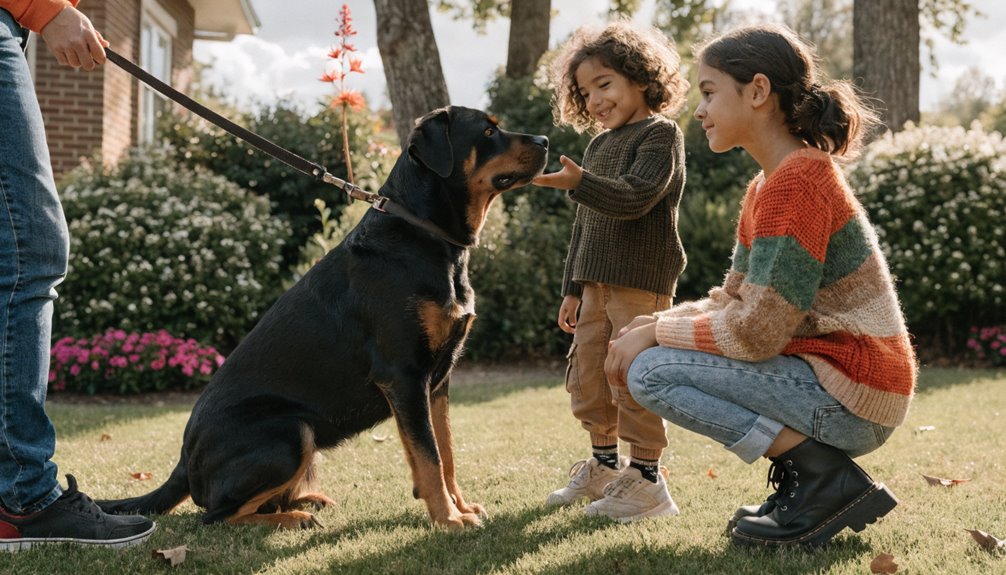
You’ll want to let your Rottweiler approach the child on its own timeline, allowing several minutes for natural sniffing, licking, and circling without rushing the process or forcing closer contact.
Begin with the child held in your arms or positioned behind a barrier so the dog can investigate scent and posture safely, then watch for comfort signals like a loose tail and soft eyes, which tell you the dog’s ready to continue, or stiff body language and fixed stares, which mean you need to pause and give space.
Keep these first meetings short—multiple 2 to 5 minute sessions with calm reinforcement work better than one long encounter, and removing your dog gently if it becomes overly excited teaches it to limit its own behavior and respect boundaries.
Allow Natural Curiosity First
Rather than rushing your Rottweiler into contact with a child, letting the dog investigate at its own pace reduces stress and lowers the risk of a negative reaction. Your furry friend needs time to process new experiences, and forced interactions create anxiety that can trigger defensive behavior.
Allow your Rottweiler to approach a blanket or clothing item belonging to the child first, letting curiosity guide the investigation naturally. Once your dog shows calm interest, you can hold the child in a cradle position, enabling your Rottweiler to sniff hands and face without sudden movements that might startle it.
This gradual approach builds confidence in both the dog and child, establishing a foundation of trust and safety before progressing to longer interactions.
Respect Boundaries During Meetings
While your Rottweiler’s natural curiosity is valuable, the pace of introduction matters far more than how quickly you move forward, so you’ll want to let your dog set the speed rather than pushing for faster progress. Watch the dog’s body language closely for signals to stop—stiffening, prolonged staring, lip-licking, whale eye, and growling all indicate discomfort. Immediately remove the child if any appear.
These signals mean your dog needs space and time to decompress. Keep sessions short and conducted in quiet, controlled environments where sudden noises won’t startle your Rottweiler into anxiety. By respecting your dog’s pace and removing pressure, you create predictability and trust, allowing the dog to develop genuine tolerance and calm behavior around children over time.
Watch for Comfort Signals
The most reliable way to build trust between your Rottweiler and children is to let your dog initiate contact rather than forcing interaction, since research and professional trainers consistently show that dogs allowed to approach on their own timeline display genuine calm signals instead of stress responses.
Watch for these comfort indicators:
- Relaxed open mouth and soft eye contact
- Loose, natural tail wagging
- Loose body posture without stiffness
- Voluntary movement toward young children
These signals mean your dog feels safe and ready to engage.
When your Rottweiler displays this calm behavior around children, reinforce it immediately with low-key praise and treats. This reinforcement builds a consistent pattern where your dog associates interactions with positive outcomes, strengthening trust gradually while respecting your dog’s natural pace throughout each session.
Establish Rules and Boundaries From Day One
Because Rottweilers are intelligent and naturally responsive to structure, you’ll find that establishing clear, non-negotiable rules from day one creates the foundation for safe interactions with children throughout your dog’s life. Set specific boundaries—no jumping on children, no access to the baby’s room, no unsupervised contact with play areas—and enforce them consistently so your dog understands what’s expected immediately.
Use immediate, consistent consequences like brief time-outs or removal of attention when your dog shows rough or overexcited behavior, while rewarding calm conduct with praise or high-value treats. This reinforcement pattern teaches your Rottweiler that controlled behavior earns positive outcomes, whereas excitement doesn’t. Make certain all caregivers and older children respond identically to infractions and rewards, preventing mixed signals that undermine your boundaries and confuse your dog about acceptable behavior.
Teach Your Child to Pet Gently (and Your Rottweiler to Accept It)
Gentle petting is a skill your child must learn deliberately, and your Rottweiler must practice accepting it, since both need training to make physical contact safe and comfortable for everyone involved.
Start by teaching your child these core techniques:
- Place an open palm flat on the dog’s shoulder or chest, stroking slowly along the fur rather than poking quickly
- Avoid the face, tail, ears, and hugging, which trigger protective reactions in large dogs
- Withdraw hands slowly if the dog moves away, respecting personal space
- Watch for discomfort signals like lip lifts, yawning, or stiffening, then redirect to a toy
Supervise every interaction as a family member, modeling soft pressure while saying “gentle.”
Practice short thirty-to-sixty-second sessions multiple times daily, rewarding calm acceptance with treats or praise to reinforce positive associations with touch.
Supervise Every Interaction and Redirect Overly Excited Play
Supervision isn’t optional when your Rottweiler and children interact, since large-breed play can cause accidental injury even when the dog means no harm—a playful jump that delights an adult can knock a small child down, and enthusiastic nipping during roughhousing can break skin without aggressive intent.
You must supervise every interaction and stay alert for signs of mounting excitement: jumping, nipping, or knocking over. The moment you notice these behaviors, interrupt calmly with a 10–30 second time-out by removing the dog’s attention. Redirect that arousal into a safe activity like fetch or chewing. Keep high-value toys readily available. Consistent reinforcement of calm interactions teaches your Rottweiler that gentle behavior earns continued engagement, while overexcitement ends it.
Recognize Red Flags and Know When to Seek Professional Help
Recognizing escalating stress or fear in your Rottweiler requires you to watch for subtle body language changes that often come before growling or snapping, since these early signals give you time to intervene and prevent an incident.
You should monitor for:
- Stiff posture, fixed stares, raised hackles, and slow movements
- Clear warnings like low growls, air snaps, or hard stares
- Resource guarding when children approach food, toys, or resting areas
- Sudden temperament shifts, unprovoked aggression, or extreme avoidance
When you notice these signs, separate your dog and child calmly, then contact a certified applied animal behaviorist immediately.
If your Rottweiler shows sudden aggression or fails obedience training around children, schedule a veterinary exam within 48 hours to rule out pain or illness before pursuing behavioral modification.
Frequently Asked Questions
Do Rottweilers Do Well With Kids?
You’ll find that Rottweilers can do well with kids when you provide proper socialization, training, and supervision. Their size poses risks, but individual temperament matters more than breed—well-trained Rottweilers are often gentle companions.
What Is the 3 3 3 Rule for Introducing Dogs?
You’ve heard the saying that haste makes waste—and that’s precisely why you’ll follow the 3-3-3 rule: allow three minutes for calm assessment, three minutes of gentle interaction, then three days of gradual exposure to build trust safely.
Can Rottweilers Be Left Alone for 8 Hours?
You can leave adult Rottweilers alone for 8 hours occasionally if they’re well-exercised beforehand, but you shouldn’t do it regularly. Puppies can’t manage that long. You’ll need midday breaks or professional help for routine absences.
What Bites Harder, a Pitbull or a Rottweiler?
Rottweilers generally bite harder—they’re larger and more muscular, delivering around 328–350 psi versus pit bulls’ 235–300 psi. However, you’ll find bite risk depends more on individual temperament, training, and owner responsibility than breed alone.
Conclusion
You’ve now established the foundation for safe Rottweiler-child interactions through assessment, preparation, and consistent supervision. Research shows that 77% of dog bites occur during unsupervised play, underscoring why your vigilance matters. By maintaining clear boundaries, reinforcing positive behaviors, and staying alert to warning signs, you’re creating an environment where both your child and dog can thrive together, transforming potential risks into rewarding companionship built on trust and structure.