Some of the links in this post are affiliate links. This means we may earn a small commission if you make a purchase through these links—at no extra cost to you. We only recommend products and tools that we genuinely believe will help you with your Rottweiler.
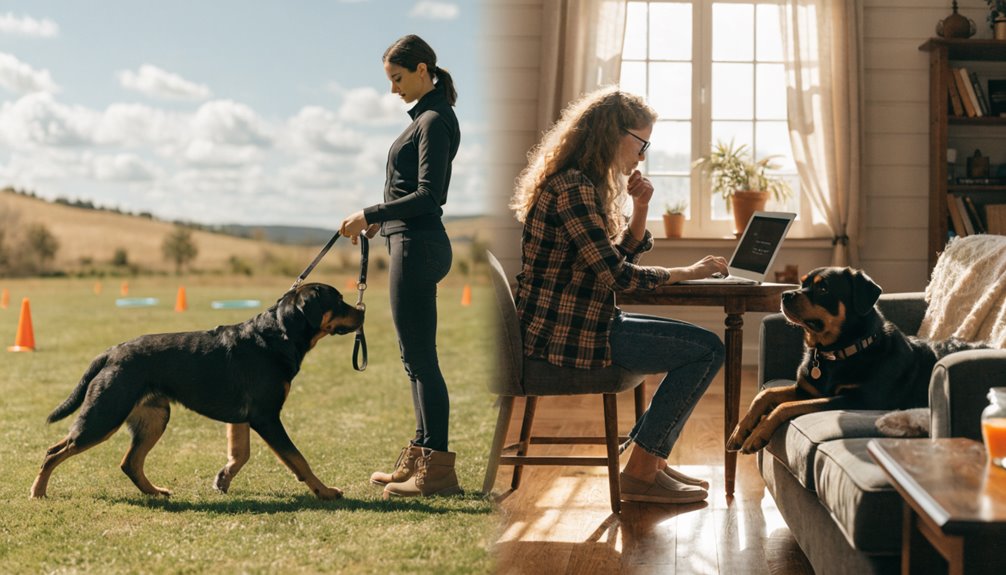
For Rottweilers, a professional trainer offers real-time corrections, live socialization exposure, and immediate safety adjustments that online courses can’t match—critical during the 6–18 month adolescent period when impulse control develops. Online courses provide affordable, flexible foundational theory, but lack the hands-on physical scaffolding and split-second positioning needed for reactive or powerful breeds. A hybrid approach—combining online modules with monthly in-person sessions—balances flexibility and accountability while addressing your dog’s specific developmental needs throughout this sensitive window.
- Key Takeaways
- Why In-Person Training Matters for Rottweilers
- Why Online Courses Appeal to Busy Owners
- Real-Time Feedback vs. Self-Paced Learning
- Socialization and Real-World Exposure: A Critical Gap
- How Much Should You Budget?
- Red Flags and Green Lights in Trainer Credentials
- Can You Combine In-Person and Online Training?
- Five Questions to Ask Before Hiring
- Making Your Final Choice
- Frequently Asked Questions
- Conclusion
Key Takeaways
- Professional trainers provide real-time corrections and safety adjustments critical for large, powerful adolescent Rottweilers with delayed impulse control.
- Online courses offer flexible, affordable foundational knowledge but cannot deliver split-second physical corrections or real-world socialization exposure.
- Hybrid training combining online modules with monthly in-person sessions balances flexibility, accountability, and competence-building during critical developmental periods.
- Verify trainer credentials through documented Rottweiler experience, at least 50 supervised handling hours, and references from past clients.
- In-person assessment of leash reactivity and controlled greetings with your dog present demonstrates trainer competence better than written tests alone.
Why In-Person Training Matters for Rottweilers
Consider what happens during a Rottweiler’s critical adolescent window between 6 and 18 months: your dog’s body is developing rapidly into a large, powerful frame that can easily pull you off balance or cause injury through uncontrolled movements, yet their impulse control often lags behind their physical strength.
In-person training with a professional trainer provides real-time assessment and correction that remote instruction simply can’t match. Your trainer watches for subtle cues—muscle tension, throat changes, hard eye contact—and adjusts your positioning immediately to prevent handler injury.
They model calm leadership while physically scaffolding exercises, building your dog’s safety skills through controlled exposure and supervised practice. This hands-on structure prevents overwhelming your Rottweiler and reduces reinforcement of reactive behavior, establishing consistency and reliable impulse control during their most critical developmental stage.
Why Online Courses Appeal to Busy Owners
If your work schedule doesn’t leave room for weekly training sessions or travel time to a trainer’s facility, online courses can bridge that gap by letting you learn and practice on your own terms, often with 24/7 access to recorded lessons you can review after work or late at night.
Many online dog training courses compress foundational material into 6–8 week self-paced tracks, so you won’t need to take time off work. Live video sessions and recorded feedback let you practice Rottweiler-specific handling techniques at home, replay corrections on demand, and build consistency without the logistics of childcare or travel.
This structure works especially well when local expertise in large breed management is limited in your area.
Real-Time Feedback vs. Self-Paced Learning
While online courses solve the scheduling problem for busy owners, they can’t replicate the immediate correction that a professional dog trainers provides during a live session, and that gap matters most when you’re handling a 100-pound dog who moves faster than you can think. Real-time feedback lets trainers adjust your leash tension, timing, and body positioning in split-second intervals—adjustments that prerecorded videos simply can’t make.
With reactive or dominance-tinged behaviors, professional dog trainers modify distance and reward timing instantly to prevent escalation. Online courses excel at delivering theory, safety protocols, and replayable demonstrations you revisit on demand, but they depend entirely on your ability to execute physical corrections under pressure. A hybrid approach—online courses for foundational knowledge plus periodic live sessions for hands-on refinement—combines both strengths.
Socialization and Real-World Exposure: A Critical Gap
Online courses excel at teaching you the mechanics of obedience—sit, stay, heel—but they can’t replicate the unpredictable environment your Rottweiler will face once you step outside your home, and that gap creates a dangerous blind spot in her training. Virtual sessions lack the live distractions that build genuine impulse control: other dogs within arm’s reach, unfamiliar people approaching, traffic noise, and novel locations. Your Rottweiler needs repeated, graded exposure to these stimuli under controlled conditions.
| Training Method | Distance Exposure | Socialization Depth | Real-World Transfer |
|---|---|---|---|
| Online dog training classes | Minimal | Limited | Unpredictable |
| In-person trainer groups | 2–10 feet proximity | Repeated, varied | Reliable |
| Hybrid approach | Controlled progression | all-encompassing | Strong |
A pragmatic hybrid strategy—pairing online coursework for theory with scheduled in-person trainer sessions—closes this gap effectively.
How Much Should You Budget?
Because you’re investing in your Rottweiler’s safety and reliability, understanding the true cost of training—both in-person and online—helps you make a choice that fits your finances and your dog’s needs. Your budget depends on which path you choose and what outcomes you’re seeking.
Consider these pricing ranges:
- In-home professional trainers: $75–$200 per hour, with recommended 4–8 session packages totaling $300–$1,600
- Group classes: $100–$300 for 6–8 weeks, offering lower per-session costs but less individualized attention
- Online courses: $50–$2,500 depending on program depth and instructor feedback
Plan a combined initial investment of $500–$2,500, then budget $50–$200 monthly for ongoing refreshers. Factor in additional expenses like equipment, board-and-train programs, or veterinary consultations, which materially extend your total commitment.
Red Flags and Green Lights in Trainer Credentials
When you’re evaluating a trainer’s qualifications, you’ll want to verify whether they’ve completed direct handling assessments—meaning someone observed and graded their actual work with dogs, not just their test scores on paper—because this shows they can apply techniques safely under real conditions.
You should also ask if you can observe a live training session or watch video recordings of the trainer working with other Rottweilers in person, since watching their timing, positioning, and correction methods in action reveals whether they truly understand how to manage the breed’s strength and arousal patterns, not just whether they studied the theory.
Direct Handling Assessment Verification
Credentials matter most when they prove a trainer’s capacity to handle real dogs in real situations, and the distinction between theory and practice is where many trainer qualifications reveal their true value.
When you evaluate a trainer’s background, you’re fundamentally asking: has this person been directly observed working with live-assessed large-breed dogs under structured conditions?
Ask these verification questions:
- Request specific dates, supervisor names, and documented pass/fail criteria from their hands-on assessments
- Inquire about total observed hours and whether their training included mentored apprenticeships with reactive or powerful breeds
- Request case notes, client references, or video recordings showing real-time problem-solving with dogs similar to yours
Trainers with legitimate live experience can articulate exactly who supervised them, how long they trained, and what competence markers they demonstrated under pressure.
Live Teaching Observation Opportunities
Verifying a trainer’s hands-on competence requires more than reviewing their résumé—you’ll want to see them work with live dogs and adapt their teaching in real time, because that’s where the gap between knowing dog training theory and actually executing it under pressure becomes visible.
Request to observe a live teaching session, whether in-person or via livestream, to assess how trainers respond when a Rottweiler’s arousal escalates mid-session. Watch whether they adjust distance, modify criteria, or shift handler instruction smoothly without hesitation.
Trainers comfortable with observation and able to explain specific adjustments they’ve made demonstrate transparency and breadth of real-world in-person dog experience. This direct visibility into their adaptive problem-solving reveals competence that online credentials alone can’t verify.
Can You Combine In-Person and Online Training?
You’ll find that blending online coursework with hands-on sessions creates a more complete training plan than either method alone, especially for a strong breed like the Rottweiler. This hybrid approach combines the flexibility and theoretical depth of an online training course with the real-time assessment and safety management that in-person practical sessions provide.
Blending online coursework with hands-on sessions creates complete Rottweiler training, combining theoretical depth with real-time safety assessment.
Your structured plan should include:
- Online modules for foundational concepts, video demonstrations, and repeatable homework that you complete daily at home
- Monthly in-person practical sessions during adolescence to practice leash handling, impulse control under motion, and real-world distractions
- Remote coaching between visits, allowing your trainer to review progress through recorded drills while you maintain consistency at home
This combination guarantees you develop both conceptual understanding and live-assessed competence, critical for managing a Rottweiler’s strength and arousal effectively.
Five Questions to Ask Before Hiring
Before you hire a trainer, you’ll want to confirm they’ve worked with dogs in real settings—not just through online courses—since live handling experience with actual Rottweilers shows whether they can read body language, time corrections properly, and keep everyone safe when a strong dog tests boundaries.
Ask them directly about their hands-on assessment methods, their safety protocols for managing bite risk, and whether they’ll observe your dog’s behavior before starting work, because trainers who’ve been coached and corrected by experienced mentors typically make better real-time decisions than those who’ve only studied theory.
Request specific examples of Rottweilers they’ve trained, client references you can contact, and a written safety plan they’ll follow during sessions, so you can verify their experience matches what your dog actually needs.
Real-World Handling Assessment
When a trainer claims experience with Rottweilers, the gap between theoretical knowledge and hands-on competence often determines whether your dog actually improves or simply learns to mask problems around that specific person.
Online classes can’t replicate the real-time adjustments required when a large-breed dog deviates from plan.
You need direct observation of how the trainer handles your dog under actual conditions.
Request these specific details:
- Live session access showing leash reactivity, counter-surfing, and controlled greetings with your dog present
- Documented hours of supervised Rottweiler experience with mentor sign-off on competence
- Real-time adaptation examples where the trainer changed distance, modified cues, or adjusted safety positioning when your dog resisted
Ask about their live assessment experience coaching owners in group settings where large-breed strength creates genuine pressure.
This distinction separates trainers who understand Rottweiler-specific training from those relying on generic online course frameworks.
Live Teaching Experience Verification
A trainer’s credentials on paper don’t always translate to skill when a hundred-pound Rottweiler pulls hard on leash or lunges at another dog, which is why verifying their live teaching experience matters more than their course completion certificates.
Ask whether they’ve completed at least 50 live-handling hours with real dogs under direct instructor observation and correction, not just recorded demos or written work.
Find out how many reactive/large-breed cases they’ve personally managed—aim for 20 or more—and request outcome metrics showing reduced lunging or improved recall within 6 to 8 weeks.
Confirm they’ve completed supervised apprenticeship hours combining online theory with in-person intensives.
Request references from two past Rottweiler clients who can verify their actual teaching consistency and real-time adjustment skills.
Making Your Final Choice
Your decision between a professional trainer and an online course shouldn’t rest on convenience alone, because the stakes with a Rottweiler—a large, powerful breed with strong guarding instincts—demand that you match the training method to your dog’s temperament and your own capacity to execute what you learn.
Rottweiler training decisions demand matching method to temperament and capacity—not convenience alone.
Consider these factors:
- In-person professional training provides hands-on correction, real-time safety positioning, and immediate feedback that safety-sensitive issues like resource guarding require
- Hybrid online courses balance flexibility with accountability through live video coaching and supervised practice sessions
- Your lifestyle fit determines whether you can consistently apply techniques or need structured accountability
If your Rottweiler shows reactivity or aggression, prioritize certified trainers with documented working-breed experience.
If life demands flexibility, choose a hybrid model combining online theory with periodic in-person assessments, ensuring theoretical knowledge translates into confident, reliable handling.
Frequently Asked Questions
What Is the 3-3-3 Rule for Dog Training?
You’ll experience three distinct phases when bringing home a dog. In the first three days, you’re managing stress. Over three weeks, you’re building trust and routines. By three months, you’re establishing long-term behavioral patterns.
Are Online Dog Training Courses Worth It?
Online courses are gold for building your foundation, but you’ll hit a ceiling without hands-on guidance. You’re best combining video lessons with in-person sessions to master your Rottweiler’s strength safely.
What Is the 7 7 7 Rule for Dogs?
You’ll expose your puppy to seven new people, seven different dogs, and seven unique environments weekly during weeks 3–14. You’re building confidence through short, positive experiences that reduce future fear and reactivity.
How Long Does It Take to Fully Train a Rottweiler?
You’ll need eight to twelve weeks for basics, six to twelve months for off-leash reliability, and ongoing refreshers throughout your Rottweiler’s life to maintain those hard-earned skills.
Conclusion
You’ll find that the best choice isn’t choosing one method over the other, but rather recognizing where each excels. You’re likely tempted to save money with online courses, yet you’ll discover that professional trainers provide irreplaceable real-time correction your Rottweiler genuinely needs. Conversely, you’ll appreciate how online resources reinforce consistency between sessions. You’ve got the roadmap now; your next step involves matching your dog’s specific needs with the right combination of both approaches.