Some of the links in this post are affiliate links. This means we may earn a small commission if you make a purchase through these links—at no extra cost to you. We only recommend products and tools that we genuinely believe will help you with your Rottweiler.
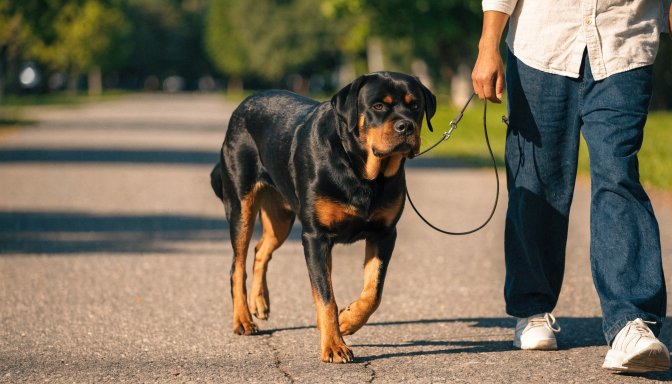
You’re dealing with a powerful breed bred for herding—they’ve got serious strength and smarts. Start with the right equipment: fabric martingale collars and sturdy harnesses distribute pressure evenly. Practice in low-distraction areas first, keeping sessions short (5–10 minutes). Reward calm behavior immediately with treats. Use consistent commands like “easy” and stop walking when tension hits the leash. Your Rottweiler reaches full height by one year but stays energetic longer—consistent daily training accelerates maturation. Master these foundations, and you’ll transform walks into bonding moments that strengthen trust between you both.
- Key Takeaways
- Understanding Rottweiler Temperament and Leash Training Readiness
- When Does Your Rottweiler Finally Settle Down?
- Why Leash Training Matters for Large, Powerful Breeds
- Choosing the Right Collar and Harness for Your Rottweiler
- Selecting a Leash That Supports Loose Leash Walking
- Introducing Your Rottweiler to Leash and Collar
- Managing Excitement for Successful Loose Leash Walks
- Your First Loose Leash Walking Practice Sessions
- Teaching the “Heel” Command for Calm Walking
- Rewarding Good Leash Manners: What Works Best
- How to Stop and Wait When Your Rottweiler Pulls
- What to Do When Your Rottweiler Reacts to Other Dogs
- Redirecting With Toys and Treats During Walks
- Level Up: Distractions and New Environments
- How Long Does Loose Leash Training Take?
- Common Training Mistakes That Slow Progress
- Troubleshooting Pulling and Lunging: Beyond the Basics
- When to Seek Help From a Professional Trainer
- Strengthening Your Bond Through Successful Leash Training
- Frequently Asked Questions
- Conclusion
Key Takeaways
- Rottweilers are intelligent and eager to please, making them responsive to consistent positive reinforcement during leash training.
- Use fabric martingale collars and sturdy harnesses that distribute pressure evenly to ensure comfort and prevent irritation.
- Practice loose leash walking in low-distraction environments with brief 5-10 minute sessions, rewarding calm behavior immediately.
- Stop walking immediately when leash tension occurs and use consistent commands like “easy” to reinforce discipline.
- Seek professional help if pulling persists, aggressive behaviors emerge, or frustration arises during training sessions.
Understanding Rottweiler Temperament and Leash Training Readiness
Rottweilers are powerful dogs bred centuries ago as cattle herders and guardians. Their confident temperament means they’ll naturally test boundaries—it’s hardwired into them.
But here’s the good news: they’re incredibly intelligent and genuinely keen to please you.
Rottweilers are incredibly intelligent and genuinely keen to please you—that’s your real advantage in training.
What this means for leash training:
Your Rottweiler thrives on consistency and clear direction. They’re not being stubborn; they’re just confident enough to question unclear commands. Strong positive reinforcement—treats, praise, enthusiasm—taps directly into their motivation to please.
Familiar environments reduce anxiety during leash introduction. Start training where your dog feels secure.
This foundation transforms loose leash walking from a struggle into a collaborative experience between you and your capable companion.
When Does Your Rottweiler Finally Settle Down?
Your pup reaches full height by one year old, but that doesn’t mean calm behavior follows. They’re still bursting with energy—lots of it. Those youthful hormones keep running strong.
Here’s the good news: you don’t have to wait passively. Consistent training and daily exercise dramatically speed up maturation. Mental stimulation matters too.
Proper socialization during puppyhood? That accelerates settling considerably.
Think of it this way: you’re building a foundation now. The effort you invest today—those long walks, training sessions, and mental challenges—directly shapes your adult Rottweiler’s temperament tomorrow.
Why Leash Training Matters for Large, Powerful Breeds
When you’re walking a 90-pound dog with the strength to pull you off your feet, leash training isn’t optional—it’s essential.
Your Rottweiler’s power demands respect and structure. Here’s why leash training matters:
- Safety first — You control accidents and aggressive encounters before they happen.
- Prevents dangerous behaviors — Early training stops pulling and lunging that strain both of you.
- Builds mutual respect — Consistent practice strengthens your bond and his obedience.
- Enables socialization — Proper leash manners reduce reactivity toward other dogs and people.
Without leash training, your powerful breed becomes unpredictable in crowded environments.
With it? You’ve got a confident, well-mannered companion.
Your walks transform from stressful battles into enjoyable experiences where both of you thrive together.
Choosing the Right Collar and Harness for Your Rottweiler
You’ll want to nail three critical factors when selecting gear for your Rottweiler: ensuring you’ve got the right comfort and proper fit so your dog breathes easily and moves freely, choosing the right materials—like fabric martingale collars—that won’t injure your powerful pup, and deliberately avoiding harmful collar types such as choke chains that can damage your dog’s neck.
Your Rottweiler’s safety and happiness depend on these foundational choices, so let’s explore what actually works for this muscular, intelligent breed.
Comfort And Proper Fit
Your Rottweiler’s comfort directly impacts their walking behavior. A poorly fitted collar causes choking, escape risks, and skin irritation—derailing your training completely.
You’ll want to prioritize:
- Soft materials like hemp or nylon that prevent irritation during extended wear
- Fabric martingale collars designed safely—avoiding chains or buckles that risk injury
- Sturdy harnesses distributing pressure evenly across their powerful body
- Proper measurements allowing one finger between equipment and skin
For your muscular Rottweiler, a well-fitted harness transforms walks from uncomfortable struggles into manageable, pleasant experiences.
Check the fit regularly—your dog grows, and equipment needs adjustment. When comfort’s optimized, your Rottweiler focuses on learning, not fighting discomfort.
That’s when loose leash walking truly begins.
Material Selection For Rottweilers
Now that you’ve nailed the fit, let’s talk about what your equipment’s actually made of—because material matters as much as measurements do.
The Best Fabrics for Your Rottweiler
Soft materials like hemp and nylon are your best friends here. Why? They’re comfortable against your dog’s skin and reduce irritation during walks.
These materials won’t chafe or cause rawness like harsh alternatives would.
What to Avoid
Skip heavy padded or rubber handles on leashes. They might feel cushioned, but they actually reduce your sensitivity to your Rottweiler’s movements—and that’s vital for effective communication during training.
The Collar Choice
Fabric martingale collars deliver gentle correction without injury risk.
Chains and buckles? Avoid them completely. They’re outdated and dangerous for your powerful companion.
Smart material selection for Rottweilers sets your training foundation solid.
Avoiding Harmful Collar Types
When it comes to keeping your Rottweiler safe and comfortable, not all collars are created equal. You’ll want to avoid certain types that can harm your dog’s wellbeing and training progress.
Why Avoiding Harmful Collar Types Matters
Pinch collars and prong collars might seem effective, but here’s the truth: they increase stress and anxiety in dogs.
Instead, prioritize these safer alternatives:
- Fabric martingale collars (gentle pressure without choking)
- Soft nylon options (comfortable for daily wear)
- Hemp materials (durable and skin-friendly)
- Head halters (excellent for strong pullers)
The Right Fit Prevents Problems
Ensure your collar fits correctly—you shouldn’t slide more than two fingers underneath.
Heavy padded handles reduce your sensitivity during training, making communication harder. Your Rottweiler deserves equipment that keeps them safe while building trust between you both.
Selecting a Leash That Supports Loose Leash Walking
What to Avoid:
- Retractable leashes encourage pulling and sabotage your training efforts.
- They prevent consistent behavior management.
Better Choices:
- Durable nylon or hemp collars offer comfort and prevent choking.
- Front-clip harnesses discourage pulling naturally.
- Head halters work brilliantly for strong dogs.
Safety Matters:
Reflective gear isn’t just trendy—it’s essential. Low-light visibility could save your dog’s life during evening walks.
Your Rottweiler’s safety depends on these smart equipment choices that support successful loose leash walking together.
Introducing Your Rottweiler to Leash and Collar
Before you clip that leash to your Rottweiler’s collar, you’ve got homework to do. Introducing your Rottweiler to leash and collar requires patience and strategy. Your dog’s first impression matters—a lot.
Follow these essential steps:
- Let them explore the equipment freely in your home before any attachment happens.
- Start indoors with short wearing periods to build comfort and confidence gradually.
- Reward calm behavior with treats and enthusiastic praise whenever they wear the gear.
- Practice obedience commands—sit, stay—before leash attachment to reinforce focus.
Choose well-fitted, comfortable materials like soft nylon or hemp. This prevents discomfort and guarantees safety during walks. Your Rottweiler’s powerful build demands proper equipment that won’t cause chafing or restriction.
The introduction phase sets your foundation for successful loose leash walking ahead. Don’t rush it.
Managing Excitement for Successful Loose Leash Walks
Your Rottweiler’s equipment is comfortable and familiar now—great! Managing excitement is your next essential step.
Pre-Walk Preparation
Before you even touch that leash, engage your dog in calming activities. Practice commands like “sit” consistently—this creates focus and reduces over-stimulation. Your Rottweiler’s nervous system needs time to settle.
Engage in calming activities and practice “sit” commands before the walk to create focus and reduce your Rottweiler’s over-stimulation.
Desensitization Strategy
Try this: practice your entire walk routine indoors or in your yard first. No actual walking required. This technique—called desensitization—trains your dog’s brain to recognize walk cues without the adrenaline spike.
During the Walk
Watch your Rottweiler’s body language closely. Stiff posture? Excessive pulling? Stop immediately and wait for relaxation. Reward calm behavior generously.
Consistency Wins
Practice multiple times daily. Repetition rewires your dog’s response patterns, helping them control that excitement naturally.
Your First Loose Leash Walking Practice Sessions
It’s time to put training into action—and here’s the key: start small and controlled.
Your first loose leash walking practice sessions will set the foundation for success. Here’s what you’ll do:
- Choose familiar territory – Pick a quiet, low-distraction environment where your Rottweiler feels comfortable and confident.
- Keep sessions brief – Practice for only 5-10 minutes to prevent overwhelm and maintain focus.
- Establish commands first – Use “sit” and “heel” before walking to signal expectations and build mental readiness.
- Reward immediately – Deliver treats and praise the instant your dog exhibits calm behavior on the loose leash.
Consistency matters tremendously. Practice multiple times daily to reinforce positive habits.
Your Rottweiler’s confidence grows through repetition—each session strengthens their understanding of loose leash walking standards.
You’re building neural pathways, fundamentally rewiring their walking instincts toward calmness and focus.
Teaching the “Heel” Command for Calm Walking
You’ll master loose leash walking by building three critical skills: starting with basic positioning, reinforcing heel consistency, and progressing through distractions.
Each skill builds on the last, transforming your Rottweiler’s pulling instincts into calm, focused walking behavior.
Let’s explore how to establish proper heel positioning and turn it into an unshakeable habit your dog maintains—even when temptation strikes.
Starting With Basic Positioning
The foundation of loose leash walking begins here—with mastering the heel command, where your Rottweiler walks calmly beside you without pulling or lagging. This command transforms chaotic walks into peaceful experiences.
Position your dog at your side during leash walks. Here’s your positioning strategy:
- Stand with your Rottweiler close—shoulder aligned with your leg.
- Keep the leash slack, not tight or restrictive.
- Maintain consistent speed throughout your walk on a leash.
- Reward calm behavior immediately with treats and praise.
Why This Matters
Rottweilers weigh 80-135 pounds. Their strength demands respect. Proper positioning distributes their weight safely, preventing shoulder strain on both of you.
Start in quiet environments. Minimal distractions help your dog focus.
Short, consistent practice sessions build muscle memory faster than sporadic training. Your patience now prevents frustration later.
Reinforcing Heel Consistency
Consistency transforms the “heel” command from an occasional request into your dog’s natural walking instinct. You’ll reinforce heel consistency by using identical commands, tone, and timing every single time. Your Rottweiler’s brain—particularly the reward center—strengthens neural pathways through repetition.
| What You Do | What Happens | The Result |
|---|---|---|
| Use same command daily | Brain creates muscle memory | Automatic heel response |
| Reward immediately | Dopamine release reinforces behavior | Willing compliance |
| Practice consistently | Habit formation strengthens | Reliable loose leash |
Short training sessions work best. Five to ten minutes daily outperforms sporadic hour-long marathons. Praise enthusiastically when your Rottweiler walks beside you correctly. Treats seal the deal—literally and neurologically.
Gradually introduce distractions once basic positioning solidifies. Reinforce heel consistency across environments: quiet streets, parks, bustling neighborhoods. Your patient, persistent approach transforms walks from exhausting battles into enjoyable bonding moments.
Progressing Through Distractions
Once your Rottweiler masters “heel” in calm settings, real-world challenges await. You’re ready to introduce distractions—the true test of walking calmly together.
Building Distraction Tolerance
Progress systematically through these scenarios:
- Start with mild distractions: distant sounds, parked cars, or empty sidewalks
- Advance to moderate challenges: other pedestrians, bicycles, or squirrels at a distance
- Introduce complex environments: parks with multiple dogs and people present
- Practice during peak activity hours when stimuli intensify considerably
Each step strengthens your Rottweiler’s focus. Their pack-oriented brain—evolved over millennia for cooperation—responds powerfully to consistent leadership.
Maintaining Calm Walking
When distractions emerge, immediately reinforce correct positioning. Reward walking calmly beside you with treats and enthusiastic praise.
Your Rottweiler learns: staying focused equals rewards. Gradually, they’ll ignore competing stimuli naturally.
You’re not suppressing instinct; you’re channeling it productively. That’s genuine training mastery.
Rewarding Good Leash Manners: What Works Best
High-value treats—small pieces of chicken or beef—tap directly into your Rottweiler’s food motivation. Pair these with enthusiastic praise and petting. This multi-sensory positive reinforcement strengthens your bond while reinforcing desired leash skills.
The Timing Factor
Immediate rewards create crystal-clear associations. Delayed praise? Your dog won’t connect it to their walking behavior.
Consistency matters too. Use specific commands paired with instant rewards. This approach makes future walks increasingly enjoyable and controlled.
How to Stop and Wait When Your Rottweiler Pulls
You’re about to discover why stopping dead in your tracks becomes your most powerful training tool—it teaches your Rottweiler that pulling gets them nowhere, while patience gets them everywhere.
When you recognize that telltale leash tension and your dog lunges forward, you’ll stand completely still, allowing the leash to loosen naturally and signaling that relaxation (not force) leads to progress.
This technique works because dogs are incredibly smart learners who understand cause-and-effect—they’ll quickly figure out that calm behavior opens the walk back up, making loose-leash walking feel like their own brilliant discovery rather than something you’re forcing them to do.
Recognizing Pulling Behavior
When your Rottweiler lunges forward or yanks on the leash, that’s your cue to act—immediately. Recognizing pulling behavior is essential for successful loose leash training. Your dog communicates through tension, and you must respond consistently.
Watch for these telltale signs:
- Leash tension increases – the rope tightens noticeably
- Forward momentum accelerates – your pup surges ahead enthusiastically
- Body leans into the pull – shoulders strain forward
- Excitement escalates – barking or whining accompanies the behavior
Rottweilers, descended from Roman mastiffs used for herding, possess natural drive and strength. Their biology drives them forward—but you control the outcome.
Stop walking immediately when pulling starts. Don’t move forward. This simple response teaches your dog that pulling prevents progress. Patience wins here.
Every consistent stop reinforces the lesson: relaxation equals movement.
Implementing The Stop Technique
The moment your Rottweiler’s leash grows taut—that’s your signal to freeze. This stop technique works because dogs learn through consequences. When you halt immediately, your Rottweiler discovers that pulling doesn’t advance progress.
The Process:
- Stop completely when tension appears on the leash.
- Wait patiently for calm behavior—relaxed shoulders, loose leash tension.
- Resume walking only after they settle.
Why It Works:
Rottweilers are intelligent working dogs bred for obedience. Their brains respond to clear cause-and-effect patterns. Pulling = no movement. Calmness = forward progress.
Strengthen Results:
Praise enthusiastically when your dog relaxes. Offer high-value treats during waiting periods. This positive reinforcement cements good habits.
Consistency matters greatly. Practice this technique every single pull without exception. Your Rottweiler will eventually choose calm walking over futile pulling.
Patience pays off remarkably.
Reinforcing Calm Walking Responses
Once your Rottweiler pulls, stopping completely sends a powerful message—pulling stops progress. This counterintuitive technique harnesses canine learning through consequence, not punishment. When you halt movement, your dog’s brain registers that tension equals stagnation.
Reinforcing calm walking responses requires consistent application:
- Pause immediately when leash tension increases
- Wait silently until your Rottweiler relaxes completely
- Resume walking the moment tension releases
- Reward generously with treats and enthusiastic praise
This cycle teaches your dog that calmness permits forward motion. Dogs instinctively seek reward and avoid stagnation—biology favors movement.
Use commands like “easy” consistently. Your Rottweiler’s 300-pound frame demands this discipline early.
Practice in quiet environments first, gradually introducing distractions. Your patience builds their impulse control. Success transforms walks from battles into bonding experiences.
What to Do When Your Rottweiler Reacts to Other Dogs
Encountering another dog on your walk shouldn’t turn into a tug-of-war match. When your Rottweiler reacts to other dogs, you’ve got a clear action plan.
Stop immediately. Don’t keep walking. Wait for calm behavior before moving forward—this prevents reinforcing reactive behavior.
Redirect attention:
- Use high-value treats or favorite toys
- Command “watch me” to refocus on you
- Break the fixation on the other dog
Practice desensitization gradually. Expose your Rottweiler to other dogs from safe distances in controlled settings. This reduces anxiety over time.
Implement structure with commands like “leave it” during encounters. Consistency reinforces positive responses.
Know your limits. If reactivity persists despite your efforts, consult a professional trainer. They’ll provide customized techniques for your dog’s specific needs.
Redirecting With Toys and Treats During Walks
Redirecting with toys and treats isn’t just a reward system—it’s your secret weapon for maintaining loose leash walking, especially when distractions threaten to derail your progress.
Your Rottweiler’s attention span works like a biological switch. When external stimuli trigger their prey drive, you’ll need high-value rewards to flip that switch back toward you.
Here’s how redirecting with toys and treats works:
- Stop walking when tension hits the leash.
- Wait for your dog to release that tension.
- Immediately engage them with favorite toys or treats.
- Reinforce the desired direction with praise.
Practice these techniques in calm environments first. Low-distraction settings build muscle memory—both yours and your Rottweiler’s.
Once solid habits form, managing stimulating environments becomes dramatically easier. Your consistency creates predictability, transforming chaotic walks into controlled, enjoyable experiences.
Level Up: Distractions and New Environments
Your Rottweiler’s loose leash skills won’t magically transfer everywhere—they need real-world practice in varied settings.
Start Small, Build Big
Begin in low-distraction areas where your dog can focus. Parks, quiet streets, trails—each environment presents new distractions: unfamiliar sounds, scents, and sights that challenge their concentration.
Progressive Exposure Works
Gradually introduce complexity. Your Rottweiler’s brain adapts through repetition—neuroplasticity allows them to rewire responses. When they maintain loose leash control around distractions, reward immediately with treats or praise.
Why This Matters
Rottweilers possess strong prey drives (a biological trait from their herding heritage). Controlled exposure builds self-control and confidence simultaneously.
The Real Test
Practice everywhere: bustling downtown streets, dog parks, hiking trails. Monitor body language constantly. Watch for tension, excitement, or anxiety.
These signals guide your progression speed. Consistency across environments solidifies those loose leash habits permanently.
How Long Does Loose Leash Training Take?
You’ll notice your Rottweiler’s training timeline depends entirely on their unique temperament, age, and prior experience—some dogs master loose leash walking in weeks, while others need months of patient practice.
Your daily commitment makes all the difference: even just 10-15 minutes of consistent training each day accelerates progress far more than sporadic weekend sessions ever could.
The bottom line? You’re not just teaching your dog a skill; you’re building a habit together, and that takes regular, focused effort to stick.
Individual Learning Pace Matters
Every Rottweiler learns at their own speed—and that’s completely normal.
Your dog’s progress depends on several factors. Individual learning pace matters because each Rottweiler has unique traits affecting training success:
- Age and energy levels — Younger dogs need more time due to higher distractibility.
- Temperament variations — Some Rottweilers are naturally calm; others are more spirited.
- Past experiences — Dogs with previous training advance faster than untrained dogs.
- Owner consistency — Your dedication directly impacts how quickly your dog masters loose leash walking.
You might see improvements in days or need several months—both are realistic timelines.
Short 5-10 minute sessions, repeated multiple times daily, accommodate your specific dog’s pace. Positive reinforcement accelerates learning dramatically, rewarding desired behaviors immediately.
Your Rottweiler isn’t stubborn; they’re simply processing information at their unique rhythm.
Patience paired with consistent training creates breakthrough moments worth celebrating.
Consistency Accelerates Training Progress
Consistency—showing up the same way, every single day—is what transforms loose leash walking from a frustrating struggle into a reliable skill.
Your Rottweiler’s brain actually rewires through repetition. When you maintain consistency in commands, reward timing, and training format, you’re creating neural pathways—physical brain connections—that stick.
Here’s the magic: dedicated practice triggers noticeable progress within weeks.
Your action plan:
- Practice 5-10 minute sessions daily
- Use identical commands every time
- Reward immediately when your dog succeeds
- Train in varied environments progressively
This routine-based approach accelerates learning dramatically. Your Rottweiler learns faster when expectations stay predictable.
Most dogs achieve proficiency within several weeks to months—not years—depending on their temperament and history.
Consistency isn’t boring; it’s the shortcut to freedom.
Common Training Mistakes That Slow Progress
When you’re teaching a Rottweiler loose leash walking, small errors can derail your entire training plan. These common training mistakes slow progress greatly.
Mistakes That Undermine Success
- Inconsistent commands — Your dog gets confused when you switch phrases or techniques, making learning slower and frustrating for both of you.
- Delayed rewards — Rottweilers thrive on immediate positive reinforcement (praise or treats given right away). Waiting even seconds weakens the connection between behavior and reward.
- No routine — Without predictable patterns, your dog can’t link specific actions to outcomes, creating unpredictability.
- Long training sessions — Boredom sets in quickly. Short, engaging 5-10 minute sessions keep motivation high.
Avoid introducing distractions too early. Master basics first—then gradually add complexity.
You’ll accelerate progress dramatically.
Troubleshooting Pulling and Lunging: Beyond the Basics
Three powerful strategies separate dogs who walk calmly from those who constantly strain against the leash.
Strategy 1: The Stop-and-Wait Method
When your Rottweiler pulls on the leash, halt immediately. Wait for relaxation—this teaches cause and effect. Forward motion rewards loose leash walking, not pulling.
When your dog pulls, stop immediately. Wait for calm behavior. Forward motion becomes the reward for loose leash walking.
Strategy 2: Equipment Upgrades
Front-clip harnesses and head halters redirect your dog’s attention effectively. They discourage lunging by redirecting force toward you, not forward.
Strategy 3: Graduated Exposure
Start training in quiet areas. Gradually introduce distractions as your Rottweiler succeeds. This builds focus despite environmental stimuli.
Consistency Matters Most
Practice across multiple locations. Your dog generalizes behavior through repetition. Varied environments strengthen responsiveness considerably.
Reward calm walking with treats and praise consistently. Your Rottweiler will connect loose leashes with positive outcomes.
When to Seek Help From a Professional Trainer
Even the best training methods sometimes hit a wall. You’ve tried everything—consistent commands, positive reinforcement, patience—yet your Rottweiler still pulls relentlessly. That’s when a professional trainer becomes invaluable.
When Professional Help Makes Sense
Consider seeking a professional trainer if:
- Your dog consistently pulls despite weeks of dedicated training efforts
- Aggressive behaviors emerge toward other dogs or people during walks
- Chronic reactivity or overexcitement resists your basic leash training techniques
- You feel frustrated or overwhelmed by the training process itself
A professional trainer provides personalized strategies tailored specifically to your Rottweiler’s temperament and needs.
They’ll design structured plans addressing underlying behavioral issues—not just surface-level pulling. Regular check-ins guarantee consistent progress while adapting techniques as your dog evolves.
You’re not admitting defeat; you’re investing in lasting success.
Strengthening Your Bond Through Successful Leash Training
Successful leash training transforms your relationship with your Rottweiler—it’s not just about stopping the pulling. You’re establishing trust and communication that positions you as a calm, confident leader. Your dog responds to consistency, and when you deliver it, something shifts between you both.
Building Connection Through Positive Reinforcement
Treats and praise work powerfully. Rottweilers have strong food-motivation drives—biologically wired to respond to rewards. Each walk becomes an opportunity to strengthen your bond through teamwork.
Rottweilers respond powerfully to treats and praise—each walk becomes an opportunity to strengthen your bond through teamwork.
Creating Shared Success
Regular training sessions clarify expectations. Your Rottweiler understands what you want.
Walks transform from stressful struggles into rewarding experiences you both anticipate. You’re not fighting anymore—you’re moving together, aligned and harmonious.
That’s the real victory.
Frequently Asked Questions
How to Encourage Loose Leash Walking?
You’ll encourage loose leash walking by rewarding your Rottweiler with treats and praise when they walk beside you without pulling. Stop walking when they pull, then resume once they’ve relaxed, teaching them that loose leashes mean progress.
Do Rottweilers Need Long Walks?
“An ounce of prevention is worth a pound of cure.” Yes, you need to give your Rottweiler at least 60 minutes of daily exercise through long walks and playtime. You’ll prevent behavioral issues and destructive tendencies from developing.
Why Do Police No Longer Use Rottweilers?
You’ll find police departments favor other breeds because Rottweilers need consistent training, learn complex commands slower, and carry higher liability risks. Belgian Malinois and German Shepherds offer more predictable temperaments for high-stress situations.
How to Train a Rottweiler to Walk on Leash?
You’ll introduce your leash gradually in familiar settings, use positive reinforcement with treats and praise, establish clear commands like “heel,” practice short walks in low-distraction areas, and remain patient as your Rottweiler learns at their own pace.
Conclusion
You’ve learned the techniques. You’ve practiced the fundamentals. But here’s the real question: will you commit? Your Rottweiler’s success depends on consistency—not perfection. Those loose leash walks you’ve dreamed about? They’re waiting. Stay patient. Stay focused. Your bond’s about to transform into something extraordinary. The journey’s just beginning.