Some of the links in this post are affiliate links. This means we may earn a small commission if you make a purchase through these links—at no extra cost to you. We only recommend products and tools that we genuinely believe will help you with your Rottweiler.
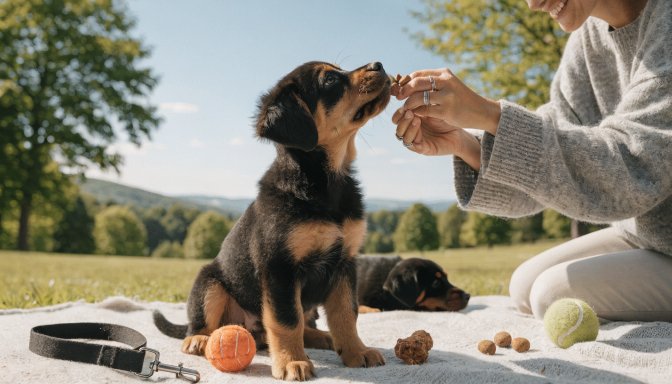
Start socialization at weeks 6–8 with vaccinated dogs in controlled settings. Introduce your puppy to various people—different ages, sizes, voices—while rewarding calm behavior with treats. Expose them to children gradually, supervising interactions closely. Practice bite inhibition through gentle play. Monitor stress signals: tucked tail, excessive yawning, lip licking. Enroll in puppy kindergarten by week 12. Visit public spaces post-16 weeks. Use crate training for security. Reinforce positive associations around food. Continue socialization into adulthood to prevent fear-based aggression. Understanding the specific timelines and techniques transforms everything about your dog’s future temperament.
- Key Takeaways
- Why Rottweilers Become Dangerous Without Early Socialization
- The Critical Socialization Window: Weeks 3–16
- What Reputable Breeders Do Before You Bring Puppy Home
- Who Should Your Puppy Meet First?
- Exposing Puppies to Children Without Triggering Protective Instincts
- Is My Puppy Overwhelmed? Reading Stress Signals
- Safe Dog-to-Dog Introductions: Managing Rottweiler Reactivity
- Desensitizing Puppies to Car Rides and Travel
- Crate Training as a Socialization Tool, Not Just Confinement
- Why Rottweilers Need Extra Noise Desensitization
- Preparing Puppies for Vet Visits and Grooming Handling
- Exposing Puppies to Urban Noise, Stairs, Grass, and Tile
- Pet Store Visits and Public Spaces: Safe First Outings
- Building Confidence Through Controlled Puppy Playdates
- Puppy Kindergarten: Structured Group Socialization
- Early Bite Inhibition: Teaching Soft Mouths and Impulse Control
- Handling Resource Guarding Before It Becomes a Problem
- Rewarding Good Behavior: When and How to Use Treats
- Common Rottweiler Behavioral Challenges: Guarding, Reactivity, and Strength
- Reading Your Puppy’s Body Language: When to Stop and Retreat
- Timing Socialization Around Puppy Shots: What’s Safe?
- Involving All Family Members in the Socialization Process
- Stop Jumping and Body-Slamming Early
- What to Do if Your Puppy Shows Wariness or Defensiveness
- Building a Realistic Socialization Schedule
- Continuing Socialization Into Adulthood: When Puppyhood Ends
- Creating a Sustainable Long-Term Socialization Plan
- Frequently Asked Questions
- Conclusion
Key Takeaways
- Begin socialization during the critical 3-16 week developmental period to establish lasting behavioral patterns and emotional stability.
- Introduce puppies gradually to vaccinated dogs, children, and varied environments while rewarding calm behavior with treats and praise.
- Teach bite inhibition and impulse control commands like “leave it” and “wait” to channel natural behaviors safely.
- Monitor stress signals including yawning, lip licking, tucked tail, and excessive panting; remove puppy immediately if overwhelmed.
- Enroll in puppy kindergarten with similarly-sized, calm dogs to foster positive peer interactions in supervised settings.
Why Rottweilers Become Dangerous Without Early Socialization
Without early socialization, your Rottweiler’s natural protective instincts can spiral into dangerous aggression. During the critical first 16 weeks of life, your puppy’s brain develops rapidly—missing this window creates lasting problems.
Here’s what happens:
Fear-Based Reactions: Unfamiliar people and situations trigger anxiety instead of curiosity. Your Rottweiler misinterprets normal interactions as threats, leading to defensive aggression.
Strength + Wariness = Danger: Unlike smaller breeds, your large Rottweiler can cause serious injury when fearful. Their powerful jaws and muscular build amplify every behavioral issue.
Confusion About Boundaries: Without proper exposure, your dog struggles distinguishing allowable versus suspicious behavior. This confusion creates unpredictable responses.
Socialization prevents these outcomes. Early positive experiences—meeting children, other animals, varied environments—build confidence and reduce aggression risk considerably.
The Critical Socialization Window: Weeks 3–16
You’ve got a narrow window—just 13 weeks—when your Rottweiler puppy’s brain is like a sponge soaking up everything. During weeks 3 to 16, their neural pathways are forming rapidly, which means experiences they’ve now literally wire their confidence and comfort levels for life. Miss this moment, and you’re fighting an uphill battle against fear and protective aggression later.
Optimal Exposure Timeframe
Here’s the thing: puppies in this stage aren’t born fearful—they learn to be. You’re not just playing with your pup; you’re actively building their emotional blueprint through safe encounters with people, sounds, textures, and environments.
The earlier you start (responsible breeders begin before puppies even leave the litter), the better your chances of raising a dog who rolls with the punches instead of seeing threats everywhere.
Foundational Developmental Stage
During the first 16 weeks of life, your Rottweiler puppy’s brain is literally rewiring itself—and you’re holding the remote control.
This critical window shapes everything: temperament, confidence, fear responses. Your puppy’s neural pathways are forming rapidly. Positive experiences now create lasting neural connections that influence adult behavior.
What You’re Building
Puppy socialization during weeks 3–16 establishes your dog’s emotional foundation.
Here’s what happens:
- Week 3–4: Breeders introduce gentle handling and safe sounds
- Week 5–8: Your puppy explores home environments with positive reinforcement
- Week 9–12: You expand exposure to diverse people and settings
- Week 13–16: Your puppy consolidates learning into confident responses
Each positive interaction literally rewires neural pathways—creating well-adjusted adults.
Skip this window? Fear-based behaviors often emerge later.
You’re not just training; you’re building your dog’s brain.
Optimal Exposure Timeframe
During these thirteen weeks, your puppy’s brain absorbs information rapidly. Each positive encounter—a car ride, a friendly stranger, a new environment—creates lasting neural connections.
Miss this window? You’re fighting an uphill battle later.
What You’re Building
Gradual exposure to sights, sounds, and smells prevents fear-based reactions. Introduce gentle handling, diverse people, and other dogs consistently.
Well-socialized puppies distinguish normal situations from genuine threats instinctively.
The Bottom Line
This critical socialization period doesn’t last forever. Start early, stay consistent, and watch your confident Rottweiler emerge.
What Reputable Breeders Do Before You Bring Puppy Home
Before you bring your Rottweiler puppy home, reputable breeders lay essential groundwork across three important areas.
You’ll want to understand how they’re building your puppy’s early socialization foundations—gentle handling starting around week three, exposure to diverse sounds and environments, and positive reinforcement that shapes behavior.
They’re also conducting rigorous health testing standards and temperament development practices, ensuring transparency about health records while fostering littermate interactions that teach fundamental social skills.
Early Socialization Foundations
During this significant early training period, breeders expose puppies to essential experiences:
- Varied stimuli—sounds, sights, and textures that prevent fear responses later
- Gentle handling—positive human contact creating trust and comfort associations
- Environmental exposure—car rides and different spaces fostering adaptability
- Controlled interactions—managed experiences building confidence without overwhelming developing brains
You’re witnessing neuroscience in action. A puppy’s brain develops rapidly during these weeks—missing socialization literally rewires their stress responses.
Well-socialized puppies arrive at your home already comfortable with novelty, reducing behavioral issues dramatically.
Responsible breeders recognize this foundation determines your dog’s entire future. They’re not rushing profits; they’re investing in balanced, confident adults ready for life’s challenges.
Health Testing Standards
While early socialization shapes your Rottweiler’s personality, what happens in the breeder’s veterinary clinic shapes their entire body.
Reputable breeders don’t skip health testing—they embrace it. You deserve transparency about your puppy’s genetic background. These screenings catch hidden problems before they become yours.
| Health Test | What It Checks | Why It Matters |
|---|---|---|
| Hip & Elbow Evaluation | Joint development | Prevents painful arthritis later |
| Cardiac Assessment | Heart function | Catches defects early |
| Ophthalmologist Check | Eye health | Protects vision |
| JLPP Testing | Nerve/throat issues | Identifies genetic paralysis risk |
Responsible breeders require orthopedic rechecks between 12-24 months. They screen breeding adults for Degenerative Myelopathy (DM)—a progressive spinal condition. Quality breeders offer health guarantees backing their commitment.
You’re not just buying a puppy. You’re investing in years of healthy companionship.
Temperament Development Practices
Your Rottweiler’s personality doesn’t magically appear on pickup day—it’s carefully built from week one.
Reputable breeders don’t leave temperament to chance. They actively shape your puppies’ futures through deliberate, science-backed practices. Here’s what ethical breeders do:
- Gentle handling from day one — Starting at three weeks, breeders handle puppies constantly, building comfort with human touch.
- Environmental exposure — Puppies experience car rides, different sounds, and varied settings to create positive associations early.
- Diverse social interactions — Breeders facilitate meetings with children, adults, and other people during the critical first three months.
- Real-world preparation — Crate training and everyday experiences reduce stress before puppies reach their new homes.
This deliberate socialization period rewires puppies’ brains—literally strengthening neural pathways for confidence and adaptability.
When you bring home your well-socialized Rottweiler, you’re getting years of professional development already invested.
Who Should Your Puppy Meet First?
Early socialization isn’t just helpful—it’s critical for your Rottweiler’s future confidence and temperament. You’ll want to introduce your puppy to diverse individuals who’ll shape their comfort levels around humans. Start with familiar family members, then expand systematically.
| Priority Group | Why It Matters | Best Timing |
|---|---|---|
| Family members | Build foundational trust | Weeks 3-8 |
| Children | Learn unique behaviors early | Weeks 6-12 |
| Different-sized adults | Reduce size-based fear responses | Weeks 8+ |
Puppy classes offer controlled environments where your pup meets other dogs and learns proper canine communication. Children deserve special attention—their unpredictable movements and sounds greatly influence future interactions. Introduce various body types and ages gradually using treats and praise. This reinforcement helps your Rottweiler accept different stimuli confidently, building a socially adaptable adult dog ready for real-world situations.
Exposing Puppies to Children Without Triggering Protective Instincts
You’ll want to teach your Rottweiler puppy bite inhibition—basically, how to control jaw pressure—while he’s young and interacting with children.
Managing his excitement level during these playtimes matters tremendously: overstimulated puppies can nip or display protective behaviors that’ll be harder to break later.
Start with calm, supervised interactions, use positive reinforcement (treats and praise work great), and watch for signs of anxiety or defensiveness so you can redirect his energy before protective instincts kick in.
Teaching Bite Inhibition Early
Because Rottweilers are naturally protective dogs with powerful jaws, teaching bite inhibition—the ability to control bite force—is absolutely critical during puppyhood.
You’ll want to establish this foundation early. Here’s your action plan:
- Encourage gentle mouthing while immediately stopping hard bites by withdrawing attention and play.
- Use treats and praise to reward calm, soft interactions with your hands.
- Practice consistent exposure so your pup learns appropriate play boundaries.
- Monitor excitement levels during child interactions, incorporating calm greetings to maintain control.
This training prevents future incidents. When your Rottweiler mouths gently, you’re rewarding impulse control—not aggression.
Think of it as teaching self-awareness. Puppies who understand bite inhibition become trustworthy adults around children.
You’re not suppressing natural behaviors; you’re channeling them safely. Start now, stay patient, and watch your pup develop into a reliable family member.
Managing Protective Instincts Calmly
While your Rottweiler pup’s protective nature is hardwired into their DNA—thanks to centuries of breeding for guarding work—you can shape how they express it around children.
Gradual Exposure Strategy
Introduce Rottweiler puppies to various children systematically. Start with calm, gentle interactions. Expose them to different ages and behaviors progressively. This acclimates your pup to diverse stimuli without triggering defensive responses.
Rewarding Calm Behavior
Use treats and praise liberally. Reward relaxation around kids, not excitement. When your puppy stays composed, they learn that children mean positive outcomes—not threats requiring protection.
Monitoring Play Sessions
Keep greetings controlled and supervised. Maintain focus on your puppy during interactions. Prevent hyper-enthusiasm before it escalates. Early management prevents protective instincts from developing into problematic patterns.
This balanced approach transforms natural guarding tendencies into confident, child-friendly behavior.
Is My Puppy Overwhelmed? Reading Stress Signals
Learning to spot stress signals in your Rottweiler puppy is absolutely essential—it’s like having a built-in translator for their emotional state!
Your puppy communicates overwhelm through specific body language. You’ll notice they’re stressed when they display these key indicators:
- Excessive yawning, lip licking, and turning away signal your pup needs a break immediately.
- Sudden sitting or lying down reveals stress and desire to retreat from overwhelming experiences.
- Tucked tail or raised hackles indicate anxiety or discomfort in their current environment.
- Excessive panting or drooling without physical exertion shows they’re feeling genuinely overwhelmed.
When you spot these signals, remove your puppy from the triggering situation right away. This prevents negative associations with socialization.
Your vigilance helps them adjust positively to new experiences while building their confidence gradually.
Safe Dog-to-Dog Introductions: Managing Rottweiler Reactivity
Your Rottweiler’s first doggy encounters set the foundation for their entire social life—and you’re in control of how they unfold. Start introductions with familiar, calm dogs in controlled environments—never at dog parks initially.
Your Rottweiler’s first doggy encounters set the foundation for their entire social life—and you’re in control of how they unfold.
What You’ll Monitor:
- Growling or stiff body posture signals trouble
- Tail position and ear tension reveal stress levels
- Play style: rough versus appropriate interaction
Your Action Plan:
Use positive dog training techniques immediately. Reward calm behavior with treats and praise when your pup meets new dogs.
Watch for reactivity signs and intervene quickly—poorly managed introductions amplify fear and aggression.
Puppy classes offer structured socialization where your Rottweiler learns proper canine communication safely.
Build confidence gradually through repeated, positive experiences with trustworthy dogs before expanding their social circle.
Desensitizing Puppies to Car Rides and Travel
Many Rottweiler puppies experience genuine anxiety in vehicles—and that’s completely normal. Your pup’s nervousness stems from unfamiliar motion, sounds, and enclosed spaces. The good news? You’ll desensitize them effectively through gradual exposure.
Building Car Confidence
Start with short car rides to acclimate your puppy to movement and vehicle sounds. Here’s your action plan:
- Use a dog crate, barrier, or harness for safety and security.
- Introduce traffic noise gradually during each trip.
- Teach off-limits rules early to prevent car chasing behaviors.
- Monitor comfort levels, adjusting trip duration as needed.
Your Role Matters
Stay calm yourself—puppies sense your anxiety. Short, positive car rides build confidence progressively.
You’re fundamentally rewiring their brain’s response to travel stimuli. Within weeks, your Rottweiler will transform from anxious passenger to relaxed road companion.
Crate Training as a Socialization Tool, Not Just Confinement
You’re about to discover that crate training isn’t just about confinement—it’s actually a powerful socialization superpower that builds your Rottweiler’s confidence from the inside out.
By creating positive associations with the crate early on, you’re giving your puppy a secure “safe space” where they can decompress during new experiences, which directly reduces separation anxiety and fear responses.
Think of it this way: a comfortable crate becomes your puppy’s personal confidence coach, helping them tackle social challenges with calm, steady nerves.
Building Positive Crate Associations
Because puppies’ brains are still developing their threat-detection systems, introducing a crate as a refuge—not a prison—rewires how they process confinement.
Your Strategy for Building Positive Crate Associations
You’re fundamentally reprogramming your Rottweiler puppy’s emotional response to crate training. Here’s how:
- Use high-value treats inside the crate to create immediate positive connections.
- Leave the door open initially so your puppy explores voluntarily without pressure.
- Praise calm behavior consistently, reinforcing relaxation as the desired response.
- Rotate toys strategically to maintain novelty and sustained interest.
Start with brief sessions—five to ten minutes—while you’re home. Your puppy learns the crate isn’t abandonment; it’s security.
Remove collars beforehand. This simple act eliminates hazards and demonstrates you prioritize their safety.
When building positive crate associations, you’re not just training; you’re building trust. Your consistency transforms confinement into comfort.
Social Confidence Through Safe Spaces
Your crate transforms from a confinement tool into a confidence-building sanctuary—a psychological anchor that helps your Rottweiler puppy navigate the overwhelming world of socialization.
Why Safe Spaces Matter During Socialization
Your puppy’s brain develops rapidly during weeks 3-16. During this critical window, controlled environments prevent sensory overload.
Think of the crate as your puppy’s personal decompression chamber—a retreat when new experiences feel too intense.
Strategic Observation Points
You’ll position the crate near new stimuli: unfamiliar sounds, visitors, other dogs.
Your puppy observes safely from distance, gradually building confidence without forced interaction. This approach reduces anxiety-related behaviors while promoting natural curiosity.
Building Real Socialization
Short crating periods actually enhance socialization outcomes.
Your consistent use signals: “This space is yours. You’re secure.”
Your puppy learns resilience—not avoidance—transforming the crate into a confidence catalyst for lifelong social success.
Why Rottweilers Need Extra Noise Desensitization
When a Rottweiler’s protective instincts meet an unfamiliar sound, their brain can shift into high alert—and that’s where problems start. You’re dealing with a breed hardwired for vigilance, which means noise desensitization isn’t optional—it’s essential.
Here’s why your pup needs extra attention:
Your Rottweiler needs extra attention because their protective nature amplifies startle responses to unexpected noises.
- Their protective nature amplifies startle responses to unexpected noises.
- Untreated sound anxiety triggers aggressive or fearful reactions later.
- Early exposure before 16 weeks shapes lifelong confidence levels.
- Positive reinforcement during noise exposure prevents behavioral issues.
Without gradual sound introduction, your Rottweiler develops heightened sensitivity. You’ll notice them reacting aggressively to vacuum cleaners, thunderstorms, or fireworks.
The good news? Strategic noise desensitization—using treats, praise, and calm exposure—teaches your puppy that unfamiliar sounds aren’t threats. This investment pays dividends throughout their entire life.
Preparing Puppies for Vet Visits and Grooming Handling
Just like noise desensitization builds confidence around sounds, early vet and grooming exposure builds confidence around handling—and it’s equally critical for Rottweilers.
Making Vet Visits Positive
Transform vet visits into enjoyable experiences by bringing high-value treats and playing outside the clinic before appointments.
During vet visits, encourage your puppy to explore the waiting area and practice being weighed. This familiarity reduces anxiety considerably.
Building Grooming Comfort
Gradually introduce grooming tools using treats and praise.
Start with brushing sessions at home, then schedule groomer visits for environmental acclimation—your puppy encounters new sights, sounds, and smells in a controlled way.
Monitoring Progress
Watch your puppy’s reactions closely throughout these introductions.
Use positive reinforcement whenever you notice relaxed behavior.
This pattern—exposure plus rewards—creates lasting confidence around necessary handling procedures that’ll last their entire lives.
Exposing Puppies to Urban Noise, Stairs, Grass, and Tile
Between 8 and 16 weeks of age, your Rottweiler’s brain is like a sponge—absorbing everything it encounters and filing those experiences away as either “safe” or “scary” for life.
Between 8 and 16 weeks, your Rottweiler’s brain absorbs everything, filing experiences as either “safe” or “scary” for life.
You’ll want to expose your puppy strategically during this critical window.
Building Sensory Confidence
Create diverse experiences that shape your pup’s future comfort:
- Urban sounds: Play traffic, sirens, and crowd noises at low volumes, gradually increasing intensity.
- Stair training: Start with low steps, building physical coordination and confidence progressively.
- Texture exploration: Let your puppy walk on grass, tile, and concrete surfaces regularly.
- Positive reinforcement: Use treats and praise immediately after each exposure.
This approach prevents anxiety and fear responses.
Your Rottweiler develops resilience—not recklessness.
You’re fundamentally programming their nervous system for urban living success.
Pet Store Visits and Public Spaces: Safe First Outings
Your puppy’s next big adventure starts at the pet store—a controlled environment packed with novel sights, sounds, and smells that’ll challenge their developing brain.
Starting Small with Pet Store Visits
Begin with brief 10-15 minute visits to pet-friendly stores. Your Rottweiler’s amygdala—the fear center—needs gradual exposure, not shock.
Watch for stress signals: tucked tail, excessive panting, or hesitation.
Building Positive Associations
Use high-value treats during pet store visits. Reward calm behavior near displays, unfamiliar sounds, and other animals.
This creates favorable neural pathways—essentially rewiring their instinctive wariness into curiosity.
Expanding Your Horizons
Progress to diverse public spaces: parks, farmer’s markets, community events. Each environment strengthens impulse control and confidence.
Confirm full vaccination before dog parks.
Practice obedience commands amid distractions. Your well-mannered puppy becomes an adaptable, confident adult Rottweiler.
Building Confidence Through Controlled Puppy Playdates
You’ve made it past those initial outings—now it’s time to strategically choose playdate partners and manage interactions so your Rottweiler pup gains real confidence.
You’ll want to select calm, vaccinated, similarly-sized dogs whose owners understand your puppy’s developmental stage (typically weeks 3-16 mark critical socialization windows).
Selecting Appropriate Playdate Partners
Three critical factors determine whether playdates build your Rottweiler puppy’s confidence or derail their social development: the playmate’s temperament, size compatibility, and energy level.
Evaluating Your Playdate Partners
You’ll want to select well-adjusted, socialized dogs who model appropriate behaviors. Here’s what matters most:
- Temperament screening — Choose calm, friendly dogs without aggression histories or fear-based reactions.
- Size matching — Pair your puppy with similarly-sized companions to prevent intimidation or accidental injuries.
- Energy alignment — Match playful puppies with equally enthusiastic partners, not exhausted or overly dominant dogs.
- Behavioral compatibility — Observe how potential playdate partners interact with other dogs before committing.
These playdate partners become your puppy’s social teachers. A well-chosen companion demonstrates bite inhibition, appropriate play-bowing, and healthy conflict resolution.
Your puppy’s nervous system literally rewires through positive interactions—making partner selection your most powerful socialization tool.
Managing Positive Play Interactions
Once you’ve selected the right playdate partner, the real work begins—orchestrating interactions that build confidence rather than trigger fear.
Start Small, Build Big
Your puppy can become more comfortable through gradual exposure. Begin with 10-15 minute sessions, then extend duration as confidence grows.
Short encounters prevent overwhelm—Rottweilers’ sensitive temperaments need pacing.
Watch for Warning Signs
Monitor body language constantly. Intervene early if you spot stiff postures, raised hackles, or growling.
Redirect attention immediately using treats and praise for calm behavior.
Reward Good Manners
Positive reinforcement works brilliantly here. When your puppy demonstrates appropriate play—gentle mouthing, play bows, taking breaks—reward instantly.
This creates associations: socialization equals good things.
Match Energy Levels
Pair your Rottweiler with similarly-energized playmates.
Mismatched intensity breeds frustration and fear, undermining socialization goals.
Puppy Kindergarten: Structured Group Socialization
Structured puppy kindergarten classes aren’t just playtime—they’re your Rottweiler’s first classroom for learning essential social skills.
You’ll witness your pup’s confidence blossom as they navigate diverse canine personalities and body language. Here’s what makes puppy kindergarten transformative:
- Supervised play sessions build positive peer interactions in controlled environments, preventing fear-based aggression later.
- Exposure to different breeds and sizes teaches your Rottweiler adaptability—crucial since they’ll encounter varied dogs throughout life.
- Positive reinforcement training strengthens your bond while managing behavior effectively through consistent, reward-based methods.
- Early socialization prevents behavioral issues that under-socialized dogs commonly develop, creating well-mannered companions.
Your participation matters tremendously.
Consistent attendance demonstrates that social experiences are normal, safe, and rewarding.
Puppies absorb your calm energy—anxiety transfers quickly.
This investment now? It’s worth every penny for a confident, well-adjusted adult dog.
Early Bite Inhibition: Teaching Soft Mouths and Impulse Control
While puppy kindergarten builds your Rottweiler’s social confidence around other dogs, there’s another critical skill demanding your attention at home: bite inhibition.
Start Early—Really Early
Begin at 8 weeks old. Your puppy’s jaw strength will eventually reach 328 PSI—that’s serious power.
Early training prevents accidental injuries later.
The Soft Mouth Technique
Reward gentle bites immediately with praise and treats. When your puppy bites hard, say “no” firmly and stop playing.
They’ll learn: soft mouths get attention; hard mouths lose it.
Build Impulse Control
Teach “leave it” and “wait” commands.
These phrases help your Rottweiler manage excitement during high-energy moments—exactly when accidents happen.
Redirect to Toys
Encourage play with toys, not hands.
This association teaches appropriate play boundaries that stick for life.
Consistency matters.
You’re building neural pathways today that protect everyone tomorrow.
Handling Resource Guarding Before It Becomes a Problem
Resource guarding—that territorial behavior where your puppy growls over food or toys—isn’t a dominance issue or a sign of a “bad dog.”
It’s actually a survival instinct hardwired into their DNA from their wolf ancestors, who’d to protect meals to survive.
You can prevent resource guarding from becoming a serious problem through early intervention:
- Start positive associations by rewarding your puppy when people approach during meals
- Practice “leave it” commands to give them control and clear expectations
- Gradually decrease distance others can approach while they eat, building comfort slowly
- Vary environments regularly so they learn safety extends everywhere, not just home
This proactive approach teaches your Rottweiler that people near resources mean good things happen—not threats.
Rewarding Good Behavior: When and How to Use Treats
You’ve got seconds—literally—to reward your pup’s good behavior and lock it into their brain. Your timing and treat choices make the difference between a well-trained Rottweiler and one who’s confused about what you actually want.
Let’s explore how to nail both elements so your puppy learns fast and stays motivated.
Timing Treats For Success
The split-second matters more than you’d think. Your Rottweiler’s brain forms associations lightning-fast—within milliseconds of performing desired behavior. Here’s why precision timing transforms your training:
- Immediate delivery creates clear mental connections between action and reward.
- Quick rewards prevent interrupting training flow or momentum.
- Consistent timing strengthens neural pathways—literally rewiring puppy brains.
- Split-second precision maximizes treat effectiveness in distracting environments.
Use small, chewable treats for rapid delivery. Your puppy’s dopamine (a brain chemical) spikes instantly when rewarded correctly. That biological response? It’s pure motivation gold.
Watch closely during sessions. The moment your Rottweiler sits, lies down, or responds—treat immediately.
Hesitation breaks the connection. Your timing isn’t just helpful; it’s absolutely essential for successful training and lasting obedience.
High-Value Reward Selection
Small pieces of cooked chicken or cheese work exceptionally well for Rottweiler puppies. These high-value rewards trigger dopamine release—the brain chemical that reinforces learning. Your puppy’s reward system literally lights up.
Why Size and Quality Matter
Tiny, easily consumable treats keep your puppy focused. Large treats break concentration and derail training momentum.
High-value rewards should be special—reserved specifically for socialization sessions, not given freely.
Rotating Your Rewards Strategy
Puppies lose interest in repetitive rewards.
Switching between chicken, cheese, and freeze-dried liver maintains excitement and engagement.
This variety prevents boredom while maximizing motivation during challenging new experiences.
Common Rottweiler Behavioral Challenges: Guarding, Reactivity, and Strength
Your pup faces three main challenges requiring your attention:
- Guarding behavior manifests as resource protection; consistent commands teach appropriate responses.
- Reactivity toward unfamiliar dogs develops without early canine socialization; diverse settings prevent aggression.
- Physical strength creates leash-pulling problems; focused training guarantees safety for inexperienced handlers.
- Bite inhibition gaps in puppies need immediate addressing; mouthiness prevention builds safer interactions.
Under-socialized Rottweilers develop wariness and aggression—don’t let that become your reality.
Ongoing socialization throughout their lives transforms natural protective instincts into reliable, confident behavior.
You’ve got this.
Reading Your Puppy’s Body Language: When to Stop and Retreat
Body language—it’s your puppy’s honest truth when words can’t speak.
Stress Signals You Can’t Ignore
Your puppy communicates discomfort through specific physical cues. Watch for:
- Tail tucking between hind legs
- Ears pinned back against the head
- Lip licking, yawning, or head turning away
- Stiff body posture with raised hackles
Vocalizations Matter Too
Growling or barking doesn’t always mean aggression. Often, these sounds signal anxiety or your puppy’s need for space. When you hear them, back off immediately.
The Comfort Zone
Relaxed postures—loose wagging tails, soft eyes—indicate your puppy feels safe. Conversely, escape attempts or hiding behaviors demand respect for their boundaries.
Your Action Plan
Stop interactions when stress appears. Change environments. Give breaks.
Your puppy’s emotional safety builds stronger socialization long-term.
Timing Socialization Around Puppy Shots: What’s Safe?
Once your vet gives the green light, you’re ready to strategically expand your Rottweiler’s world. Timing socialization around puppy shots is essential for healthy puppies and responsible pet ownership.
Your Vaccination-Socialization Timeline:
- 6-8 weeks: Start safe socialization at home with vaccinated dogs only—this builds early confidence.
- 12 weeks: After your puppy’s booster shots, visit pet-friendly stores and controlled environments safely.
- 16 weeks: Complete vaccinations access public dog parks, where unvaccinated dogs might gather.
- Beyond 16 weeks: Continue confidence-building through positive experiences with diverse people, sounds, and environments.
Your Rottweiler’s first vaccinations aren’t just about preventing illness—they’re your golden ticket to responsible socialization.
Vaccinations protect your puppy’s health while unlocking the door to safe, responsible socialization experiences.
Don’t rush public dog parks too early; waiting protects your puppy’s developing immune system. Healthy puppies who receive proper vaccinations enjoy safer exposure during their critical socialization window, setting them up for well-adjusted adult life.
Involving All Family Members in the Socialization Process
Socialization isn’t a solo project—it’s a whole-family endeavor that transforms your Rottweiler puppy into a genuinely well-adjusted dog. When all family members participate, you’re fundamentally multiplying your puppy’s learning opportunities. Each person introduces different voices, handling styles, and energy levels—crucial for developing confidence.
| Family Member | Socialization Role | Key Benefit |
|---|---|---|
| Parent | Structured training sessions | Reinforces commands consistently |
| Siblings | Playful interactions | Teaches appropriate greeting behavior |
| Grandparents | Gentle handling | Builds comfort with diverse ages |
Your kids can teach your puppy to focus during greetings. Grandparents provide calmer interactions. Everyone uses treats and praise, creating positive associations. This variety prevents your Rottweiler from bonding too intensely with one person—a common issue with large breeds historically bred for pack work.
Stop Jumping and Body-Slamming Early
You’ll want to tackle jumping early—before your Rottweiler’s size makes it dangerous.
Start with calm greeting protocols like requiring a sit before attention, then redirect that boundless energy through consistent training commands and focused practice.
Finally, reinforce polite behavior every single time with treats and praise, so your pup learns that four paws on the ground gets the real rewards.
Establish A Calm Greeting Protocol
Early greetings shape your Rottweiler’s entire social future. You’re literally rewiring your puppy’s brain during these critical moments—neuroscience proves repetition builds neural pathways. A calm dog develops confidence, not anxiety.
Your Greeting Protocol:
- Teach your pup to sit before any interaction begins.
- Use treats and praise when they remain composed around visitors.
- Maintain eye contact to focus their attention on you, not strangers.
- Practice supervised introductions with select individuals gradually.
You’ll redirect jumping attempts using a consistent “off” command. Reward calm behavior immediately—timing matters. This establishes crystal-clear expectations: sitting politely earns attention; jumping doesn’t.
Think of it like this: you’re the director of their social movie. Every greeting rehearsal either reinforces good manners or accidentally rewards chaos.
Your Rottweiler learns fast. Make those early interactions count by staying consistent and enthusiastic about their progress.
Redirect Energy Through Training
Sitting politely at the door is just the beginning—now comes the real work.
You’ll redirect energy through training by channeling your Rottweiler’s natural power into structured activities.
Structured Activities Work Best
Rottweilers possess significant muscle mass and drive—they’re literally built for work.
Obedience training and agility exercises burn mental and physical energy simultaneously. Your puppy can’t jump when focusing on commands.
The Energy Formula
- Daily training sessions (15-20 minutes)
- Agility obstacles and jumps
- Fetch and retrieval games
- Swimming exercises
Why This Matters
A tired Rottweiler is a well-behaved Rottweiler.
When you redirect their explosive energy constructively, jumping becomes unnecessary.
Consistent practice teaches impulse control while strengthening your bond.
You’re fundamentally giving that powerful body a productive purpose—preventing destructive behaviors before they start.
Reinforce Polite Behavior Consistently
Stop jumping before it becomes a 200-pound problem.
Your Rottweiler’s jumping behavior requires immediate, consistent intervention. Here’s how to reinforce polite behavior consistently:
- Teach “sit” before greetings — This replaces jumping with calm, controlled positioning.
- Use positive association — Reward sitting with treats, praise, or affection immediately.
- Practice in training classes — Structured environments help your pup learn appropriate social conduct.
- Redirect consistently every time — No exceptions; mixed signals undo progress.
Rottweilers possess powerful leg muscles that give them natural jumping ability. When they’re puppies, this seems cute.
At 200 pounds? It’s dangerous.
Positive reinforcement works because dogs make mental connections between actions and rewards. Your pup learns: polite behavior equals good things happen.
Family members and friends should practice these controlled greetings too. Consistency matters most—everyone uses the same rules, creating a predictable, safe environment where your Rottweiler thrives socially.
What to Do if Your Puppy Shows Wariness or Defensiveness
When your Rottweiler puppy backs away, growls, or shows stiff body language around new people or situations, you’re witnessing a natural—but manageable—response.
Building Confidence Through Strategic Exposure
Wariness and defensiveness stem from unfamiliar stimuli triggering your puppy’s protective instincts. You’ll transform your puppy into a confident dog by controlling the pace and environment.
| Strategy | Action |
|---|---|
| Assess triggers | Identify what causes wariness |
| Reduce intensity | Move to calmer settings |
| Reward calmness | Use treats and praise |
| Gradual exposure | Introduce stimuli slowly |
Your Action Plan
Start in low-pressure environments. Pair new experiences with high-value rewards. Supervise all interactions closely, redirecting defensive behavior before escalation occurs.
When to Seek Help
If wariness persists despite consistent effort, consult a veterinarian or professional animal behaviorist. They’ll provide tailored strategies addressing your puppy’s specific needs and temperament.
Building a Realistic Socialization Schedule
Because your Rottweiler puppy‘s brain is most receptive during the first three months of life—a period scientists call the “critical socialization window”—you’ll want to act fast.
Your puppy’s neurological development during this phase determines future confidence and temperament.
Here’s how to build a practical schedule:
- Week 1-4: Introduce family members, household sounds, and safe indoor environments
- Week 5-8: Add supervised interactions with vaccinated dogs and varied textures
- Week 9-12: Gradually expose your puppy to pet-friendly stores, parks, and crowds
- Week 13+: Continue diverse experiences—different people, surfaces, and settings
Start small. Overwhelm backfires.
You’re not cramming experiences into weeks; you’re strategically layering them. Each positive encounter builds neural pathways that reinforce confidence.
Think marathon, not sprint. Your realistic schedule prevents burnout while maximizing socialization benefits throughout puppyhood.
Continuing Socialization Into Adulthood: When Puppyhood Ends
Your Rottweiler’s critical socialization window closes around 16 weeks—but here’s the thing: socialization doesn’t stop there.
Why Continuing Socialization Into Adulthood Matters
You’ll want to maintain ongoing exposure throughout your dog’s life.
Adult Rottweilers benefit tremendously from structured interactions with new people, dogs, and environments. This prevents fearfulness and behavioral issues down the road.
Your Adult Rottweiler’s Social Toolkit
Pair diverse experiences with positive reinforcement—treats and praise build lasting confidence.
Introduce your dog to well-socialized older dogs; they’ll teach appropriate canine behavior naturally.
Addressing Under-Socialization
Did your Rottweiler miss early socialization? Gradual reintroduction works.
Supervised exposure to new situations—combined with encouragement—helps adult dogs overcome social challenges.
Remember: a well-adjusted Rottweiler stays that way through consistent, lifelong engagement with their world.
Creating a Sustainable Long-Term Socialization Plan
Sustaining your Rottweiler’s social confidence requires deliberate planning—not random outings. You’ll build on the foundation you created during puppyhood by maintaining consistent socialization throughout their life.
Your Long-Term Strategy
- Schedule monthly outings to varied environments—parks, pet stores, beaches—ensuring your adult dog encounters fresh stimuli regularly.
- Enroll in advanced training classes annually to reinforce social skills and prevent behavioral regression as your dog matures.
- Rotate social partners: invite different people over, arrange playdates with various dogs, and expose your Rottweiler to diverse ages and personalities.
- Monitor stress signals—pinned ears, tension—and adjust exposure levels accordingly, keeping all encounters positive through treats and praise.
Consistency matters. Your Rottweiler’s adaptability depends on ongoing exposure.
Think of socialization as lifelong maintenance, not a puppy phase checkbox. You’re investing in a confident, well-adjusted companion who navigates life’s unpredictability with ease.
Frequently Asked Questions
How Do I Socialize My Rottweiler Puppy?
You’ll socialize your Rottweiler puppy by exposing them to diverse people, environments, and sounds before 16 weeks. Use treats and praise during supervised interactions with other dogs, children, and new settings to build positive associations.
What Is the 7 7 7 Rule for Puppies?
You expose your puppy to seven different experiences—people, places, sounds, and objects—at least seven times each during the first seven weeks. This builds confidence and reduces anxiety as your puppy matures.
What Is the 3-3-3 Rule for Puppies?
Your puppy’s adjustment unfolds like a blooming flower. The 3-3-3 rule shows you that within three days they’re disoriented, three weeks they’re settling in, and three months they’ve flourished into their true self with confidence.
What Is the 10 10 10 Rule for Puppies?
You expose your puppy to 10 different people, 10 different dogs, and 10 different environments by 10 weeks old. You’re building positive associations that reduce behavioral issues and create a well-adjusted, confident dog.
Conclusion
You’re building a bridge—not a wall—between your puppy and the world. Early socialization? It’s your foundation. Without it, you’re constructing on sand. But here’s the truth: you’ve got this. Consistent exposure, patience, and realistic expectations transform potential into possibility. Your pup isn’t born dangerous; you’re choosing to raise them confident, calm, and trustworthy. That’s powerful.