Some of the links in this post are affiliate links. This means we may earn a small commission if you make a purchase through these links—at no extra cost to you. We only recommend products and tools that we genuinely believe will help you with your Rottweiler.
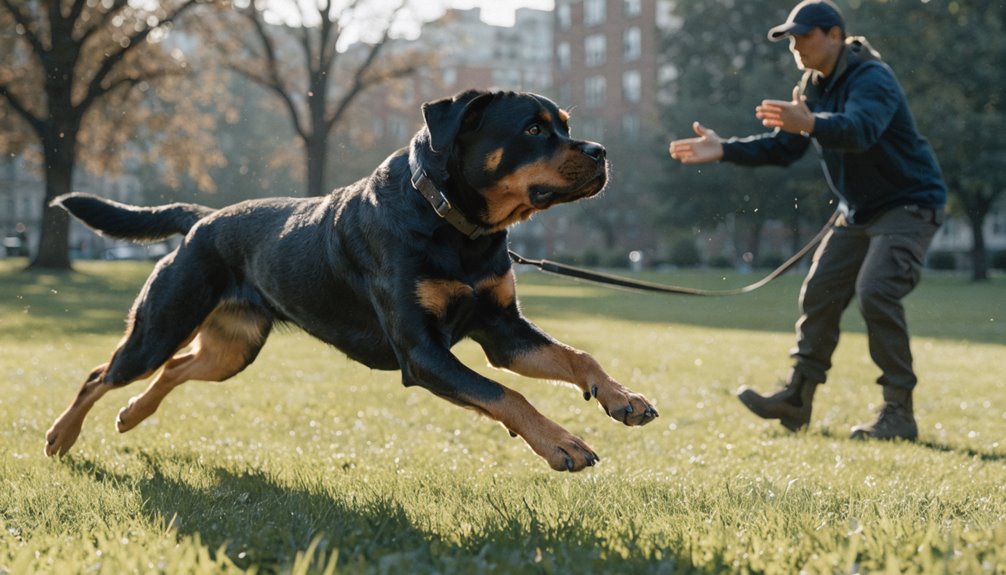
Reliable Rottweiler recall starts with charging a distinct cue—like a loud, happy “Come!”—by pairing it consistently with high-value treats like chicken or cheese. Practice in short 5–10 minute sessions in low-distraction spaces with a long-line attached, rewarding every successful response immediately. Once you’ve confirmed 90–100% success across three different locations at 20–50 feet, you can attempt off-leash work in fully enclosed areas. The sequence matters: distance first, then duration, then distractions, because their protective instincts and prey drive demand methodical structure, not shortcuts. Understanding the specific progression that prevents cue poisoning reveals why most recall training fails.
- Key Takeaways
- What Makes Reliable Recall Training Work for Rottweilers
- Start Recall Training With a Long Line in Low-Distraction Settings
- Charge Your Recall Cue With High-Value Rewards
- Layer Distance, Duration, and Distractions in Order
- Don’t Ruin Your Recall Cue: Mistakes to Avoid
- Generalize Recall Across 5 Different Environments
- Know When Your Rottweiler Is Ready for Off-Leash
- Your First Off-Leash Sessions: What to Expect
- Frequently Asked Questions
- Conclusion
Key Takeaways
- Charge recall cue with loud, happy voice paired with high-value treats until dog anticipates coming reliably before real-world use.
- Practice 5–10 minute sessions two to three times daily, rewarding every successful response immediately to build consistent habit strength.
- Use 15–50 foot long-line across three distinct locations with increasing distractions before attempting off-leash to ensure safety and control.
- Progress systematically: distance first, then duration, then distractions; advance only after 90–100% success at current level to prevent failure.
- Monitor body language for focused ears and soft eye contact indicating readiness; reattach long-line immediately if fixation or ignoring occurs.
What Makes Reliable Recall Training Work for Rottweilers
Because Rottweilers have strong prey drive and protective instincts, their recall reliability doesn’t happen by accident—it’s built through early, frequent practice that establishes a distinct cue (like a loud, happy “Come!”) as a reliable predictor of better outcomes than any distraction in the environment.
You’ll charge this cue by pairing it consistently with high-value treats like chicken or toy play, so your dog learns the command signals something genuinely worthwhile.
Practice progresses from low-distraction indoor recalls to long-line sessions spanning 20–50 feet across multiple locations before you ever consider off-leash work.
This structure makes certain your Rottweiler generalizes recall reliably, building the consistency and reinforcement necessary for real-world obedience in varied, unpredictable situations.
Start Recall Training With a Long Line in Low-Distraction Settings
Now that you’ve established the foundation for reliable recall—understanding how Rottweilers learn and what motivates them—you’re ready to put that knowledge into practice with a structured, controlled approach.
Begin in low-distraction environments like quiet rooms, fenced yards, or empty parking lots where you can safely maintain distance while keeping control. Attach a 15–30 ft long-line to your dog’s collar, then use high-value treats such as chicken, cheese, or hot dog pieces to reward every successful response.
Work in short 5–10 minute sessions, two to three times daily, gradually increasing distractions only after your Rottweiler demonstrates consistent success at the current location and distance. This methodical progression builds reinforcement and reliability before advancing to more challenging environments.
Charge Your Recall Cue With High-Value Rewards
The foundation of reliable recall rests on building a strong, positive association between your chosen word and exceptional rewards, a process called “charging” the cue.
Reliable recall begins with charging your cue: pairing your chosen word with exceptional rewards until your dog anticipates it eagerly.
Start while your Rottweiler is relaxed and unfocused, saying your recall word in a loud, cheerful voice immediately before delivering high-value treats like cooked chicken or steak bites. Repeat this sequence until your dog shows keen anticipation when hearing the word.
Vary your rewards unpredictably—sometimes one treat, sometimes a handful or a favorite toy—to maintain strong positive expectancy.
Never use the cue when your dog is unlikely to respond, as this creates learned irrelevance. If your recall word becomes associated with negative outcomes, it becomes a poisoned cue; retire it and charge the behavior using an entirely new word.
Layer Distance, Duration, and Distractions in Order
Once your Rottweiler shows keen anticipation for the recall word and you’ve confirmed the cue is positively charged, you’re ready to build reliability by layering in distance, duration, and distractions—but only in that specific order, and only when your dog meets a clear success threshold at each stage.
Start with these four sequential steps:
- Begin recalls at 1–3 feet indoors, advancing distance only after 90–100% success across multiple sessions
- Add duration by requesting 2–5 second waits before releasing to come, gradually extending to 30–60 seconds
- Introduce low-level distractions like a walking person once distance and duration prove reliable
- Progress to medium distractions such as another leashed dog only after achieving 90%+ success
This structured approach prevents overwhelm and maintains consistency, ensuring your Rottweiler’s recall stays dependable across real-world situations.
Don’t Ruin Your Recall Cue: Mistakes to Avoid
You’ve built distance, duration, and distractions into your training with care, but even a well-structured recall can break down if you make common mistakes during the process itself.
The most damaging error is calling your recall cue repeatedly without reward—calling three, four, or five times teaches your dog that the word predicts nothing, which poisons the cue permanently. Similarly, never pair your recall cue with negative outcomes like punishment, play-ending, or leash attachment, since your dog will learn that coming means bad things happen. Avoid intimidating body language or dramatic approaches that create fear.
If you’ve already poisoned the cue through overuse or negative pairing, stop using that word entirely and introduce a fresh recall cue paired with genuine positive reinforcement and short, reliable success.
Generalize Recall Across 5 Different Environments
Reliable recall isn’t truly reliable until your Rottweiler performs it consistently across many different environments, because dogs don’t automatically transfer a behavior learned in one place to another—a dog who comes perfectly in your living room may ignore the same cue in a busy parking lot or wooded trail, where new sights, sounds, and smells compete for attention.
To build this consistency, you’ll practice long-line recall in at least five distinct locations:
- Living room (minimal distractions)
- Fenced yard (mild outdoor stimuli)
- Quiet neighborhood park (moderate distractions)
- Wooded trail (natural environmental complexity)
- Busy parking area (maximum distractions)
Start each location at short distances with high-value rewards, logging 10–20 successful recalls before increasing difficulty.
Vary the time of day and weather conditions to reinforce generalization.
Only progress when your Rottweiler demonstrates 9–10 consecutive successes consistently.
Know When Your Rottweiler Is Ready for Off-Leash
Before you remove the long-line entirely, your Rottweiler must demonstrate consistent recall success across multiple real-world scenarios, because the jump from a 15–20 foot line to true off-leash freedom represents a dramatic shift in risk and control.
You’ll want to confirm consistent long-line recall at 20–50 feet in at least three distinct locations with progressively higher distractions before considering the changeover. Aim for 99% reliability—your dog returns immediately 9–10 out of 10 trials and accepts gentle handling without hesitation.
Watch for calm responses when leaving distractions. Because Rottweilers carry strong prey drive and variable focus, keep the long-line nearby during early off-leash outings, using it intermittently across several sessions until you’ve logged many varied successes in safe, fenced environments.
Your First Off-Leash Sessions: What to Expect
You’ll want to start your first off-leash sessions in a secure, low-distraction environment like a fenced yard or quiet field, keeping initial sessions short (5–15 minutes) so your Rottweiler doesn’t become overwhelmed or lose focus.
Watch carefully for signs of readiness—your dog should stay relatively close to you, check in periodically, and respond quickly to your “Come!” calls even when mildly distracted, which tells you the long-line foundation work has taken hold.
If your Rottweiler ignores you, fixates on a hole or animal, or drifts too far away, you’ll immediately reattach the long-line and lower the challenge level, since these behaviors signal you need more structured practice before expanding off-leash freedom.
Starting In Secure Areas
When your Rottweiler has demonstrated consistent long-line recalls at a specific location, you’re ready to remove the leash entirely—but only in a fully enclosed, secure environment like a fenced yard, indoor hallway, or gated dog park. This controlled setting lets you reinforce the behavior without external risks, creating the foundation for reliable recall habits.
Start with these essential steps:
- Begin with 5–10 minute sessions to prevent overwhelm
- Practice recalls every 1–2 minutes using a loud, happy “Come!”
- Reward immediately with high-value treats like chicken or cheese
- Monitor exploration range, expecting 10–30 feet before return
Early sessions show variable results—your dog may test boundaries or fixate on distractions. If recalls fail or focus lapses, reattach the long-line immediately, reduce environmental distractions, and shorten your next session, reinforcing consistency through structured repetition across multiple secure locations.
Reading Your Rottweiler’s Readiness
Most dogs aren’t ready for off-leash work until you’ve confirmed reliable long-line recalls across at least three different locations and contexts—your home yard, a quiet park, and a short hike—because consistency across varied settings signals that your Rottweiler understands the command regardless of environment or distraction level.
Once you’ve established this foundation, watch your dog’s body language carefully during early off-leash trials. Focused ears, a loose tail, and soft mouth contact indicate readiness to engage and respond. Conversely, intense fixations, a crouched body posture, or absence of eye contact suggest your Rottweiler’s attention is captured by distractions or prey drive, meaning you’ll need more long-line practice before attempting freedom.
Keep high-value treats nearby, and if your dog fails a recall, immediately reattach the long-line and reduce the level of distraction for additional structured work.
Frequently Asked Questions
What Is the 7 7 7 Rule With Dogs?
You practice recall training in three progressive stages: 7 feet with high-value rewards, then 7 yards on a long-line, then 7 different locations or times. This builds generalization and prevents context-specific learning.
How to Train Dog Recall at Home?
Studies show 73% of dogs respond better to recall training in low-distraction environments. You’ll start indoors, use a distinct cue like “Come,” reward every success with high-value treats, then gradually increase distance and distractions using a long-line.
What Is the 3-3-3 Rule for Dog Training?
You practice recall for 3 minutes per session, 3 times daily, for 3 days in one environment before increasing difficulty. This prevents fatigue, builds reliable patterns, and keeps your dog’s motivation high.
Can You Teach Any Dog Recall?
You’d think Rottweilers can’t learn recall, but you’re wrong. You can teach any dog reliable recall with consistent positive reinforcement, progressive distractions, and long-line practice across multiple locations until proven.
Conclusion
You’ve now built a bulletproof recall by progressively practicing patience, precision, and persistence through structured sessions. Your Rottweiler’s reliable response reflects your consistent reinforcement and careful control of conditions. Remember, recall remains a continuous commitment, not a completed checkpoint. Periodically practice these proven principles, stay vigilant about maintaining your cue’s value, and you’ll preserve the powerful partnership you’ve purposefully developed.