Some of the links in this post are affiliate links. This means we may earn a small commission if you make a purchase through these links—at no extra cost to you. We only recommend products and tools that we genuinely believe will help you with your Rottweiler.
Your Rottweiler’s high-drive temperament requires consistent mental engagement to prevent boredom-related destructive behaviors like excessive barking, chewing, or escape attempts. Mental activities—puzzle feeders, scent work, and hide-and-seek games—tire their brain as effectively as physical exercise while building focus and confidence. Incorporate 15–30 minute daily sessions using scatter feeding, snuffle mats, and nose games; these methods transform routine mealtimes into problem-solving opportunities. Early recognition of frustration signals allows you to adjust difficulty and prevent stress. Understanding how to structure these activities by age guarantees long-term health and a calmer household.
- Key Takeaways
- Why Mental Stimulation Matters for Rottweilers
- Recognizing Boredom: Signs and Behavioral Red Flags
- Quick Wins: Scatter Feeding and Snuffle Mats
- Puzzle Feeders: Mental Stimulation Through Problem-Solving
- Scent Work: Harnessing Your Dog’s Natural Hunting Instincts
- Training and Tricks for Focus and Confidence
- Obstacle Courses: Problem-Solving Through Navigation
- Hide-and-Seek and Find-It Games
- Toy Rotation Strategies to Prevent Boredom
- Create Your Weekly Enrichment Plan
- Safety and Age Guidelines
- Frequently Asked Questions
- Conclusion
Key Takeaways
- Puzzle feeders and scatter feeding transform meals into 10–30 minute problem-solving sessions that mentally tire your Rottweiler effectively.
- Daily nose games and scent work leverage their powerful sense of smell to provide mental fatigue comparable to physical exercise.
- Rotate 6–8 toys weekly with hide-and-seek games to maintain novelty and prevent boredom-related destructive behaviors.
- Watch for excessive barking, destructive chewing, or restlessness—early signs indicating your dog needs increased mental enrichment.
- Structure three daily 15–30 minute mental sessions combining training tricks, snuffle mats, and interactive games for optimal engagement.
Why Mental Stimulation Matters for Rottweilers
Because Rottweilers are a high-drive working breed, they’re naturally inclined toward activity and problem-solving, which means they’ll struggle without regular mental stimulation. When you don’t provide adequate engagement, they’ll develop destructive behaviors like chewing, excessive barking, and escape attempts as outlets for their restless energy.
Mental stimulation works differently than physical exercise—it tires their brain through activities like scent work, puzzle toys, and obedience training, directly reducing hyperactivity and related problems. You’ll notice that consistent daily mental enrichment improves their cognitive function and confidence while lowering anxiety.
Structured activities such as 15–30 minute obstacle courses or focused training sessions prevent boredom effectively, creating a calmer, more well-behaved dog. This consistency strengthens your bond and establishes the behavioral foundation your Rottweiler needs to thrive.
Recognizing Boredom: Signs and Behavioral Red Flags
Now that you understand why mental stimulation matters, you’ll need to recognize when your Rottweiler isn’t getting enough, because the signs often appear before serious behavioral problems develop.
Watch for excessive barking, pacing, or restlessness, especially when your dog wakes up or stays alone, since these behaviors signal mental boredom rather than physical needs. Destructive behavior like chewing furniture, pillows, or trash indicates your Rottweiler’s searching for outlets to burn excess energy.
Excessive barking, pacing, and destructive chewing signal mental boredom—not physical needs—in your Rottweiler.
You might also notice frantic greeting behavior when you return home, repeated digging, or escape attempts throughout your house. Persistent attention-seeking, compulsive licking, or repetitive actions suggest frustration from insufficient enrichment.
Recognizing these patterns early allows you to increase mental stimulation before destructive habits become deeply established, making training easier and your dog’s daily life more balanced and satisfied.
Quick Wins: Scatter Feeding and Snuffle Mats
You can transform routine mealtimes into extended mental work by scattering your Rottweiler’s daily kibble across a grass patch or safe floor, which slows eating by up to 60% and keeps them engaged in natural foraging for 5–20 minutes.
Snuffle mats offer another practical option, hiding kibble or treats in fabric layers to channel your dog’s nose-driven instincts for 10–30 minutes per session, and you’ll maintain consistency by reducing bowl portions when using these methods so total daily calories stay the same.
Both approaches work best when you supervise initial sessions to guarantee safe interaction, rotate hiding patterns to prevent boredom, and provide fresh water afterward, since the calming effect of focused sniff-work can lower your dog’s heart rate.
Scatter Feeding Benefits
Scatter feeding—spreading kibble across a lawn or hiding it within a snuffle mat—transforms a routine meal into an extended foraging activity that engages your Rottweiler’s natural instincts while slowing consumption from a quick 1–2 minutes into a sustained 10–20 minute session.
This mental stimulation reduces boredom and prevents gulping, which can cause digestive issues. By substituting 25–50% of a meal into scatter feeding sessions, you’ll provide enrichment without overfeeding, though you’ll need to adjust overall portions accordingly.
Use this technique 3–4 times weekly, or daily for high-energy dogs, in 10–15 minute increments.
The snuffle mat’s fabric strips engage your dog’s powerful nose while mimicking natural foraging, lowering stress and burning mental energy that might otherwise fuel destructive behaviors.
Snuffle Mat Engagement
While scatter feeding works well on open surfaces, a snuffle mat concentrates that same foraging activity into a compact, reusable tool that you can use indoors regardless of weather or space constraints. This durable, washable mat transforms mealtimes into extended mental stimulation sessions lasting 5–20+ minutes, depending on difficulty level.
To get started effectively, follow these steps:
- Begin with 1–2 tablespoons of kibble or a few treats placed on top
- Progressively bury food deeper as your Rottweiler develops reliable scenting strategies
- Supervise initial sessions to prevent chewing the mat itself
- Freeze or dampen spreadable fillers like yogurt for longer engagement
After snuffle mat sessions, allow 5–10 minutes of calm-down time and reduce meal portions accordingly, preventing overfeeding while maintaining consistent mental enrichment.
Puzzle Feeders: Mental Stimulation Through Problem-Solving
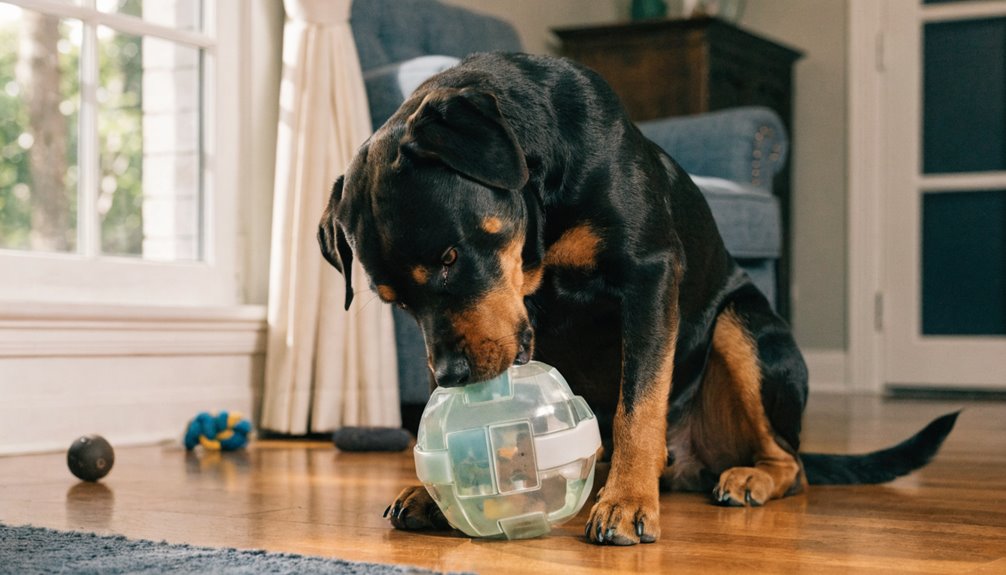
Puzzle feeders work by requiring your Rottweiler to manipulate, slide, or nudge compartments and obstacles to access food, transforming a simple meal into an active problem-solving session that taps into their natural foraging instincts.
For your dog, this approach offers multiple benefits: it slows down rapid eating to reduce bloat risk, extends mealtime from a few minutes to 10–30 minutes, and delivers mental stimulation as effective as a 20–30 minute walk.
Starting with easier designs and gradually increasing complexity helps your Rottweiler build confidence and problem-solving skills without frustration, setting the foundation for sustained engagement over time.
How Puzzle Feeders Work
Food-dispensing toys break down mealtime into a series of small challenges your Rottweiler must solve to access their food, transforming a task that typically takes minutes into an extended problem-solving session lasting anywhere from 5 to 30 minutes depending on the puzzle’s difficulty level.
These puzzle feeders work by requiring your dog to manipulate specific components to release rewards:
- Compartments that slide or rotate to reveal hidden kibble
- Flaps that lift to expose treats beneath
- Sliders that your dog pushes with their nose or paws
- Multi-chamber designs combining several action types
Benefits For Rottweilers
Because Rottweilers are intelligent, food-motivated dogs who often consume their meals in just a few minutes, puzzle feeders offer a practical solution that transforms eating into sustained mental work, slowing their pace and engaging their problem-solving abilities in ways that regular bowls cannot.
Using puzzle toys for one or two daily meal periods provides mental stimulation comparable to a 20–30 minute training session, which helps tire high-energy Rottweilers and reduces destructive behaviors. By keeping them occupied with food-dispensing challenges, you address both their physical and cognitive needs simultaneously.
This consistent engagement strengthens focus and impulse control while preventing bloat-related issues caused by rapid eating, making puzzle feeders an efficient tool for managing behavior and promoting long-term wellness.
Scent Work: Harnessing Your Dog’s Natural Hunting Instincts
Tapping into your Rottweiler’s powerful sense of smell through structured scent work offers one of the most effective ways to deliver mental stimulation, since nose-based games can tire your dog as thoroughly as 20 to 30 minutes of physical exercise. You’ll find that scent work leverages your dog’s natural hunting instincts while building focus and problem-solving skills.
Start with these foundational approaches:
- Hide high-value treats in easy locations, then progressively increase difficulty and distance
- Use snuffle mats and find-it games to build tracking persistence
- Practice scent walks where your dog sniffs freely for concentrated olfactory enrichment
- Introduce structured games like hot-and-cold or hide-and-seek with scented toys
Rotate scent sources regularly to prevent boredom, supervise all activities, and adjust difficulty if your dog shows frustration or fatigue. Consistency reinforces searching behaviors and strengthens recall.
Training and Tricks for Focus and Confidence
While scent work taps into your Rottweiler’s instinctive drives, structured training builds the focus and impulse control that’ll serve your dog across every situation—from walks to household interactions.
Short reward-based training sessions of 5–10 minutes, repeated 2–4 times daily, keep your Rottweiler mentally stimulated without causing fatigue or frustration. Break tricks into small steps using progressive shaping, reinforcing each approximated behavior with high-value treats before increasing difficulty.
When you teach your dog functional tricks like “bring leash” or “settle on mat,” you’re building real-world reliability alongside confidence.
Track progress through successful reps per session, rotating challenges every 1–2 weeks to maintain engagement and prevent boredom while strengthening the focus skills that matter most.
Obstacle Courses: Problem-Solving Through Navigation
You’ll build your indoor obstacle course by arranging household items like couch cushions for tunnels and chairs for weaving, then progress from simple, clearly marked layouts to more complex patterns as your Rottweiler gains confidence and problem-solving skills.
Safety becomes your primary concern throughout this training, requiring you to supervise all sessions closely, avoid high-impact jumps until at least 15 months of age, and monitor your dog’s joints carefully since this breed’s size and power make them vulnerable to injury.
Your success depends on balancing short, frequent training sessions with rest periods of calming activities, using treats and praise to reinforce successful navigation, and adjusting difficulty levels based on your dog’s responses rather than rushing progression.
Building Your Indoor Course
Building an indoor obstacle course for your Rottweiler doesn’t require expensive equipment or a large space—household items like couch cushions, chairs, broom handles, and small footstools can create an effective setup that challenges both agility and problem-solving skills.
Start with three basic obstacles and gradually increase complexity as your dog masters each one:
- Weave poles using broom handles or PVC pipes
- Low jump obstacle set at 6–12 inches high
- Tunnel or cushion climb for navigation practice
- Additional challenges added weekly to prevent habituation
Keep sessions short—15 to 30 minutes—and supervise closely throughout.
Vary the obstacle order and layout each time you train, which provides mental stimulation and maintains engagement.
This consistent structure builds confidence while preventing boredom and reinforcing your Rottweiler’s problem-solving abilities.
Advancing Difficulty Levels
Once your Rottweiler reliably completes the basic three-obstacle course with minimal handler guidance, you’re ready to layer in both physical and cognitive complexity that’ll challenge problem-solving skills and build lasting mental engagement.
Introduce decision-making challenges by creating split paths where your dog must choose the correct sequence, gradually extending routes to six or eight steps.
Progressively raise difficulty by increasing weave spacing, adding unstable surfaces like wobble boards, and reducing your verbal cues.
Embed problem-solving elements such as pause tables requiring your dog to nose a target or interact with puzzle toys available before proceeding.
Use ten to thirty-second holds to strengthen impulse control.
Track completion times and errors, advancing only when performance improves roughly twenty percent across several sessions, ensuring sustainable progress without joint strain.
Safety And Joint Protection
Because Rottweilers are a large, heavy breed with frames that continue developing until roughly 18 months of age, the obstacles you design must prioritize joint protection above difficulty progression. You’ll protect growth plates and prevent injury by following these guidelines:
- Keep obstacles low to the ground—just a few inches for puppies, gradually increasing height as your dog matures
- Use non-slip flooring or mats throughout your course to prevent sliding injuries
- Monitor session length carefully, limiting obstacle work to 15–30 minutes with frequent breaks
- Watch for limping, stiffness, or reluctance, stopping immediately if you notice these signs
Design broad, stable surfaces and allow wide turning radii to reduce hip and elbow stress. Build your course indoors using cushions, footstools, and cardboard tunnels rather than high-impact elements.
Hide-and-Seek and Find-It Games
Through hide-and-seek and find-it games, you’ll tap into your Rottweiler’s natural scenting ability while building their mental stimulation and reinforcing recall in a structured, rewarding way.
Start hide-and-seek by asking your dog to stay while you hide in an easy spot, then call them to find you.
For Find It, hide 5–10 high-value treats around a single room, beginning with visible placements and progressing to under cushions or behind doors as difficulty increases.
Use a calm “colder/warmer” voice or excited praise to guide searches, building a shared communication system that improves listening and problem-solving.
Rotate locations and swap treats for favorite toys, keeping sessions to 5–10 minutes, 2–3 times daily.
Always supervise, make sure hiding spots are safe, and end each session with a reward to reinforce positive engagement.
Toy Rotation Strategies to Prevent Boredom
Rotating your Rottweiler’s toys weekly keeps their play environment fresh and prevents the mental fatigue that comes with constant access to the same objects, which research shows directly reduces destructive boredom behaviors.
You’ll maintain engagement by managing toy accessibility strategically:
- Rotate a selection of 6–8 toys every week so each feels novel every 2–3 weeks
- Keep two active toys (puzzle feeders, treat dispensers) and two interactive toys (tugs, balls) accessible while storing others
- Reintroduce a hidden favorite after 1–3 weeks to trigger renewed enthusiasm through scent and appearance
- Monitor engagement time per toy, aiming for 10–30 minutes of focused play before rotating
Pair rotations with novelty boosts—chicken broth drops, snuffle mat hiding, or kibble insertion—to extend mental stimulation and play value while maintaining consistency in your Rottweiler’s enrichment schedule.
Create Your Weekly Enrichment Plan
While toy rotation keeps your Rottweiler’s play environment fresh, a structured weekly enrichment plan makes certain you’re delivering the right types of mental exercise at the right times, preventing gaps where boredom can resurface. You’ll schedule three 15–30 minute mental sessions daily: one training session, one puzzle-toy session, and one scent walk or sensory activity.
This consistency guarantees your dog receives balanced stimulation without fatigue. Plan one longer 45–60 minute scent walk weekly, plus two shorter 15–20 minute walks focusing on sniffing. Rotate toys every week while maintaining two food-dispensing puzzles of varying difficulty.
Balance all enrichment with adequate rest and cool-down breaks, allowing your Rottweiler’s mind and body to recover fully between sessions.
Safety and Age Guidelines
Because Rottweilers develop at different rates throughout their lives, you’ll need to adjust mental enrichment activities based on age and physical maturity to prevent injury and guarantee your dog stays engaged without becoming overwhelmed. Protecting your dog’s long-term health requires understanding what works at each life stage.
- Delay high-impact activities like repeated stair sprints and intense jumping until your Rottweiler reaches 15 months old, since their growth plates are still developing and vulnerable to damage.
- Tailor session length to age, offering puppies only 5–10 minute mental sessions with frequent breaks, while adult dogs can handle 15–30 minute challenges.
- Supervise all puzzle toys and DIY enrichment to prevent ingestion of small parts, removing any toys with wear or loose pieces.
- Monitor for frustration signs—excessive panting, limping, or disinterest—and lower difficulty or stop the activity when you notice these symptoms.
Frequently Asked Questions
How to Mentally Stimulate a Rottweiler?
You can mentally stimulate your Rottweiler through puzzle feeders, scent games like “Find It,” short training sessions teaching tricks, rotating toys weekly, and varying your walks to new routes or obstacle courses.
What Is 15 Minutes of Mental Stimulation for Dogs?
You’ll practically rewire your dog’s entire brain in just fifteen minutes of focused mental work. You combine training drills, puzzle toys, and scent games that tire their cognition as effectively as thirty to forty minutes of physical exercise.
How Do I Keep My Dog Mentally Stimulated at Home?
You’ll keep your dog mentally stimulated at home by rotating toys weekly, using puzzle feeders, teaching short training tricks, and varying activities like scent walks and hide-and-seek. Plan 15–30 minute sessions daily.
Do Rottweilers Need Stimulation?
Yes, you absolutely need to provide mental stimulation for your Rottweiler. They’re intelligent working dogs that require daily cognitive challenges alongside physical exercise to prevent destructive behaviors and maintain their well-being.
Conclusion
You’ve now got a million strategies to keep your Rottweiler’s mind sharp at home. The key is consistency—you’ll rotate toys, practice scent games, and adjust activities based on your dog’s age and energy level. Start with one or two enrichment techniques this week, then build your routine gradually. Mental stimulation prevents boredom-related behaviors, strengthens your bond, and creates a calmer, happier companion who thrives indoors.