Some of the links in this post are affiliate links. This means we may earn a small commission if you make a purchase through these links—at no extra cost to you. We only recommend products and tools that we genuinely believe will help you with your Rottweiler.
Food aggression in your Rottweiler stems from feeling threatened during meals, often rooted in past scarcity or protective instincts. You can safely reverse this by respecting your dog’s space while eating, then gradually building trust through desensitization—tossing treats near the bowl, hand-feeding, and gentle contact. Consistency across your household matters; everyone must use identical techniques. Separate your dog from children during feeding to prevent incidents. If aggression intensifies despite training, contact a certified animal behaviorist immediately. Understanding the specific stages of reversal requires exploring structured approaches tailored to your dog’s severity level.
- Key Takeaways
- Understanding Rottweiler Food Aggression and Warning Signs
- Why Your Rottweiler Became Food Aggressive
- Why Not to Approach During Meals
- Food Aggression Risk Around Children
- Create a Safe Feeding Space
- Stage One: Getting Comfortable With Your Presence
- Stage Two: Adding Treats From Across the Room
- Stage Three: Dropping Treats Into the Bowl
- Stage Four: Hand Feeding to Build Trust
- Stage Five: Touching the Bowl Without Taking Food
- Stage Six: Lifting the Bowl While Offering Rewards
- Stage Seven: Involving All Family Members
- When to Stop Training and Call a Professional
- Working With a Certified Behaviorist
- Managing Food Aggression Between Multiple Dogs
- Preventing Food Aggression in Rottweiler Puppies
- Teaching “Leave It” to Prevent Guarding
- Common Training Mistakes That Backfire
- Tracking Progress and Adjusting Your Approach
- Long-Term Management Strategies
- Frequently Asked Questions
- Conclusion
Key Takeaways
- Respect your Rottweiler’s space during feeding to reduce stress and prevent reinforcing territorial guarding behaviors.
- Establish a quiet, dedicated feeding area with consistent times to create predictability and lower anxiety levels.
- Gradually desensitize food aggression by tossing treats from safe distances, then hand-feeding to build trust.
- Supervise children around feeding times and teach them to recognize warning signs like growling or raised hackles.
- Contact a Certified Applied Animal Behaviorist if food aggression intensifies or training increases your dog’s anxiety.
Understanding Rottweiler Food Aggression and Warning Signs
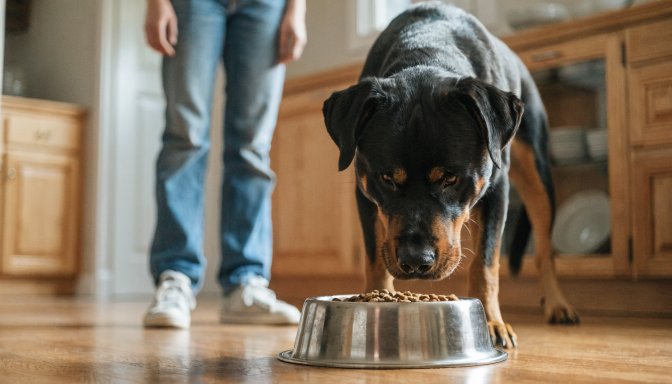
When a Rottweiler guards its food bowl with growling, raised hackles, or snapping, you’re witnessing food aggression—a territorial response that occurs when a dog feels threatened or defensive about its meals or feeding area.
You’ll recognize warning signs early if you know what to observe: mild behaviors like growling or stiff body posture appear first, followed by moderate signs such as snapping or lunging when you approach the bowl.
Recognizing these indicators matters because food aggression can escalate into dangerous biting or chasing. Rottweilers, bred for protective instincts, show this behavior more frequently than some breeds.
You shouldn’t ignore these warning signs, especially in households with children or guests, since early intervention prevents the behavior from worsening and keeps everyone safe around feeding times.
Why Your Rottweiler Became Food Aggressive
If your Rottweiler guards its food bowl aggressively, the behavior didn’t develop overnight—it stems from a combination of past experiences, breed tendencies, and environmental triggers that you’ll want to understand before attempting any intervention.
Your dog’s guarding behavior may originate from competitive feeding during puppyhood or shelter life, where resources were scarce and survival depended on protecting meals. Rottweilers also carry genetic predispositions toward protective instincts that naturally encourage resource guarding.
Resource guarding in Rottweilers stems from early scarcity experiences and breed-specific protective instincts developed over generations.
Traumatic histories involving food deprivation or abuse intensify this response, creating heightened anxiety whenever someone approaches their bowl or moves food away.
Environmental factors matter too—the presence of children or unfamiliar people can amplify aggression as your Rottweiler perceives increased threats to their resources, making intervention timing and consistency critical for safety.
Why Not to Approach During Meals
Your instinct to stay away from your Rottweiler’s food bowl during meals actually serves a critical purpose in preventing and managing food aggression rather than encouraging it.
When you approach while your dog guards his bowl, you reinforce his belief that resources require protection, intensifying territorial responses. Interruptions during eating create stress and anxiety, which exacerbate guarding behaviors instead of alleviating them.
Your dog’s natural instinct drives him to protect what he perceives as valuable, so stepping back establishes trust and reduces the anxiety associated with your presence.
Food Aggression Risk Around Children
Children often don’t recognize the warning signs that precede food aggression, such as growling or stiffened body posture. This means they’re more likely to approach a feeding Rottweiler without understanding the risk.
You can reduce incidents considerably by supervising all feeding times, keeping children in a separate area while your dog eats, and teaching them to recognize and respect a dog’s need for space during meals.
Establishing this structure consistently reinforces safe behavior for both your children and your dog, making mealtimes predictable and secure for everyone involved.
Children’s Vulnerability To Warnings
Because dogs rely heavily on body language to communicate discomfort and boundaries, children often miss the critical warning signs that precede food aggression in Rottweilers and other breeds. You’ll notice that young children typically lack the developmental awareness to recognize subtle signals like growling, raised hackles, or stiff posture, which represent your dog’s first attempts to establish space during meals.
| Warning Sign | What It Means | Your Child’s Typical Response |
|---|---|---|
| Growling | “Back away now” | Often ignores or laughs |
| Stiff body posture | Escalating tension | Continues approaching |
| Raised hackles | High arousal state | Doesn’t recognize danger |
Your children don’t intentionally provoke these signs of aggression; they simply haven’t developed the ability to interpret canine communication. Supervision during feeding times remains your most effective strategy for preventing misunderstandings between your Rottweiler and your family.
Supervision And Safety Measures
Understanding why your Rottweiler guards food is the first step toward preventing incidents, and recognizing these patterns allows you to implement protective strategies before problems develop.
Supervision during mealtime serves as your primary safety measure, ensuring you can intervene if tension arises between your dog and children.
Establish a designated feeding area, separated from where kids play, so your Rottweiler can eat without feeling threatened or interrupted. This physical structure reduces opportunities for accidental provocation.
During feeding time, keep children at a distance and teach them never to approach the bowl or reach for food.
Consistency in these safety measures reinforces boundaries for everyone involved, creating predictable routines that minimize risk and foster calmer interactions around meals.
Create a Safe Feeding Space
You’ll want to establish a quiet, dedicated feeding area for your Rottweiler, away from household traffic and distractions, since a calm environment directly reduces stress and the likelihood of guarding behaviors.
This space functions as a predictable routine that reinforces to your dog that mealtimes are safe and manageable, which is especially important given their size and strength.
Designated Feeding Area Setup
When you establish a quiet, distraction-free feeding space for your Rottweiler, you’re creating an environment that directly reduces the stress and anxiety that can trigger food aggression.
Your designated feeding area should be removed from household traffic, away from other pets and children, where your dog can eat without feeling threatened or interrupted.
Consistency matters greatly here, as using the same location for every meal reinforces that this is your Rottweiler’s personal eating space, which actually decreases resource guarding behaviors.
Place the bowl in this designated feeding area at regular times each day, establishing a predictable routine your dog can rely on.
This structure transforms mealtime from a potential conflict zone into a calm, controlled experience where your Rottweiler feels secure enough to relax while eating.
Calm Environment Management
Beyond establishing a physical feeding location, you’ll want to actively manage the broader environment during mealtimes so your Rottweiler can eat without encountering triggers that spike anxiety or defensiveness.
Calm environment management means removing distractions like other pets, children, and household noise that can elevate your dog’s stress levels. Consistency matters here, too—feeding at the same times daily creates predictability, which naturally reduces anxiety around meals.
Monitor the dog’s body language while eating, watching for tension in their posture, stiff ears, or rigid stance, all signs that something’s making them uncomfortable.
If you notice these signals, calmly remove the distraction rather than waiting for aggressive behavior to escalate. This proactive approach teaches your Rottweiler that mealtimes remain safe and controlled, strengthening their confidence during feeding.
Stage One: Getting Comfortable With Your Presence
The foundation for reducing food aggression rests on helping your Rottweiler become comfortable with your presence during meals.
The foundation for reducing food aggression starts with helping your Rottweiler feel comfortable around you during meals.
So you’ll start by positioning yourself several feet away from the food bowl while your dog eats. During stage one, monitor the dog’s body language closely, watching for signs of tension like stiff posture, raised hackles, or intense staring. Your Rottweiler should appear relaxed and focused on eating rather than on you.
Maintain this distance across ten consecutive meals, repeating the same calm approach each time. Avoid sudden movements or loud noises that might trigger guarding behavior. Consistency matters here—your dog needs repeated positive experiences to build trust.
Once your Rottweiler regularly eats peacefully with you nearby, you’re ready to progress further.
Stage Two: Adding Treats From Across the Room
You’ll begin this stage by establishing a safe distance from your dog’s food bowl, tossing high-value treats into the bowl while watching carefully for
Distance Safety Protocol
Once your Rottweiler’s eaten several meals calmly with you standing nearby, it’s time to introduce treats from a distance, which helps shift their perception of your presence from a potential threat to a source of good things.
Stand two feet away from the bowl and toss a high value treat inside while your dog eats, creating a positive association with your involvement in mealtime.
Watch your dog’s body language closely—relaxed ears, soft eyes, and continued eating indicate comfort, while stiffness or tension signals you should increase your distance.
Consistency matters here; repeat this process across multiple meals before gradually moving closer.
Your calm demeanor reinforces safety, allowing your Rottweiler to rewire their defensive response and accept your proximity during feeding without stress or aggression.
Treat Tossing Technique
Building on the foundation you’ve established by standing nearby while your Rottweiler eats calmly, Stage Two expands your dog’s comfort zone by introducing distance and movement into the treat-tossing process.
You’ll stand several feet away and toss high-value treats into their bowl during meals, creating positive associations with your presence and movement. This treat tossing technique reinforces that your approach means good things happen, actively reducing food guarding behavior.
Gradually decrease the distance over ten consecutive calm meals, watching closely for signs of stress or aggression. If your dog shows negative reactions, increase the distance again before progressing.
Consistency matters here; the reinforcement from superior treats builds security and trust, helping your Rottweiler understand that your proximity signals safety rather than threat.
Monitoring Body Language
As you toss treats from across the room during your Rottweiler’s meals, reading their body language becomes your primary tool for determining whether to continue progressing or pause the training.
Watch for relaxed ears, soft eyes, and a natural eating rhythm, which signal comfort with your presence. These calm indicators mean you’re ready to decrease distance gradually in future sessions.
Conversely, raised hackles, stiff posture, or intense focus on food suggest your dog needs more time at this stage.
By monitoring body language consistently, you gather vital information about your dog’s stress levels and readiness to advance.
Use positive reinforcement by rewarding calm responses with high-value treats, creating associations that food near you means good things happen, not threats.
Stage Three: Dropping Treats Into the Bowl
Now that your Rottweiler has grown accustomed to your presence near the food bowl, you can begin introducing treats while they’re actively eating. This helps them associate your approach with positive experiences rather than threats to their meal.
Select high-value treats that your dog values more than the kibble in the bowl, since this encourages them to remain focused on eating rather than guarding their food. Start by standing several feet away, then gradually decrease the distance as your dog demonstrates calm, relaxed eating behavior.
Drop treats into the bowl consistently during multiple feeding sessions, reinforcing the positive connection between your presence and rewards. This structured repetition builds trust over time, teaching your Rottweiler that your approach signals good things, not competition for resources.
Stage Four: Hand Feeding to Build Trust
Once your Rottweiler accepts treats dropping into their bowl without tension, you’re ready to move closer and offer food directly from your hand, which deepens the trust you’ve been building through earlier stages.
Hand feeding requires calm movements and patience, as your dog learns that your presence during meals signals positive experiences rather than competition.
Hand feeding teaches your dog that your presence during meals means positive experiences, not competition for food.
- Hold treats at chest height while maintaining steady, relaxed posture
- Allow your dog to take food gently from your open palm without grabbing
- Continue offering treats as your dog finishes their regular meal
Repeat this process consistently until your Rottweiler actively anticipates your hand near their bowl.
This reinforcement strengthens the association between your presence and reward, gradually replacing food-guarding behaviors with trust and relaxation during feeding times.
Stage Five: Touching the Bowl Without Taking Food
Your Rottweiler’s trust has grown through hand feeding, and now you’ll deepen that progress by introducing physical contact with the bowl itself while your dog eats. During this stage, you’ll touch the bowl while your dog remains calm and relaxed, gradually building their comfort with your presence near their food resource.
| Action | Frequency | Goal |
|---|---|---|
| Touch bowl gently | Every meal | Normalize contact |
| Offer treats nearby | Consistently | Reinforce positive association |
| Gradually raise bowl height | Progressively | Reduce guarding behavior |
| Monitor body language | Throughout | Guarantee relaxation |
Consistency matters considerably here, as repetition helps your dog finish meals comfortably while you interact with the bowl. Success arrives when your Rottweiler permits contact without displaying aggression or resource guarding, demonstrating that you’ve successfully reinforced a calm relationship with their food resource through patient, structured practice.
Stage Six: Lifting the Bowl While Offering Rewards
Building on the trust you’ve established through hand feeding and bowl touching, Stage Six introduces a new element: lifting the bowl while simultaneously offering high-value treats, which teaches your Rottweiler that bowl elevation leads to positive rewards rather than food loss.
Start by lifting the bowl just a few inches while offering treats from the side, keeping your dog relaxed throughout. Gradually increase the height as your dog remains calm, reinforcing the connection between lifting the bowl and receiving rewards. Monitor body language constantly for tension or stiffness.
- Lift the bowl slowly while presenting high-value treats at mouth level
- Pause at different heights, allowing your dog to accept rewards comfortably
- Return the bowl only when your dog shows complete relaxation
Progress only when your dog demonstrates consistent comfort at each height level.
Stage Seven: Involving All Family Members
You’ll want to involve all family members in your Rottweiler’s training because inconsistency undermines your progress. When different people use different techniques or rules around the bowl, your dog becomes confused about what behavior you’re actually rewarding.
Each person in your household should practice the same feeding routine and desensitization steps, assigning specific roles like who handles meals or provides treats. This builds trust between your dog and everyone who interacts with them.
Regular family discussions about what’s working and what’s challenging help you stay coordinated, catch warning signs together, and maintain the structured approach that food aggression requires to improve.
Consistent Training Across Household
When every family member approaches your Rottweiler’s food aggression differently, you’re fundamentally teaching the dog that the rules aren’t stable, which actually reinforces guarding behaviors rather than reducing them.
Consistent training across your household requires unified strategies from all family members who interact with your dog.
Establish these foundational practices:
- Everyone uses identical hand-feeding techniques, approaching slowly from the side rather than directly over the bowl.
- All household members reinforce calm behavior around food with the same verbal cues and reward timing.
- Each person maintains consistent boundaries, never allowing resource guarding to go uncorrected, even when tired or busy.
When you maintain this unified approach, your Rottweiler learns that the feeding environment is predictable and safe, gradually reducing the anxiety that drives food aggression.
Building Trust With Everyone
After you’ve made progress with your Rottweiler’s food aggression through earlier stages, the critical next step involves bringing all household members into the process, because a dog that trusts one person but remains guarded around others hasn’t truly overcome the underlying anxiety driving the behavior.
Each family member should participate in desensitization and counterconditioning exercises, creating consistency that reinforces safety across multiple relationships. You’ll want to establish a shared feeding routine where different people manage mealtimes, which builds trust gradually through repeated, positive interactions.
When your Rottweiler remains calm during these shifts, everyone should offer immediate praise and rewards. Regular family discussions about progress help everyone stay aligned, ensuring your dog receives the unified message that people near food means security, not threat.
When to Stop Training and Call a Professional
Recognizing when your training efforts aren’t working is just as important as knowing how to train, because continuing ineffective exercises can actually make food aggression worse rather than better.
Professional intervention becomes necessary when you notice specific warning signs that indicate your Rottweiler’s condition is deteriorating or remaining unchanged despite your consistent efforts.
Professional intervention becomes necessary when your Rottweiler’s condition deteriorates or remains unchanged despite consistent training efforts.
Watch for these critical indicators:
- Your dog displays severe behaviors like biting, lunging, or chasing during feeding times, signaling that food aggression has intensified beyond manageable levels.
- Your Rottweiler shows extreme anxiety or stress during desensitization exercises, suggesting the training approach is counterproductive and causing harm.
- Guarding behavior emerges around children or unfamiliar adults, creating safety risks that require specialized professional intervention.
Contact a Certified Applied Animal Behaviorist or veterinary behaviorist immediately when these patterns appear.
Working With a Certified Behaviorist
Because food aggression in Rottweilers often stems from complex emotional and behavioral patterns that require specialized expertise, working with a certified behaviorist offers you access to proven intervention techniques tailored specifically to your dog’s situation. A veterinary behaviorist or Certified Applied Animal Behaviorist will design a structured plan using desensitization and counterconditioning, gradually introducing treats during meals to build positive associations with your presence.
| Training Element | Purpose | Timeline |
|---|---|---|
| Assessment | Identify aggression triggers | Initial consultation |
| Staged interactions | Create safe exposure | Weeks 1-4 |
| Reinforcement | Build new responses | Ongoing |
Your behaviorist monitors body language closely while coaching you through each step. Consistency across all family members proves essential for helping your dog overcome this behavior, reducing bite risk considerably.
Managing Food Aggression Between Multiple Dogs
When you’re managing food aggression between multiple dogs in your household, the primary challenge is that competition over resources naturally triggers guarding instincts, and these instincts intensify when dogs feel they must defend their meals from one another.
You’ll want to restructure your feeding routine to eliminate this competition entirely.
- Feed your dogs in completely separate rooms with closed doors, preventing visual confrontation and reducing tension around resources.
- Use slow feeder bowls that encourage a relaxed eating pace, which naturally decreases anxiety and aggressive responses during mealtime.
- Establish consistent feeding times so your dogs anticipate structure, knowing exactly when they’ll eat without uncertainty.
Implement “trade up” training where each dog learns to relinquish guarded food for higher-value treats, promoting cooperation.
A professional dog trainer can guide this process, ensuring your dogs guards transform into calm, non-confrontational behaviors during meals.
Preventing Food Aggression in Rottweiler Puppies
The foundation for preventing food aggression in Rottweiler puppies starts with hand feeding, a practice that builds trust during meals and conditions your puppy to view your presence near their food as a positive rather than a threat.
As you hand feed, speak kindly and pet your puppy to create a calm environment that reinforces positive associations with mealtime.
Gradually shift to feeding in a bowl placed in your lap, maintaining the relaxed atmosphere you’ve established.
Introduce special treats during feeding times to desensitize your puppy to hands near their food, encouraging sharing behavior.
Consistent feeding schedules and routines establish structure that helps your puppy feel secure, reducing the likelihood they’ll guard their meals.
Teaching “Leave It” to Prevent Guarding
You’ll build a strong foundation for “leave it” by starting with high-value treats in your hand, covering them with your other hand, and rewarding your Rottweiler when they look away from the food rather than toward it.
Once your dog consistently ignores the treat at close range, you’ll practice safe distance training by gradually increasing the space between you and your dog, introducing lower-value distractions, and reinforcing their ability to maintain focus on you instead of the item.
This structured approach, repeated across different environments and objects, creates the impulse control your dog needs to resist guarding behaviors around food.
Building Command Foundation
One of the most effective ways to reduce resource guarding in Rottweilers is to teach a strong “leave it” command, which redirects your dog’s focus away from guarded items and toward you instead.
You’ll build this foundation by starting in a distraction-free environment where your dog can understand the command clearly before facing more challenging situations.
To establish this behavior:
- Present high-value treats in your hand, say “leave it,” and reward only when your dog looks away
- Place treats on the floor at a distance, practicing the command while reinforcing success with praise
- Gradually increase difficulty as your dog demonstrates consistent understanding
Consistency across all family members using identical commands and techniques creates unified reinforcement, which solidifies the desired behavior effectively and prevents confusion that undermines training progress.
Practicing Safe Distance Training
After you’ve established the basic “leave it” command in controlled settings, the next phase involves practicing at varying distances from the resource your Rottweiler typically guards, which allows you to build their confidence and reliability before facing real-world temptations.
| Distance Level | Setup | Reward Method |
|---|---|---|
| Far | 10+ feet from item | High-value treat |
| Medium | 5-8 feet from item | High-value treat |
| Close | 2-3 feet from item | High-value treat |
Start at considerable distance, then move one step closer as your dog shows consistent response. Watch for relaxed body language before advancing. Use high-value treats to reinforce compliance and redirect focus away from the guarded object. This gradual progression builds trust while reducing stress, ensuring your Rottweiler responds reliably to the command regardless of proximity to tempting resources.
Common Training Mistakes That Backfire
When you’re working to resolve food aggression in your Rottweiler, the methods you choose matter as much as the effort you invest, because certain training approaches can actually make the problem worse rather than better. Common training mistakes often trigger aggressive responses instead of reducing them.
- Using punishment or intimidation during training increases anxiety and defensive behaviors, undermining the trust necessary for progress.
- Rushing through desensitization stages overwhelms your dog and reinforces the very aggression you’re trying to eliminate.
- Allowing inconsistent responses from family members sends mixed signals, preventing your Rottweiler from understanding what behavior you expect.
You’ll find success by moving deliberately through each stage, maintaining consistency across all handlers, and using high-value treats that genuinely capture your dog’s interest during counterconditioning exercises.
Tracking Progress and Adjusting Your Approach
Because food aggression doesn’t improve on a straight line, you’ll need to actively monitor your Rottweiler’s behavior during feeding times to catch the subtle shifts that indicate whether your training’s working or whether you need to make adjustments.
Document specific instances of aggression alongside your dog’s body language—stiff posture, growling, or rapid eating—to identify patterns and triggers that require attention.
Track progress by noting when your Rottweiler shows calmer responses, then gradually increase difficulty only after mastering each training stage.
If aggression persists or worsens, adjust your feeding environment by changing the location, reducing distractions, or modifying your routine.
Work with a certified behaviorist to refine your strategy based on your dog’s unique responses, ensuring consistency and effective reinforcement throughout the process.
Long-Term Management Strategies
Establishing consistency in your Rottweiler’s feeding routine creates the foundation for lasting behavioral change, since dogs thrive on predictability and structure that reduces anxiety around mealtimes.
Long-term management strategies require you to maintain these habits even after aggression improves, preventing regression.
Your resource guarding management plan should include:
- Scheduled feeding times at the same location daily, reinforcing your dog’s confidence that food will reliably appear.
- Continued desensitization exercises with high-value treats near the bowl, strengthening positive associations with your presence.
- Periodic monitoring of eating behaviors and body language, allowing you to catch early warning signs before escalation.
Consistency prevents your Rottweiler from reverting to protective behaviors, while ongoing reinforcement solidifies trust.
This commitment to structured management protects both your dog’s emotional well-being and your household’s safety long-term.
Frequently Asked Questions
How to Stop Rottweilers From Being Food Aggressive?
You’ll establish consistent feeding routines, gradually desensitize your dog to your presence during meals, and use high-value treats to build trust. For severe cases, you’ll consult a certified behaviorist for tailored strategies.
What Is a Red Flag Puppy’s Behavior?
Like a dam beginning to crack, you’ll notice red flags when your puppy growls during meals, stiffens around toys, refuses to share interactions, or exhibits extreme anxiety while eating—all signaling potential aggression you shouldn’t ignore.
Can You Correct Food Aggression in Dogs?
You can correct food aggression through systematic desensitization and counterconditioning. You’ll gradually associate positive experiences with people near your dog’s food. You must remain consistent and avoid punishment, which worsens aggression.
At What Age Do Rottweilers Become Aggressive Towards?
You’ll notice your Rottweiler can show food aggression signs as early as six months old, though some dogs display it by eight weeks. Aggression typically intensifies between six and eighteen months during adolescence when they’re establishing social hierarchies.
Conclusion
You’ll find that consistency and patience are your most reliable tools for managing food aggression, since research shows that roughly 20% of aggression cases stem from resource guarding rather than dominance issues. By maintaining structured feeding routines, you’re addressing the root cause of your dog’s anxiety rather than punishing the symptom. Your commitment to these strategies, combined with professional guidance when needed, creates the foundation for lasting behavioral change.