Some of the links in this post are affiliate links. This means we may earn a small commission if you make a purchase through these links—at no extra cost to you. We only recommend products and tools that we genuinely believe will help you with your Rottweiler.
Separation anxiety in Rottweilers stems from deep attachment and manifests as destructive behavior, excessive barking, and physical stress symptoms like panting and pacing, typically peaking within the first 40 minutes of your absence. You can address mild cases through gradual desensitization and treat-filled toys, while moderate anxiety requires consistent routine and counterconditioning. Severe cases need professional guidance and possibly medication. Start by ruling out medical issues, then build your dog’s confidence through short practice absences and adequate exercise—understanding the specific patterns will guide your next steps forward.
- Key Takeaways
- What Is Separation Anxiety in Rottweilers?
- Common Signs of Separation Anxiety in Your Rottweiler
- Mild, Moderate, or Severe: Rating Your Rottweiler’s Anxiety
- Is It Separation Anxiety or Something Else?
- Destructive Behavior in Anxious Rottweilers: Exits and Belongings as Targets
- Separation Anxiety and Indoor Soiling: Understanding the Difference
- Excessive Barking and Howling: A Key Sign of Rottweiler Separation Anxiety
- Physical Stress Signs in Separation-Anxious Rottweilers
- Why Rottweiler Loyalty Triggers Separation Anxiety
- Common Causes: Rehoming, Schedule Changes, and Household Shifts
- Vet Visit First: Why Medical Issues Must Be Ruled Out
- Desensitization Training for Rottweiler Separation Anxiety
- Stop Triggering Anxiety: Why Your Shoes and Keys Matter
- Make Alone Time Better Than Being Together
- Safe Spaces for Separation-Anxious Rottweilers
- Reducing Rottweiler Separation Anxiety With Exercise and Enrichment
- Stay Calm on Your Way Out and In
- When Your Rottweiler Needs a Veterinary Behaviorist?
- Anti-Anxiety Medication for Severe Rottweiler Cases
- Preventing Separation Anxiety in Young Rottweilers
- Frequently Asked Questions
- Conclusion
Key Takeaways
- Separation anxiety in Rottweilers manifests as destructive behaviors, excessive barking, and stress symptoms like pacing and drooling when left alone.
- Gradual desensitization and counterconditioning with treat-filled KONG toys effectively treat mild to moderate separation anxiety without punishment-based approaches.
- Establish consistent daily routines, provide at least 30 minutes of aerobic exercise, and offer mental enrichment to reduce anxiety levels.
- Damage typically occurs around exits and owner’s personal items; pre-departure cues like shoe sightings trigger anxious reactions in affected dogs.
- Professional guidance is necessary for severe anxiety; video recording helps diagnose symptoms and monitor progress during treatment interventions.
What Is Separation Anxiety in Rottweilers?
Distress when alone—this is the core of separation anxiety in Rottweilers, a condition that stems from their deep attachment to their owners and their need for constant companionship.
You’re dealing with a psychological response where your Rottweiler experiences genuine panic when separated from you, triggering behavioral issues like excessive barking, destructive behavior, and indoor soiling. This isn’t stubbornness or misbehavior; it’s anxiety manifesting through stress responses.
Signs of separation anxiety develop when your dog panics within the first 40 minutes of solitude, pacing and drooling as they spiral into distress. Understanding that separation anxiety in Rottweilers reflects their strong bond with you helps you approach treatment with appropriate solutions rather than punishment, focusing on gradual desensitization and environmental stability.
Common Signs of Separation Anxiety in Your Rottweiler
When your Rottweiler experiences separation anxiety, you’ll likely notice destructive behaviors like chewing furniture or scratching doors, vocalizations such as excessive barking and whining that typically peak within the first 40 minutes alone, and physical stress indicators including pacing, panting, drooling, and nervous habits like lip licking.
These signs aren’t character flaws or disobedience; they’re stress responses that reveal your dog’s genuine distress when separated from you, and recognizing them helps you understand that your Rottweiler isn’t misbehaving intentionally but rather struggling with anxiety.
Identifying which specific signs your dog displays—whether destructive, vocal, or physical—gives you concrete information to guide your response and helps you distinguish separation anxiety from other behavioral issues or simple lack of training.
Destructive Behavior Patterns
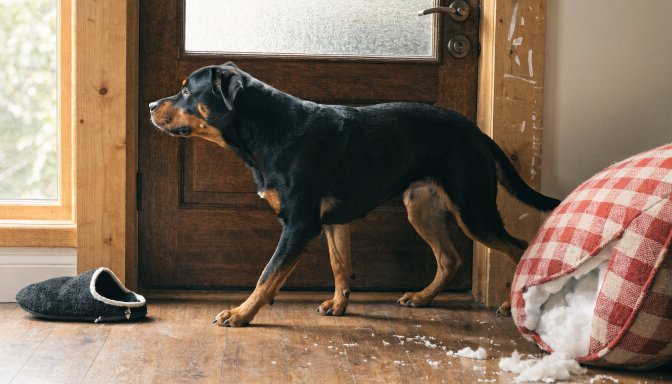
Because your Rottweiler’s anxiety intensifies during separation, you’ll likely notice destructive behaviors that target specific areas of your home, particularly exit points like doors and windows or objects carrying your scent.
These destructive behavior patterns reveal genuine distress rather than misbehavior, helping Rottweiler owners recognize what’s actually happening. Understanding these signs of separation anxiety allows you to address the root cause effectively.
- Scratching and chewing doors and window frames where you typically leave
- Tearing furniture cushions or bedding in rooms where you spend most time
- Destroying items with your scent, like clothing or blankets
- Clawing at walls or baseboards near exits
To help alleviate these destructive behaviors, create consistency in your departure routine, establish a safe space with familiar items, and gradually acclimate your dog to alone time through structured practice sessions.
Vocalization and Pacing
Your Rottweiler’s excessive vocalization and pacing represent predictable responses to separation anxiety, emerging from the same underlying distress that drives destructive behavior but manifesting in movement and sound rather than property damage.
When you leave, your dog may bark, howl, or pace within the first 40 minutes, revealing genuine anxiety rather than misbehavior. These behaviors often begin before you depart, signaling anticipatory anxiety that builds as you prepare to leave.
Pacing reflects your dog’s inability to settle, while vocalization expresses distress. Address these patterns through desensitization training, gradually exposing your Rottweiler to departure cues while reinforcing calm behavior.
Consistency matters profoundly; reward quiet moments and relaxed postures, helping your dog develop alternative responses to separation anxiety triggers.
Physical Stress Indicators
Beyond the sounds and movements your Rottweiler displays during separation anxiety lies a layer of physical stress that reveals how deeply the anxiety affects his body, not just his behavior.
These physical stress indicators are common signs that anxious dogs experience when facing separation anxiety in Rottweilers, and they typically emerge within the first 40 minutes of solitude.
- Excessive panting and heavy breathing, even in cool environments
- Increased drooling and salivation beyond normal levels
- Constant pacing around the house without settling down
- Restlessness and inability to relax or find comfort
Understanding these manifestations helps you recognize that your dog’s distress is genuine and physiological.
These responses indicate your Rottweiler’s nervous system is activated, signaling real internal struggle rather than mere misbehavior or attention-seeking.
Mild, Moderate, or Severe: Rating Your Rottweiler’s Anxiety
You’ll need to assess where your Rottweiler falls on the anxiety spectrum—from mild restlessness that responds to short practice departures, to moderate destructive behaviors requiring gradual desensitization, to severe symptoms like self-harm that demand professional help.
The intensity of your dog’s response determines your treatment strategy, since a mild case might improve with consistency and positive reinforcement alone, while moderate and severe anxiety require structured intervention plans tailored to your dog’s specific triggers and stress level.
Understanding this severity framework helps you set realistic expectations and choose the right approach, whether that’s DIY training adjustments or scheduling a consultation with a certified behaviorist.
Recognizing Anxiety Severity Levels
Understanding where your Rottweiler falls on the anxiety spectrum—mild, moderate, or severe—is essential for choosing the right intervention strategies, since each level requires a different approach to treatment and management. Your dog’s signs of stress reveal important information about what you’re dealing with, and recognizing these patterns helps you respond appropriately.
- Mild separation anxiety shows as whining or gentle pacing when you leave, without destructive behavior.
- Moderate separation anxiety includes excessive barking, minor property damage, or accidents occurring primarily during your absence.
- Severe separation anxiety involves panic responses, self-harm attempts, extreme vocalizations, and targeted destruction at exits or items carrying your scent.
- Critical timing occurs within the first 40 minutes alone, when panic responses typically trigger.
Matching your intervention to these severity levels guarantees you address the root problem effectively.
Tailoring Treatment By Intensity
Now that you’ve identified where your Rottweiler sits on the anxiety spectrum, it’s time to match your approach to that specific level, because a treatment plan that works for mild anxiety won’t address severe panic, and pushing a severely anxious dog through mild-level techniques can actually worsen the problem.
For mild separation anxiety, stuffed KONG toys during brief absences provide effective counterconditioning. Moderate cases require gradual desensitization paired with a calm departure routine, addressing persistent barking and minor destructive behaviors through consistent practice.
Severe anxiety demands professional guidance, detailed desensitization programs, and monitoring since panic peaks within 40 minutes of departure.
Is It Separation Anxiety or Something Else?
How can you tell whether your Rottweiler’s destructive behavior or excessive barking stems from separation anxiety or from something entirely different, such as boredom, lack of exercise, or an underlying medical issue?
You’ll need to assess the context and triggers carefully, because the distinction matters for treatment. Consider these key indicators:
- Location of damage – Does destruction target exits or items carrying your scent, suggesting separation anxiety rather than juvenile exploration?
- Timing patterns – Does the behavior occur only when you’re absent, or does it happen regardless of your presence?
- Pre-departure cues – Does your Rottweiler react anxiously to shoes or keys before you leave, indicating conditioned worry?
- Medical factors – Has a veterinarian ruled out underlying conditions that could mimic or worsen anxiety symptoms?
Video recording provides concrete evidence for accurate diagnosis.
Destructive Behavior in Anxious Rottweilers: Exits and Belongings as Targets
The wreckage left behind—scratched doorframes, shredded furniture, torn curtains—often tells the story of a Rottweiler’s separation anxiety more clearly than any other symptom, since anxious dogs don’t destroy randomly but target specific locations and items that connect directly to their distress.
Your dog likely focuses on exits, like doors and windows, because these represent escape routes from the panic of being alone. Similarly, your Rottweiler may attack personal belongings carrying your scent, as these items simultaneously comfort and intensify anxiety.
Understanding these patterns helps you address the root cause. By monitoring duration of separations, gradually increasing alone time, and removing access to vulnerable items, you’ll reduce destructive behavior while building your dog’s confidence during your absence.
Separation Anxiety and Indoor Soiling: Understanding the Difference
When your housetrained Rottweiler suddenly urinates or defecates indoors despite knowing better, you’re likely witnessing an anxiety response rather than a breakdown in training, since separation anxiety triggers an emotional state that overrides your dog’s established bathroom habits.
This emotional response differs fundamentally from typical housetraining issues, requiring you to recognize specific patterns that signal anxiety-driven indoor soiling rather than other causes.
Key indicators you’re observing anxiety-related soiling include:
- Accidents occurring within minutes of your departure
- Accompanying behaviors like pacing, destructiveness, or excessive vocalization
- Elimination near exits or in your bedroom
- Consistent patterns tied directly to your absence
Understanding that your Rottweiler can’t control this response guides your anxiety management strategy, shifting focus from punishment toward desensitization and creating secure structure during alone time.
Excessive Barking and Howling: A Key Sign of Rottweiler Separation Anxiety
You’ll notice that your Rottweiler’s barking and howling typically intensify within the first 40 minutes of your departure, reflecting their emotional distress and desire for your presence.
These vocalizations often grow more persistent and louder as separation anxiety deepens. Understanding this pattern helps you recognize that you’re not dealing with simple noise-making but rather a genuine anxiety response, which means addressing it requires consistent training techniques like gradual desensitization to your departures and positive reinforcement when your dog stays calm while alone.
Environmental modifications such as engaging toys, background noise, or structured routines can greatly reduce these vocalizations by lowering your dog’s stress level and providing mental engagement during your absence.
Persistent Vocalization Patterns
Excessive barking and howling that occurs specifically when your Rottweiler is alone represents a distinct vocalization pattern tied directly to separation anxiety rather than typical alert barking or response to external stimuli.
This persistent vocalization typically emerges within the first 40 minutes of separation, signaling your dog’s panic response to being away from you.
Understanding these signs helps you address separation anxiety before it worsens:
- Vocalization begins immediately after you leave, not in response to outside noises
- Barking and howling intensify during the first half-hour of separation
- Your neighbors may report complaints about the excessive noise level
- The behavior differs markedly from your dog’s normal communication patterns
Recognizing these specific patterns allows you to intervene early and prevent deterioration of your bond with your Rottweiler.
Anxiety Triggers and Responses
Because your Rottweiler’s barking and howling intensify during the first 40 minutes alone, you’re witnessing a panic response that differs fundamentally from alert barking or playful vocalization. This escalating distress signals separation anxiety, a condition rooted in your dog’s strong attachment to you.
As your Rottweiler realizes you’re absent, anxiety levels spike, triggering these vocalizations as a distress call rather than a situational response.
You’ll likely notice accompanying anxiety-related behaviors including pacing, destructive tendencies, and diminished appetite, all reinforcing the severity of your dog’s condition.
Recognizing excessive barking as your primary indicator allows you to pursue early intervention before these patterns intensify. Understanding these triggers and responses helps you develop targeted strategies that address the root cause rather than merely managing surface symptoms.
Physical Stress Signs in Separation-Anxious Rottweilers
When your Rottweiler begins displaying physical stress responses like excessive panting, drooling, pacing, and trembling during your absence, these signs point to a deeper struggle with separation anxiety rather than simple restlessness.
You’re observing your dog’s body communicating distress through involuntary reactions that intensify as anxiety builds.
- Excessive panting and drooling occur when your Rottweiler’s nervous system activates, triggering physiological changes that mirror panic responses in humans.
- Pacing and circling patterns reveal your dog’s inability to settle, as restlessness prevents relaxation and compounds the anxiety.
- Calming signals like yawning and lip licking, combined with movement, confirm genuine stress rather than boredom.
- Indoor soiling despite prior house training indicates anxiety overrides established behavior, demonstrating the anxiety’s severity.
Recognizing these physical stress signs early allows you to implement management strategies before destructive behaviors develop, preventing symptoms of separation from escalating further.
Why Rottweiler Loyalty Triggers Separation Anxiety
Your Rottweiler’s intense loyalty to you—the very trait that makes the breed so devoted and protective—paradoxically creates the conditions for separation anxiety to develop.
When you’re a family member in your dog’s world, leaving triggers genuine distress because their attachment runs deep, making Rottweilers prone to panic when separated from you.
This loyalty isn’t weakness; it’s how their protective nature manifests emotionally. Your dog’s brain interprets your absence as a threat to the pack structure they’ve bonded with, activating stress responses within 40 minutes.
Past experiences like rehoming intensify this reaction, as your Rottweiler may fear abandonment.
Understanding this connection helps you approach training with patience, building gradual tolerance through consistent practice rather than expecting immediate independence from a breed designed for close family bonds.
Common Causes: Rehoming, Schedule Changes, and Household Shifts
When you rehome a Rottweiler, you’re asking them to adapt to an entirely new environment and person after potentially traumatic past experiences, which can trigger separation anxiety as they struggle to trust that you won’t abandon them like before.
If you’ve also shifted your daily schedule—spending less time at home, changing work hours, or altering when you leave and return—your dog loses the predictable routine they need to feel secure, and this unpredictability amplifies their anxiety.
Adding household changes like new pets, family members, or even moving to a different home compounds these stressors, since your Rottweiler’s sense of safety depends on consistency and familiarity, making them cling more intensely to you when everything around them feels uncertain.
Rehoming and Abandonment Trauma
Because Rottweilers form such intense bonds with their families, they’re especially vulnerable to separation anxiety when they’ve experienced rehoming or abandonment. These past traumas can reshape how they respond to being alone. Your dog’s previous experiences create emotional patterns that persist long after the event itself, influencing their behavior during separations.
When you bring a rehomed Rottweiler into your home, you’re inheriting their history. Consider these signs that abandonment trauma’s affecting your dog:
- Panic responses when you prepare to leave, including pacing and whining
- Destructive behavior concentrated near exits or doors
- Excessive barking that intensifies as departure time approaches
- Reluctance to settle comfortably when alone
Solutions require patience and consistency, establishing predictable routines that reinforce security through structure and reassurance.
Life Changes and Routine Disruption
Rottweilers thrive on predictability, and disruptions to their daily structure—whether from rehoming, schedule changes, or household shifts—can trigger or intensify separation anxiety because these dogs rely on consistent patterns to feel secure.
When you return to office work after working remotely, your Rottweiler may struggle with the sudden absence and become anxious. Similarly, introducing new pets or family members creates uncertainty that can provoke anxious behaviors.
Moving to a new home presents additional challenges, as unfamiliar environments without established routines compound their distress.
To help reduce anxiety during life changes, you should maintain consistent feeding times, exercise schedules, and alone-time practices. Establishing stable routines reinforces your dog’s sense of security, making routine disruption less likely to escalate into serious behavioral problems.
Vet Visit First: Why Medical Issues Must Be Ruled Out
Before you attribute your Rottweiler’s destructive behavior, excessive barking, or indoor accidents to separation anxiety, it’s essential to schedule a veterinary evaluation to rule out underlying medical conditions that can produce identical symptoms.
Many physical health issues mimic anxiety behaviors, making accurate diagnosis difficult without professional assessment.
Your vet visit should include:
- Blood tests and hormone panels to examine overall health status
- Urinalysis to detect urinary tract infections or other metabolic issues
- Neurological examination to assess nervous system function
- Review of recent behavior changes and health history patterns
A veterinarian can identify problems early, ensuring that physical health issues receive treatment before you pursue behavioral modification strategies.
Resolving underlying medical conditions often greatly decreases anxiety symptoms and improves your Rottweiler’s overall well-being, making this vet visit a critical first step.
Desensitization Training for Rottweiler Separation Anxiety
You’ll build your Rottweiler’s confidence through gradual absence practice, starting with brief departures from a single room and extending the duration only as your dog remains calm. Rushing this process typically backfires and reinforces anxiety rather than resolving it.
By counterconditioning positive associations—pairing your departure cues with treats, toys, or calm praise—you’ll help your dog learn that leaving doesn’t signal abandonment. Consistency in repeating these patterns strengthens the neural pathways that support relaxed behavior.
Managing panic response triggers means you’ll monitor your dog’s anxiety levels closely during each session, adjusting your timeline based on their individual tolerance and recognizing that setbacks require patience rather than punishment.
Gradual Absence Practice
When anxiety stems from unfamiliarity with solitude, the solution lies in teaching your dog that being alone is manageable and predictable. You’ll gradually extend absence durations as your Rottweiler demonstrates calm behavior, building confidence through consistent practice.
- Start with departures lasting only a few minutes, allowing your dog to acclimate without experiencing high anxiety levels.
- Monitor your dog’s reactions closely, extending time away only when they show reduced anxiety and settled behavior.
- Practice regularly to establish a stable routine your Rottweiler can anticipate and adjust to over time.
- Use positive reinforcement by rewarding calm behavior upon departure and return, cultivating a relaxed attitude toward solitude.
This structured approach transforms separation anxiety into manageable independence, one short absence at a time.
Counterconditioning Positive Associations
Rather than allowing your Rottweiler to develop negative feelings about alone time, you can reshape their emotional response by deliberately pairing departures with rewarding experiences, a technique called counterconditioning.
You’ll create positive associations by offering special treats or interactive toys only when you leave, so your dog begins anticipating enjoyable activities instead of stress.
Start with very short absences and gradually increase the duration, rewarding the dog when they remain calm and relaxed during these periods.
Filled KONG toys work particularly well because they occupy your Rottweiler’s attention and make alone time feel rewarding.
Consistency in your training routine reinforces that being alone isn’t threatening but rather an opportunity for enjoyment, strengthening this new emotional response over time.
Managing Panic Response Triggers
Because your Rottweiler’s panic response doesn’t develop from the separation itself but rather from the signals that predict it, desensitization training targets these specific triggers—the cues that’ve become associated with your departure, such as picking up your keys, putting on shoes, or grabbing your wallet.
To effectively manage these panic response triggers:
- Gradually expose your dog to pre-departure cues multiple times daily without actually leaving, which breaks the automatic connection between these signals and your absence.
- Begin with brief absences of only a few minutes, then slowly extend the duration as your Rottweiler demonstrates increased comfort.
- Practice calm departures and arrivals by maintaining a low-key demeanor that prevents emotional escalation.
- Reward calm behavior during separations with positive reinforcement, helping your dog associate these moments with positive experiences rather than distress.
Consistency and patience reshape how your dog responds to separation anxiety triggers.
Stop Triggering Anxiety: Why Your Shoes and Keys Matter
Your Rottweiler’s anxiety often has a predictable trigger: the everyday actions that signal your departure, such as putting on shoes, grabbing your keys, or reaching for your jacket.
These predeparture cues communicate separation before you’ve even walked out the door, and your dog’s nervous system responds by ramping up stress. You can interrupt this pattern through gradual desensitization, repeatedly exposing your Rottweiler to these actions without leaving, so they learn these behaviors don’t always mean abandonment.
Practice short departures while engaging in your usual trigger routines, allowing your dog to associate shoes and keys with calm experiences instead of panic.
Maintain a calm demeanor during these moments, since your own relaxed energy directly influences your dog’s response and reinforces that everything remains stable and safe.
Make Alone Time Better Than Being Together
While your Rottweiler’s anxiety stems partly from missing you, it’s also rooted in the belief that alone time is inherently unpleasant. Therefore, shifting that perception becomes your primary strategy.
Shift your Rottweiler’s perception of alone time from unpleasant to rewarding, addressing anxiety at its core.
You’ll make alone time better than being together by creating positive associations with solitude, which rewires how your dog processes separation.
- Fill toys with treats or use puzzle feeders to engage your Rottweiler mentally during your absence.
- Increase the duration of your departures gradually, starting with minutes rather than hours, building your dog’s confidence progressively.
- Leave calming background noise like television or radio to provide a sense of companionship and comfort.
- Maintain a predictable daily routine so your dog feels calm and relaxed knowing what comes next.
This approach transforms alone time into something rewarding, reducing anxiety markedly.
Safe Spaces for Separation-Anxious Rottweilers
Creating a dedicated safe space gives your separation-anxious Rottweiler a specific area where they can retreat and feel secure during your absence, which reduces the stress of facing the entire house alone. You’ll want to equip this area with comfortable bedding, toys, and familiar scents that encourage relaxation and minimize destructive behaviors.
| Element | Purpose |
|---|---|
| Comfortable bed | Provides physical comfort and security |
| Familiar toys | Offers mental stimulation and comfort |
| Pheromone diffuser | Reduces anxiety through calming scents |
| Gentle background sound | Creates soothing auditory environment |
Gradually acclimate your dog to this space using positive reinforcement and treats, building positive associations over time. Keep the area free from distractions and hazards, allowing your Rottweiler to truly relax. Consistent training reinforces calm behavior, transforming the safe space into a reliable sanctuary that effectively addresses separation anxiety.
Reducing Rottweiler Separation Anxiety With Exercise and Enrichment
Physical activity and mental stimulation form the foundation for managing separation anxiety in Rottweilers, since a tired dog is naturally calmer and less prone to destructive behaviors when left alone.
You’ll want to establish a consistent routine that addresses both needs, reducing stress and building confidence during periods of separation.
- Provide at least 30 minutes of daily aerobic exercise to burn excess energy and lower anxiety levels notably.
- Offer puzzle toys and treat-filled Kongs that keep your dog’s mind engaged while you’re away.
- Schedule regular obedience training sessions that reinforce positive behaviors and provide mental enrichment.
- Incorporate interactive games like fetch to strengthen your bond while releasing pent-up stress.
This combination of exercise and engaging enrichment creates the structure your dog needs to feel secure and calm.
Stay Calm on Your Way Out and In
Your own behavior during departures and arrivals shapes how your Rottweiler responds to separation, making your composure just as important as the exercise and enrichment you’ve already established. When you maintain a calm demeanor during departures, you prevent anxiety from transferring to your dog, since Rottweilers pick up on your emotional cues.
Ignoring your dog for several minutes after you arrive home discourages excited, anxious behavior and signals that your return is routine rather than remarkable.
Establishing a predictable routine around comings and goings creates security, reducing surprise-driven anxiety. Practice brief departures without leaving your home, gradually increasing the duration of your absences so your dog adapts to solitude incrementally.
This measured approach builds confidence and teaches your Rottweiler that separations are temporary, manageable events rather than threats deserving panic.
When Your Rottweiler Needs a Veterinary Behaviorist?
When does separation anxiety in your Rottweiler warrant professional help from a veterinary behaviorist?
You’ll want to consult a veterinary behaviorist when your dog’s anxiety symptoms persist despite your consistent training efforts. A behaviorist can identify underlying medical conditions contributing to the anxiety and develop targeted behavior modification strategies tailored to your Rottweiler’s needs.
Consult a veterinary behaviorist when anxiety persists despite training to identify underlying conditions and develop personalized behavior modification strategies.
Consider seeking professional guidance in these situations:
- Your Rottweiler exhibits self-harm, aggression, or extreme vocalization when left alone.
- Basic desensitization and training haven’t reduced anxiety symptoms after several weeks.
- Stress-related behaviors emerge following major life changes like moving or new family members.
- Traditional methods fail and medication management combined with behavior modification becomes necessary.
A veterinary behaviorist offers expertise that extends beyond standard training, implementing advanced techniques and pharmaceutical options to achieve lasting improvements in your dog’s well-being and comfort during separation.
Anti-Anxiety Medication for Severe Rottweiler Cases
Although behavior modification and training form the foundation of treating separation anxiety in Rottweilers, medication can play an essential role when your dog’s anxiety is severe enough to interfere with learning and progress.
Your veterinarian or board-certified veterinary behaviorist may prescribe anti-anxiety medications like selective serotonin reuptake inhibitors (SSRIs) or benzodiazepines to stabilize your dog’s mood and reduce anxiety symptoms.
These medications work by calming your Rottweiler enough to participate in behavior modification exercises. Your vet will determine the appropriate dosage based on your dog’s weight, health status, and specific triggers.
Remember that medication alone won’t resolve severe separation anxiety; combining it with consistent behavioral therapy addresses underlying causes and produces lasting results.
Schedule regular follow-up consultations to monitor effectiveness and adjust treatment as needed.
Preventing Separation Anxiety in Young Rottweilers
Prevention offers a far more effective path than treating separation anxiety after it develops, which is why establishing healthy independence in young Rottweilers from the start makes a significant difference in their long-term emotional well-being.
Preventing separation anxiety in young Rottweilers through early independence training proves far more effective than treating it later.
You’ll want to build confidence and security through deliberate, consistent practices that shape how your puppy experiences being alone.
- Acclimate your puppy to short absences early, gradually increasing time away to foster independence.
- Provide filled KONG toys during departures, creating positive associations with solitude and calm behavior.
- Maintain consistent daily routines including exercise and playtime, helping your Rottweiler feel secure.
- Use positive reinforcement when your puppy spends time quietly in a designated safe area.
Early socialization with other dogs and people also strengthens your young Rottweiler’s confidence, making them better adapted to various situations.
Frequently Asked Questions
How Long Does It Take to See Improvement With Separation Anxiety Treatment in Rottweilers?
You’ll typically notice improvement within 2-4 weeks of consistent treatment. However, you shouldn’t expect complete resolution for 2-3 months. You’ll see gradual progress as you’re desensitizing your Rottweiler and implementing behavioral modifications consistently.
Can Separation Anxiety in Rottweilers Be Completely Cured or Just Managed?
Like managing diabetes, you’ll likely manage your Rottweiler’s separation anxiety rather than cure it completely. With consistent training, you’re building coping skills that reduce symptoms considerably, though triggers may resurface occasionally.
Are Certain Rottweiler Bloodlines More Prone to Separation Anxiety Than Others?
Yes, you’ll find that certain Rottweiler bloodlines show predispositions to separation anxiety. You should research your breeder’s lines carefully, as some families carry stronger genetic tendencies toward anxiety disorders than others do.
What’s the Difference Between Crate Training and Creating a Safe Space for Anxious Dogs?
You’re creating a confined space versus you’re designing a comforting environment. Crate training teaches containment; a safe space offers security. You’re building discipline through one method, building trust through the other.
How Do I Know if My Rottweiler’s Separation Anxiety Requires Medication Versus Training Alone?
You’ll need medication if your rottweiler shows severe panic, destructive behavior, or doesn’t improve with training after eight weeks. Your vet can assess whether you’ll benefit from combining both approaches for best results.
Conclusion
You’ll find that addressing your Rottweiler’s separation anxiety demands consistency, patience, and strategic planning. By identifying the severity of your dog’s distress, ruling out other causes, and implementing gradual desensitization techniques, you’re fundamentally rewiring how your Rottweiler responds to your departure. Whether you’re managing mild cases through behavioral modification or consulting veterinary behaviorists for severe situations, you’re investing in both your dog’s wellbeing and your household’s stability.