Some of the links in this post are affiliate links. This means we may earn a small commission if you make a purchase through these links—at no extra cost to you. We only recommend products and tools that we genuinely believe will help you with your Rottweiler.
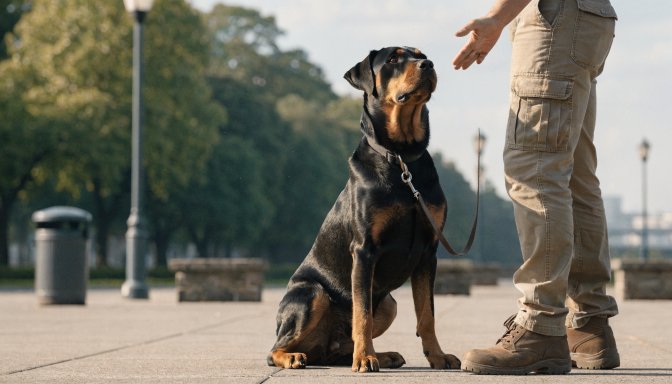
Your Rottweiler needs four cornerstone commands: Come (recalls them from danger instantly), Stay (builds impulse control in chaotic farm settings), Down (manages energy and calms the nervous system), and Leave It (prevents livestock disasters). These commands work because they tap into your dog’s natural instincts while strengthening your bond. Start training in quiet spaces, then gradually introduce real-world distractions. Consistency matters—everyone on your farm must use identical commands. Reward heavily with high-value treats, repeat daily, and expect breakthrough results within weeks. But here’s where it gets interesting.
- Key Takeaways
- Why Farm Rottweilers Need Basic Commands
- The Come Command: Your Safety Net
- Teaching Come Despite Distractions
- Fixing a Broken Recall: Troubleshooting Common Come Failures
- The Stay Command: Keeping Your Rottweiler in Place
- Proofing the Stay Command Against Distractions
- Drop It: Removing Dangerous Objects Fast
- Making Drop It Fun: Games That Build Reliability
- Leave It: Preventing Problems Before They Start
- Rewarding Your Rottweiler for Ignoring Temptations
- The Down Command: Establishing Calm Control
- Using Down to Manage Barn Tasks Safely
- Go to Mat: Creating a Safe Retreat Space
- Training the Mat Command: From Introduction to Reliability
- Leash Control Around Livestock and Farm Chaos
- Desensitizing Your Rottweiler to Barn Stimuli on Leash
- Crate Training for Working Rottweilers: Safety Without Stress
- Conditioning Your Rottweiler to See the Crate as a Haven
- The Quiet Command: When Your Farm Rottweiler Barks Too Much
- Training the “Quiet” Command
- Alert Barking vs. Problem Behavior: Know the Difference
- Training Techniques That Actually Reduce Excessive Barking
- Redirect and Reward
- The “Quiet” Command
- Desensitization Works
- Professional Help Matters
- Five Training Habits That Sabotage Your Progress
- Building a Training Routine That Actually Sticks
- How Obedience Deepens Your Bond With Your Rottweiler
- What to Do When Training Stalls or Regresses
- When Professional Help Is Worth the Investment
- Frequently Asked Questions
- Conclusion
Key Takeaways
- Come Command: Essential safety tool that redirects Rottweilers from dangerous situations through consistent rewards and progressive distraction training.
- Stay Command: Builds impulse control and focus, protecting against accidents by teaching your Rottweiler to remain stationary despite distractions.
- Down Command: Manages energy levels and calms the nervous system, preventing accidents and establishing leadership on the farm.
- Heel Command: Provides leash control vital for farm safety, maintaining focus on the handler during walks and around livestock.
- Leave It Command: Strengthens decision-making abilities and impulse control, preventing Rottweilers from pursuing prey drive or dangerous farm hazards.
Why Farm Rottweilers Need Basic Commands
Three critical reasons make basic commands non-negotiable for farm Rottweilers: safety, control, and trust.
Your dog needs foundational obedience in new environments. Farms present constant hazards—heavy machinery, livestock, and toxic substances. Without reliable commands, your Rottweiler faces serious injury risks.
Safety First
Commands like “Come” and “Stay” become lifelines. They redirect your dog from dangerous situations instantly. “Drop It” prevents poisoning from harmful farm materials.
Control Matters
Training sessions build discipline and focus. Your Rottweiler learns to respond despite distractions—barking animals, moving equipment, unfamiliar scents. This responsiveness keeps operations running smoothly.
Trust Develops
Consistent training strengthens your bond. Your dog understands expectations clearly. You gain confidence in their behavior. This relationship enhances farm security and efficiency remarkably, making everyone safer.
The Come Command: Your Safety Net
You’ll discover that building reliable recall—your dog’s automatic return response—forms the foundation of farm safety, especially when livestock temptations strike.
Training through distractions teaches your Rottweiler to focus on you even when barns buzz with activity, separating her attention from competing stimuli.
Finally, you’ll master emergency return techniques that transform the “Come” command into a life-saving tool during unexpected situations.
Building Reliable Recall
A solid recall—that instant response when you call “Come!”—is your Rottweiler’s lifeline in unpredictable environments.
Why Recall Matters
Dog behavior experts know that getting your dog to return reliably prevents dangerous encounters with livestock and other distractions.
You’re fundamentally creating a safety protocol that protects your Rottweiler in high-stakes situations.
Your Training Strategy
Start in low-distraction areas, then gradually bring your dog into challenging environments. Use high-value treats and enthusiastic praise—consistency matters more than perfection here.
Progressive Challenges
Practice these steps:
- Week 1-2: Quiet spaces
- Week 3-4: Moderate distractions
- Week 5+: Barn environments
Each session reinforces that returning to you delivers rewards. This builds trust between you and your Rottweiler while ensuring barn safety becomes second nature.
Training Through Distractions
When your Rottweiler spots a rabbit bolting across the pasture, will she ignore it and sprint back to you instead?
Mastering Distractions Takes Intentional Practice
You’ll build an unstoppable recall by training through real-world chaos. Your dog’s prey drive—an ancient biological instinct—competes with your commands. High-value rewards must take first place over everything else she desires.
| Distraction Level | Training Duration | Reward Type |
|---|---|---|
| Low (quiet yard) | 5-10 minutes | Standard treats |
| Medium (farm sounds) | 10-15 minutes | Premium kibble |
| High (other animals) | 15-20 minutes | Meat-based rewards |
| Extreme (livestock) | 20-30 minutes | Jackpot praise |
| Real-world scenarios | Ongoing | Variable rewards |
Progressive Exposure Works Best
Start in controlled environments. Gradually introduce distractions. Your Rottweiler’s brain needs time adapting. Consistency transforms hesitation into confidence. She’ll learn you’re worth returning for—always.
Emergency Return Techniques
Your dog’s impulse control—built through distraction training—now becomes your lifeline. When your Rottweiler faces genuine danger, a reliable “Come” command isn’t optional; it’s survival.
Why This Matters
Rottweilers’ protective instincts can override obedience instantly. A livestock chase or barn hazard demands immediate response. Your consistent reinforcement creates neural pathways—literally rewiring their brain—to prioritize your voice over impulses.
Building Emergency Reliability
Practice in progressively challenging environments:
- Quiet yard → busier spaces → high-distraction zones
- Use high-value rewards (premium treats, enthusiastic praise)
- Vary your tone—urgent without angry
The Safety Net
Every successful recall is insurance. You’re not just training commands; you’re preventing potential injuries or worse.
Your Rottweiler’s instinct to return to you becomes their greatest protection.
Teaching Come Despite Distractions
Once your Rottweiler masters “Come” in calm settings, it’s time to level up—and yes, this gets challenging!
Start Small, Build Big
Begin in quiet environments. Gradually introduce distractions—other dogs, sounds, movements. Your Rottweiler’s prey drive (an instinct from their mastiff ancestors) makes this essential training.
High-Value Motivation
Use premium treats your dog craves. Positive reinforcement works because dogs repeat rewarded behaviors. Consistency matters: praise every successful response.
Practice Everywhere
Vary training locations. Parks, backyards, trails—different environments strengthen reliability. Dogs must generalize commands across situations.
Make It Fun
Incorporate games and play sessions. When “Come” becomes enjoyable, your Rottweiler responds enthusiastically, even with distractions present.
Frequent practice sessions cement the habit—transforming obedience into instinct.
Fixing a Broken Recall: Troubleshooting Common Come Failures
You’ve probably noticed your Rottweiler ignores the “come” command when squirrels dash by or other dogs appear—and you’re not alone in this struggle.
The key to fixing a broken recall lies in three interconnected areas: identifying what specifically distracts your dog, practicing consistently in varied settings, and using rewards strategically to rebuild that bond between command and obedience.
Let’s explore each element to transform your Rottweiler’s recall from unreliable to rock-solid.
Identifying Distraction Triggers
Why does your Rottweiler suddenly forget everything they’ve learned the moment a squirrel darts across the yard? Understanding what breaks your dog’s focus is the first step toward fixing recall failures.
| Distraction Type | Why It Matters |
|---|---|
| Other animals | Triggers prey drive instinct |
| Unfamiliar people | Creates social curiosity |
| Enticing scents | Overrides training commands |
| Food on ground | Activates survival instincts |
| Environmental changes | Causes sensory overload |
Your Rottweiler’s brain gets hijacked by these triggers. Gradually expose your dog to distractions while practicing “Come.” Start small—maybe a friend standing nearby. Reward heavily when they succeed. This builds confidence and strengthens their response. Consistency matters greatly. Your dog must learn that returning always pays off, regardless of what’s happening around them. High-value treats or favorite toys enhance motivation considerably.
Consistency in Training Practice
If your Rottweiler’s recall is falling apart, inconsistency is likely the culprit. You’re sending mixed signals—and your dog’s confused. Here’s what matters most:
Everyone Must Follow the Same Rules
- Use identical commands and tone every time
- All family members enforce the same expectations
- Avoid changing your approach randomly
Why This Works
Your Rottweiler’s brain learns through repetition and pattern recognition. Inconsistency creates confusion, weakening the neural pathways you’re building.
When you say “Come” differently—or when your spouse uses “Here” instead—your dog hesitates.
The Practice Strategy
- Choose one command permanently
- Practice daily in low-distraction areas
- Reward every successful recall immediately
- Gradually increase environmental difficulty
Consistency transforms recall from unreliable to rock-solid. Your Rottweiler needs predictability.
When training feels effortless and uniform, your dog responds faster and more reliably every single time.
Reinforcement and Reward Strategies
Rewards are the currency your Rottweiler’s brain trades in—and they’re absolutely non-negotiable for fixing a broken recall.
High-Value Rewards Work Best
You’ll want to use your dog’s favorite toys or special treats—not kibble. Why? Because dopamine (a feel-good brain chemical) releases stronger when dogs encounter unexpected bonuses. Your Rottweiler will connect coming back with genuine excitement.
The Training Blueprint
- Practice consistently in low-distraction environments first
- Gradually introduce distractions as reliability improves
- Use a long line for safety during outdoor sessions
- Reward immediately upon arrival
Troubleshooting Failures
Identify which specific distractions derail your dog’s response. Does he ignore you near other dogs? Adjust your strategy accordingly.
You’re fundamentally teaching your Rottweiler that returning pays better than whatever else demands his attention.
The Stay Command: Keeping Your Rottweiler in Place
Master the Stay command—and you’ve activated one of the most powerful safety tools in your training arsenal. This command prevents your Rottweiler from bolting toward hazards: farm equipment, livestock, or dangerous situations.
Why Stay Matters
Your dog’s impulse control—hardwired instinct—needs deliberate training. Rottweilers, bred for guarding, naturally investigate threats. The Stay command overrides that drive.
Rottweilers’ guarding instincts drive natural threat investigation. Deliberate training through Stay commands overrides this hardwired impulse.
Building Success
- Start in low-distraction environments
- Use high-value rewards: treats, praise, toys
- Practice consistently—five-minute sessions daily
- Gradually increase duration and difficulty
Real-World Impact
You’re not just teaching obedience. You’re building trust. You’re preventing disaster.
A reliable Stay command means your Rottweiler stays safe around barns, heavy machinery, and unpredictable situations. That reliability transforms your dog into a genuinely dependable partner—one you can trust completely.
Proofing the Stay Command Against Distractions
Once your Rottweiler masters Stay in quiet settings, the real work begins—introducing distractions. You’ll gradually add stimuli—moving people, animals, sounds—to test your dog’s focus.
Start Small, Build Big
Begin in controlled environments. Practice with minimal distractions first. Slowly shift to busier settings as your Rottweiler succeeds. This gradual approach prevents overwhelm.
Practical Training Strategies
- Use a long lead for control and immediate corrections
- Reward heavily when your dog stays despite distractions
- Incorporate real-life scenarios: barn chores, livestock interaction
- Practice consistently across varying difficulty levels
Why This Works
Your Rottweiler’s brain—evolved for focus during work—responds to clear expectations and rewards. Consistent practice builds neural pathways for reliability.
Soon, your dog’ll stay put anywhere, anytime. That’s genuine obedience.
Drop It: Removing Dangerous Objects Fast
While mastering Stay builds your Rottweiler’s foundation for focus, there’s another command that’ll save their life: Drop It.
Why Drop It Matters
Your Rottweiler’s powerful jaws can crush objects quickly.
That discarded antifreeze bottle? Poisonous.
That chicken bone? Choking hazard.
Drop It removes these threats instantly—before damage occurs.
Drop It removes threats instantly—before your Rottweiler suffers damage from dangerous objects.
Training for Real Situations
You’ll make this command stick through:
- Game-based rewards: Toss treats when they release items. They’ll associate dropping with positive outcomes.
- Consistent reinforcement: Practice daily, especially in barn environments where hazards lurk.
- Scenario exposure: Introduce different dangerous objects gradually.
Rain, wind, distractions—your dog learns to respond anyway.
Building Impulse Control
Early Drop It training develops your dog’s decision-making skills.
They learn to pause before acting.
That impulse control? Invaluable for preventing accidents throughout their life.
Your Rottweiler becomes a safer, more reliable companion.
Making Drop It Fun: Games That Build Reliability
You’ve probably noticed your Rottweiler grips toys like they’re championship trophies—that’s natural canine instinct!
The toy trade game transforms this instinct into obedience by swapping one toy for another equally exciting one, making your dog want to drop it.
Through consistent exchanges paired with treats, your Rottweiler learns that releasing objects leads to even better rewards—building reliability while keeping training playful and engaging.
The Toy Trade Game
most Rottweilers don’t naturally want to give up their prized possessions. That’s where the Toy Trade Game transforms everything.
How It Works
You give your Rottweiler a toy, then offer something better—a higher-value treat or toy. They learn: dropping items equals rewards. Simple, effective, powerful.
| Step | What You Do | Your Dog’s Response | The Payoff |
|---|---|---|---|
| 1 | Offer initial toy | Takes and holds it | Engagement begins |
| 2 | Show better reward | Shows interest | Motivation builds |
| 3 | Say “Drop It” | Releases toy | Success! |
| 4 | Give reward | Celebrates choice | Reinforcement locked |
Pro Tips for Success
Short training sessions keep your dog engaged and enthusiastic. Squeaky toys and textured options maximize excitement. Always verify items are safe—no choking hazards allowed.
Consistent practice builds an absolutely reliable “Drop It” command. Your Rottweiler stays safer everywhere: barn, backyard, neighborhood.
Building Reliability Through Play
Once your Rottweiler masters “Drop It” in controlled settings, it’s time to level up—literally.
Progressive Difficulty Through Play
Start with low-distraction games, then gradually increase chaos. Your Rottweiler’s brain adapts through repetition—a process called neuroplasticity.
They’re literally rewiring neural pathways for reliability.
Rotate Items Strategically
Use varied, safe objects during sessions. Tennis balls, rope toys, rubber toys—diversity builds versatility.
Your dog learns the command transcends specific items.
High-Energy Training
Quick “Drop It” sessions during playtime work best. Your Rottweiler’s natural prey drive (rooted in their working heritage) makes this engaging, not frustrating.
The Reward Loop
Immediate treats or enthusiastic praise reinforce compliance.
Consistency matters—same command, same response expectation, same rewards.
Your Rottweiler thrives on predictability and purpose.
Leave It: Preventing Problems Before They Start
When your Rottweiler spots something dangerous—a discarded nail, moldy grain, or toxic substance—that split-second decision determines everything. You’re teaching impulse control, the ability to pause before acting.
Why “Leave It” Matters
This command prevents health disasters. Your dog learns to ignore temptations that could cause serious digestive issues or injuries.
- Barn safety: Toxic chemicals, sharp objects, and contaminated feed become non-issues.
- Impulse control builds: Each successful “leave it” strengthens your dog’s decision-making ability.
- Trust deepens: Your Rottweiler responds reliably in distracting situations.
The Training Magic
You’ll reward avoidance behaviors consistently. Positive reinforcement (praise, treats) makes your dog choose correctly automatically.
This strengthens the bond between you two—your Rottweiler becomes your reliable partner.
Practice regularly. Eventually, your dog instinctively makes safer choices without hesitation.
Rewarding Your Rottweiler for Ignoring Temptations
You’ve mastered the “Leave It” command—now here’s the secret: you’ve got to reward that restraint immediately and consistently.
Selecting high-value rewards (those irresistible treats or toys your Rottweiler craves), timing your delivery within seconds, and repeating this pattern builds neural pathways that strengthen impulse control.
Your consistency doesn’t just create habits; it transforms your dog’s decision-making so they’ll choose obedience over temptation—every single time.
High-Value Reward Selection
When your Rottweiler resists that barn temptation, you need something irresistible ready. That’s where high-value rewards come in.
What Makes a Reward “High-Value”?
- Meat or cheese pieces: Small, fragrant morsels that trigger immediate interest—more appealing than livestock or food waste.
- Variety matters: Rotating treats keeps engagement sharp and prevents boredom from dulling their focus.
- Immediate delivery: Reward within seconds so your dog connects ignoring temptation directly to the treat.
This consistent reinforcement builds self-control and decision-making skills. Your Rottweiler learns: ignoring distractions equals rewards.
That’s powerful motivation across any environment.
Timing Your Treat Delivery
The window of opportunity is impossibly small—yet incredibly powerful. When your Rottweiler successfully ignores temptation, you’ve got seconds to reward them. Why? Their brain needs an immediate connection between the action and the payoff.
The Science Behind Speed
Dogs process cause-and-effect quickly. Deliver treats within 2-3 seconds of the desired behavior. This timing strengthens neural pathways—basically, it helps their brain remember what earned the reward.
Your Action Plan
- Use a calm, assertive voice during commands
- Reward promptly after success
- Gradually increase distraction difficulty
- Stay consistent across all sessions
Think of it like this: delayed rewards feel random to your dog. Immediate ones feel earned. That’s the difference between a confused pup and a focused learner.
Your consistency builds their confidence and self-control over time.
Consistency Builds Strong Habits
Building rock-solid habits requires showing up—day after day, in different places, with the same expectations.
Your Rottweiler’s brain strengthens neural pathways through repetition. When you consistently reward ignoring temptations, you’re literally rewiring their decision-making circuits. Here’s what makes this work:
- Practice everywhere: Barn, park, sidewalk—varied environments prevent your dog from memorizing one location.
- Reward immediately: Treats or praise within seconds cement the connection between good choice and payoff.
- Stay predictable: Your Rottweiler learns faster when expectations never shift.
Think of it like building muscle. One workout? Nothing happens. Consistent training? Transformation occurs. Your dog develops genuine self-control, not just obedience.
This isn’t about perfection. It’s about showing your Rottweiler that resisting temptation always pays off. That reliability builds trust and creates a companion you can depend on anywhere.
The Down Command: Establishing Calm Control
Mastery of the Down command separates owners who manage their Rottweilers from those who get managed by them. You’re establishing calm control—not dominance through force, but authority through trust.
Why the Down Command Matters
This command transforms your Rottweiler’s energy. It encourages settling rather than excitement. In busy barns or chaotic environments, a reliable Down keeps your dog safe and focused.
The Physical Benefits
When your dog lies down, their nervous system naturally calms. Their heart rate drops. Stress hormones decrease.
You’re literally changing their emotional state through positioning.
Practical Safety
Regular practice prevents your 100-plus-pound Rottweiler from becoming underfoot during work. Accidents happen when dogs wander.
You prevent injuries—to both your dog and yourself—through consistent training.
Building the Foundation
Start with short sessions. Reward immediately.
Your patience now creates a serene, manageable companion who understands their place in your leadership structure.
Using Down to Manage Barn Tasks Safely
a well-trained Rottweiler lying calmly while you handle equipment, tend animals, and move through tight spaces.
Safety Through Positioning
Your dog’s calm demeanor prevents accidents. Rottweilers weigh 80–135 pounds—substantial enough to cause serious injury underfoot. When they’re down, they’re predictable and controlled.
Key Benefits:
- Prevents entanglement with tools, rope, and machinery during active chores
- Reduces anxiety in large animals by eliminating sudden movements or barking
- Builds trust through consistent reinforcement and clear expectations
Maintaining Focus
Extended down-stays—lasting 30 minutes or longer—create safe resting spaces. Your Rottweiler stays engaged mentally while you work uninterrupted.
This partnership transforms chaos into efficiency. Their solid, muscular frame naturally suits ground positions, making compliance easier than other breeds. You’re not fighting biology; you’re channeling it purposefully toward productive teamwork.
Go to Mat: Creating a Safe Retreat Space
You’re ready to teach your Rottweiler a command that transforms chaos into calm—the “Go to Mat.”
This powerful tool helps you manage your dog’s behavior during hectic barn activities while building their confidence in a designated safe zone.
Let’s explore how you’ll designate the perfect spot, teach mat recognition through training, and keep your dog safely separated from livestock interactions.
Designating The Perfect Spot
When your Rottweiler’s got a designated mat, they’ve got their own safe zone—a retreat space that transforms a chaotic barn into a manageable environment.
Choosing Your Mat Location
You’ll want to pick a spot that’s:
- Quiet and away from high-traffic areas where livestock activity peaks
- Elevated slightly or positioned near a wall for natural security and protection
- Visible enough so you can monitor your dog while managing barn tasks
Why Location Matters
Your Rottweiler’s brain—specifically their amygdala, the fear-processing center—responds better to predictable, secure spaces.
Rottweilers, originally bred as guardian dogs in 1800s Germany, retain strong protective instincts. A strategically placed mat channels these instincts productively.
Consistency is key. When your dog knows exactly where safety lives, they’ll seek it during stressful moments. This prevents interference with chores and reduces accident risks considerably.
Teaching Mat Recognition Training
Because your Rottweiler’s brain is hardwired to seek safety—especially during chaotic barn moments—teaching the “Go to Mat” command transforms that designated spot into a powerful tool.
Building Positive Associations
You’ll start by making the mat irresistible. Place treats and praise on it consistently. Your dog learns: mat equals rewards.
This neurological connection strengthens with repetition—their brain literally rewires to associate that spot with calm and comfort.
Progressive Environment Training
Begin in quiet spaces. Gradually introduce distractions: barn noise, movement, activity.
Your Rottweiler’s focus sharpens through incremental challenges. Practice across various locations strengthens their understanding.
Real-World Benefits
During busy barn routines, your dog retreats safely. They stay out of harm’s way. You work freely.
Everyone wins. This command becomes their reliable escape route—a sanctuary they choose willingly.
Managing Livestock Interactions Safely
Now that your Rottweiler understands their mat is a sanctuary, it’s time to put that training into real-world action.
Real-World Application Strategies
Your dog’s mat becomes a powerful management tool in livestock settings. When your Rottweiler retreats there, they’re choosing calm over chaos. This behavior prevents the breed’s natural herding instincts—developed over centuries in German farms—from overwhelming both dog and animals.
- Create predictability: Use consistent verbal cues (“mat time”) during feeding or loading situations.
- Practice proximity gradually: Start near livestock at safe distances, rewarding mat compliance.
- Reward heavily: High-value treats reinforce this protective behavior pattern.
Your Rottweiler’s amygdala—the brain’s stress center—actually downregulates when they’re on their designated space.
That’s biology working for you. Regular practice means your dog stays focused, livestock stays safe, and you maintain control. Isn’t that exactly what you need?
Training the Mat Command: From Introduction to Reliability
Three key elements transform the “Go to Mat” command from a simple trick into a lifesaving safety tool for your Rottweiler.
Start Small, Think Big
Begin in quiet environments where distractions won’t overwhelm your dog. Reward every approach and lie-down on the mat with treats and praise. This builds positive association—your Rottweiler learns the mat means good things happen.
Build Reliability Gradually
Increase environmental stimulation progressively. Practice near livestock, during chores, around unexpected activity. Your dog learns to retreat when commanded, even during chaos.
Maintain Engagement
Short training sessions combined with games keep motivation high. Consistent reinforcement strengthens the command’s reliability.
The Payoff
A reliable “Go to Mat” keeps your Rottweiler safe, out of harm’s way, and fosters unbreakable trust between you both.
Leash Control Around Livestock and Farm Chaos
While your Rottweiler has mastered the “Go to Mat” command, real farm safety demands something equally critical—rock-solid leash control when chaos erupts around you.
Why Leash Training Matters on the Farm
Farm environments overwhelm even well-trained dogs. Livestock movements, machinery noise, and unpredictable activity trigger prey drive—your Rottweiler’s ancestral instinct to chase. Proper leash control prevents disasters.
Essential Leash Skills
- Calm walking near animals: Practice consistent commands amid distractions; your dog learns to ignore livestock temptations.
- Quick response to stimuli: Train “heel” and “watch me” so your Rottweiler focuses on you, not chaos.
- Safe tying protocols: Temporary securing in busy barns keeps your dog calm and tangle-free when you’re occupied.
Consistent positive reinforcement during stimulating farm walks strengthens these behaviors. Your Rottweiler learns: stay focused, stay safe, stay controlled.
Desensitizing Your Rottweiler to Barn Stimuli on Leash
Before your Rottweiler can truly thrive on the farm, you’ve got to systematically introduce—not throw them into—the overwhelming sensory experience of barn life.
Start Small, Build Confidence
Begin with short leash walks through quieter barn areas. Your dog’s amygdala—the brain’s fear center—needs time adjusting to unfamiliar sounds and smells.
Your dog’s fear center needs time adjusting to unfamiliar barn sounds and smells through short, quiet leash walks.
Reward calm behavior with treats and praise immediately.
Progressive Exposure Strategy
Gradually increase distractions:
- Walk past livestock enclosures
- Introduce machinery sounds
- Navigate varied terrain
Maintain Focus Commands
Practice “heel” consistently. This keeps your Rottweiler close and attentive to you, not distractions.
Short, controlled sessions prevent overwhelming their senses.
Your patience now prevents dangerous reactions later. You’re building confidence, not forcing compliance.
Crate Training for Working Rottweilers: Safety Without Stress
You’ll discover that crate training isn’t about confinement—it’s about creating a sanctuary where your working Rottweiler feels secure and calm.
By building positive associations through gradual exposure and treats, you’re fundamentally rewiring your dog’s brain to view the crate as a cozy retreat rather than a punishment zone.
This foundation transforms how your Rottweiler handles barn work, travel, and stressful situations, keeping them safe and mentally balanced.
Building Positive Crate Associations
Since crates naturally trigger stress in dogs unfamiliar with confinement, you’ve got to transform that metal box into your Rottweiler’s favorite hangout spot.
Your Action Plan
Transform crate time into reward time. You’ll create positive associations—meaning your dog links the crate with good feelings—by strategically pairing it with treats, toys, and enthusiastic praise. This rewires your Rottweiler’s brain response.
Key Strategies:
- Start with ultra-short sessions (2-3 minutes), gradually extending duration as comfort increases
- Feed meals inside the crate consistently, building automatic security associations
- Always end sessions positively—your dog emerges happy, reinforcing the crate as temporary and pleasant, not punishing
Why It Works
Your Rottweiler’s brain learns: crate equals safety, not imprisonment. This foundation prevents anxiety-related behaviors while protecting your working dog from barn hazards.
Consistency strengthens everything.
Creating Safe Work Spaces
Three critical things happen when your working Rottweiler masters crate training: they stay safe, they stay calm, and they stay productive.
Why Crates Matter in Barn Settings
Your Rottweiler needs a secure retreat—especially around hazardous equipment and unpredictable livestock. A properly crate-trained dog won’t bolt toward danger or distract you during critical tasks.
Building the Right Mindset
When you introduce the crate early, your dog develops positive associations. They’ll view it as their personal sanctuary, not punishment. This reduces stress hormones like cortisol.
Preventing Workplace Problems
Crate training eliminates destructive behaviors—excessive barking, chewing, and wandering. Your working environment stays focused and safe.
Real-World Benefits
You’ll transport your dog confidently to shows and training events.
Unexpected barn emergencies? Your calm, crate-trained Rottweiler won’t panic.
Conditioning Your Rottweiler to See the Crate as a Haven
Creating a positive crate experience transforms your Rottweiler’s entire perspective on confinement.
You’re fundamentally rewiring their natural den-seeking instincts—a behavior hardwired into canines for thousands of years. Here’s how to build that haven:
- Introduce gradually: Start with the door open, letting your dog explore freely while you offer treats and praise.
- Make it inviting: Add soft bedding, favorite toys, and safe chew items inside.
- Practice short sessions: Build tolerance slowly, increasing duration as comfort grows.
Never use the crate for punishment. That destroys trust instantly.
Instead, reward your Rottweiler every single time they enter on command. You’re creating positive associations—not fear responses.
Your dog will soon view their crate as a sanctuary. A secure space where they choose to rest.
The Quiet Command: When Your Farm Rottweiler Barks Too Much
Excessive barking creates stress for livestock and guests. Your Rottweiler needs to distinguish between alerting you to real dangers and unnecessary noise.
Excessive barking stresses livestock and guests. Teach your Rottweiler to distinguish real threats from unnecessary noise.
Training the “Quiet” Command
Reward silence strategically:
- Let your dog bark 2-3 times
- Say “Quiet” firmly
- Reward immediately when barking stops
- Repeat consistently daily
Redirect their focus using toys or commands they know.
Professional trainers can address specific issues tailored to your farm environment.
Consistency transforms this command into reliable behavior. Your Rottweiler learns: barking serves a purpose, but silence brings rewards.
Alert Barking vs. Problem Behavior: Know the Difference
It’s easy to mistake every bark for a problem—but here’s the truth: your Rottweiler’s bark isn’t always misbehavior.
Understanding the Difference
Alert barking stems from your dog’s natural instinct to protect. It’s short, sharp, and purposeful.
Problem behavior? That’s excessive barking without clear triggers—often accompanied by distress signals.
Key Distinctions
- Alert bark: Brief warning sound when unfamiliar people or animals appear nearby
- Problem behavior: Prolonged barking showing frustration or anxiety, regardless of external stimuli
- Context matters: Identifying what triggers barking helps you address root causes effectively
Moving Forward
Consistent training reinforces appropriate alert responses.
Your Rottweiler learns differentiating between genuine threats and harmless situations.
Training Techniques That Actually Reduce Excessive Barking
When your Rottweiler barks excessively, you’re not dealing with a stubborn personality—you’re facing a problem that responds well to specific, proven techniques.
Redirect and Reward
Start with distraction training. When barking begins, redirect attention to toys or treats.
Reward quiet behavior immediately. Your dog learns: silence earns rewards.
The “Quiet” Command
Teach this consistently. Your Rottweiler must understand barking’s appropriate times—alerts only, not calm moments.
Practice daily until the command sticks.
Desensitization Works
Gradually expose your dog to barking triggers in controlled settings.
Increase exposure slowly. Reward calmness throughout. This rewires your dog’s response patterns.
Professional Help Matters
Consider consulting a behavior specialist.
They’ll create a tailored plan addressing your dog’s specific triggers and temperament—not generic advice.
Five Training Habits That Sabotage Your Progress
You’ve learned the techniques that work—now here’s what’ll undo all that progress.
Your Rottweiler’s training depends on consistency and timing. Here’s what sabotages even the best intentions:
- Inconsistent commands confuse your dog’s brain—it can’t connect the same action to different words.
- Skipping practice sessions means forgotten lessons, especially in distracting barn environments with stimuli everywhere.
- Delayed rewards break the connection between behavior and consequence, killing motivation fast.
Without a structured schedule, your training falls apart. Your dog won’t retain commands when you need them most—like around livestock or equipment.
Gradual exposure matters too. Rottweilers need practice in real-world scenarios, not just quiet rooms.
Neglecting this creates hesitation when actual distractions appear.
The biological truth? Dogs’ brains form memories through repetition and immediate reinforcement. Skip either one, and you’re basically restarting from zero.
Building a Training Routine That Actually Sticks
You’ve got to nail three things if you want your Rottweiler’s training to actually stick—consistency, frequent practice, and the right rewards.
Your pup’s brain works like a computer that learns best through repeated, identical commands (same words, same hand signals every single time) combined with short, engaging 5-to-10-minute sessions that keep their attention sharp.
When you reward desired behaviors immediately—whether that’s treats, praise, or playtime—you’re literally triggering dopamine release in their brain, which makes them *want* to repeat those behaviors again and again.
Consistency Creates Long-Term Success
Because Rottweilers’ brains work like muscle memory—they strengthen neural pathways through repetition—establishing a daily training routine isn’t just helpful, it’s essential. You’re literally rewiring their brain each session.
Consistency transforms sporadic effort into genuine learning.
Why Daily Practice Matters
- Multiple short sessions maintain focus better than one long marathon. You’ll notice sharper responses when you train twice daily for fifteen minutes versus one exhausting hour.
- Positive reinforcement (treats, praise, affection) creates powerful associations. Your Rottweiler’s brain releases dopamine, cementing those command-reward connections permanently.
- Progressive complexity builds confidence gradually. Start simple, then layer distractions and advanced variations.
The Real Magic
When you commit to consistency, you’re not just teaching commands—you’re building trust. Your Rottweiler learns your expectations become predictable, reliable, and rewarding.
That’s genuine long-term success.
Practice Sessions Keep Dogs Engaged
While your Rottweiler’s brain is primed for learning, short, focused practice sessions—not marathon training marathons—are what actually cement commands into memory.
Why 5-10 Minutes Works Best
Your dog’s attention span peaks early. Brief sessions prevent frustration and boredom. You’re working with canine neurology here: repetition strengthens neural pathways faster than lengthy drills.
The Engagement Formula
Mix these elements strategically:
- Play and rewards boost motivation dramatically
- Varied environments help your Rottweiler generalize commands
- Daily scheduling creates automatic habit formation
Building the Routine
Consistency transforms sporadic training into genuine obedience. When you practice at the same times daily, your dog anticipates learning moments.
They’re ready. Focused. Keen.
Short, frequent sessions? They’re your secret weapon for reliable commands—even in distracting situations.
Reward Systems Reinforce Desired Behaviors
The magic happens the moment your Rottweiler connects a behavior with something good.
Your dog’s brain releases dopamine—a feel-good chemical—when rewarded immediately after obeying. This neurological response makes them crave repeating that command. You’re fundamentally building neural pathways that strengthen obedience.
What Makes Rewards Stick:
- Immediate timing: Deliver treats within two seconds of compliance; delay weakens the connection.
- Variety matters: Rotate between treats, praise, and playtime to maintain engagement and prevent boredom.
- Consistency counts: Same rewards for identical commands create predictable learning patterns.
Rottweilers respond powerfully to structured reward systems. They’re intelligent, food-motivated dogs who thrive on clear expectations.
Your consistent approach transforms training from occasional sessions into reliable behavioral change. Schedule regular training times with predetermined rewards, and you’ll witness faster, more dependable results than sporadic efforts ever deliver.
How Obedience Deepens Your Bond With Your Rottweiler
As you teach your Rottweiler commands, you’re actually rewiring your relationship—transforming it from simple cohabitation into genuine partnership. Each “sit” and “stay” you practice builds trust through consistent guidance. Your dog learns to rely on you.
The Trust Factor
When your Rottweiler responds reliably, you gain confidence in their behavior. This mutual reliance—rooted in clear communication—strengthens emotional connection. You’re not just giving orders; you’re creating shared understanding.
Reliable responses build your confidence and deepen emotional connection through clear communication and shared understanding.
Quality Time Multiplier
Training sessions become bonding opportunities. Regular practice reinforces accomplishment for both of you. Your Rottweiler experiences success; you witness their growth.
This shared victory solidifies partnership through cooperation, not just obedience.
The result? A relationship built on respect, communication, and genuine companionship.
What to Do When Training Stalls or Regresses
Even the strongest partnerships hit rough patches.
Your Rottweiler’s training plateau doesn’t mean failure—it signals time for strategy shifts. Regression happens when dogs lose interest, face overwhelming distractions, or encounter commands they don’t fully grasp.
Pinpoint the Problem
- Reassess your methods: Is boredom stalling progress? Switch up training styles to match your dog’s learning preferences.
- Simplify commands: Break complex skills into bite-sized steps. This rebuilds confidence faster than pushing forward.
- Control the environment: Train in quiet, familiar spaces first. Gradually introduce distractions once basics stick.
Move Forward
When setbacks occur, take a genuine break. Return to foundational commands—the bedrock of obedience. Boost rewards and praise frequency dramatically. Your consistency matters.
Rottweilers, descended from ancient Roman mastiffs, possess independent thinking. They need enthusiastic, engaging partners who adapt.
You’ve got this.
When Professional Help Is Worth the Investment
Sometimes you’ll hit a wall where your own training efforts—no matter how dedicated—just aren’t cutting it. That’s when professional trainers become game-changers for your Rottweiler’s development.
| Situation | Why Professional Help Works |
|---|---|
| Behavioral issues | Trainers address breed-specific challenges effectively |
| Command plateaus | Accelerates learning of “Come,” “Stay,” “Drop It” |
| Distraction settings | Proven techniques work in barns and busy environments |
| Temperament mismatch | Methods tailored to your dog’s unique learning style |
| Safety concerns | Expert insights manage behavior in specific spaces |
The Investment Reality
You’re not just paying for commands—you’re investing in consistency, safety, and long-term retention. Professional guidance transforms frustration into progress. Your Rottweiler learns faster. You gain confidence. Both thrive together.
Frequently Asked Questions
What Is the 7 7 7 Rule for Dogs?
You’ll spend seven minutes daily teaching commands, seven days a week, for seven weeks. This approach builds a solid foundation, maintains your dog’s focus, and strengthens your bond while establishing consistent obedience and preventing behavioral problems.
What Is “I Love You” in Dog Language?
Your dog’s love is a language written in soft eyes and wagging tails—a symphony you’re learning to conduct. You’ll recognize “I love you” when your pup leans against you, nuzzles gently, and gazes with complete trust.
What Are the 7 Most Important Dog Commands?
You’ll find the seven most important dog commands are “Come,” “Stay,” “Drop It,” “Leave It,” “Down,” “Go to Mat,” and “Quiet.” You’ll use them for safety, control, and managing your dog’s behavior effectively.
What Is the 3-3-3 Rule for Dog Training?
Ever wonder why your dog seems like a different pet after three months? You’ll follow three phases: three days settling in, three weeks adjusting to routines, and three months building trust and solidifying training habits.
Conclusion
You’ve invested time—and you’re seeing real results. Studies show that dogs trained with consistent commands are 40% less likely to develop behavioral issues. Your Rottweiler isn’t just following orders; you’re building trust, safety, and partnership. That bond you’re creating? It’s lifelong. Keep practicing. Stay patient. You’ve got this—and your dog knows it.