Some of the links in this post are affiliate links. This means we may earn a small commission if you make a purchase through these links—at no extra cost to you. We only recommend products and tools that we genuinely believe will help you with your Rottweiler.
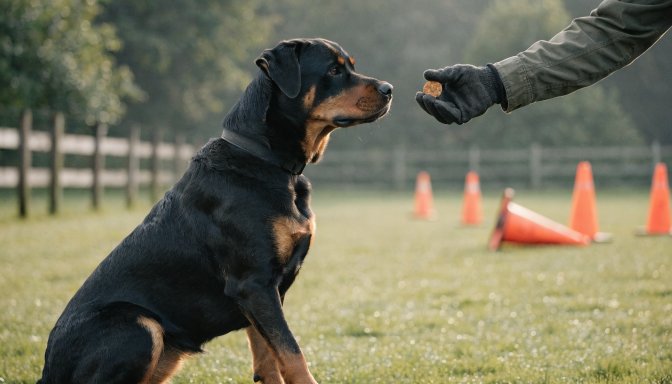
You’re starting at the most critical moment—your Rottweiler’s first week, when their brain is incredibly plastic and shaped by your leadership. Skip dominance; instead, establish calm authority through consistency and immediate rewards. Begin with three commands: sit, stay, come. Use five-minute training sessions to keep their attention sharp. Establish yourself as a confident leader—not through aggression, but through clear expectations and positive reinforcement. This foundation prevents behavioral problems later. Professional guidance transforms your approach and opens up lasting obedience patterns.
- Key Takeaways
- Why Rottweilers Need Leadership, Not Dominance
- Start Now: Why Week One Matters
- Become the Leader Your Rottweiler Respects
- Speak Once, Expect Results: Command Consistency
- First Month: Handling, Visitors, and Littermate Play
- Your First Three Commands: Sit, Stay, Come
- Leash Walking: From Comfort to Confident Heeling
- Stop Leash Pulling Before It Becomes Permanent
- Socialization: Your Defense Against Problem Behaviors
- Prevent Reactivity Toward Other Dogs
- Teach Bite Inhibition Now (Before It’s Too Late)
- Why Short Training Sessions Win With Puppies
- Rewards Work Better Than Corrections (Science Proves It)
- Potty Training and Crate Foundations
- Exercise Your Rottweiler’s Body and Mind
- Formal Training: When and What to Expect
- Your Rottweiler at Four Months
- Consistency Gaps That Break Obedience Training
- Year-One Goals: Realistic Expectations
- Common Mistakes Breeders and Owners Make
- Your Next Steps: Professional Training and Support
- Frequently Asked Questions
- Conclusion
Key Takeaways
- Start with leadership and calm authority rather than dominance to build trust and reduce anxiety in your Rottweiler.
- Begin training at 8-10 weeks when their brain is highly plastic and habits form most easily and permanently.
- Teach the first three commands—Sit, Stay, Come—using positive reinforcement with treats and short five-minute sessions.
- Practice leash training early around 8-9 weeks to prevent pulling from becoming a dangerous permanent habit in powerful dogs.
- Socialize your puppy before 16 weeks to rewire threat-detection systems and prevent fear-based reactivity and aggression later.
Why Rottweilers Need Leadership, Not Dominance
You might think dominance and leadership mean the same thing. They don’t. Dominance invokes fear and resistance—two things that sabotage obedience training.
Leadership, though? That’s guiding behaviors through positive reinforcement and consistent expectations.
Why This Matters for Your Rottweiler
When you establish clear leadership, you’re not bullying your dog. You’re becoming their reliable guide. Your Rottweiler feels secure knowing their role and boundaries.
This structured environment reduces anxiety and fosters cooperation.
Starting early prevents behavioral issues. It reinforces good habits from puppyhood onward.
Strong leadership transforms your Rottweiler into a trustworthy companion who manages their protective instincts beautifully.
Start Now: Why Week One Matters
You’ve got one shot during week one—and it’s a big one. Your Rottweiler’s brain is primed for learning after seven weeks of age, meaning the habits you establish now become the blueprint for their entire life.
Miss this critical socialization window, and you’re fighting uphill; nail it, and you’re building an obedient, confident companion from day one.
Foundation Sets Lifetime Habits
Because Rottweilers’ brains are remarkably plastic during their first 8-10 weeks—meaning they’re wired to absorb and cement lessons quickly—starting training early isn’t just helpful; it’s transformative.
Why Early Training Matters
Your puppy’s neural pathways are literally forming right now. Early training establishes neural connections that last a lifetime.
Think of it like setting concrete before it hardens—once those patterns solidify, changing them becomes exponentially harder.
Consistent Training Builds Automatic Responses
When you practice sit, stay, and basic commands repeatedly during week one, you’re not just teaching tricks.
You’re programming default behaviors. Your Rottweiler’s brain learns: This is how we operate.
The Habit Advantage
Puppies trained early develop self-discipline naturally.
They’ll follow commands instinctively—not begrudgingly. Consistent training transforms obedience from a struggle into your dog’s preferred way of living.
Start now. You’re literally shaping decades of behavior.
Critical Socialization Window Opens
While your Rottweiler puppy’s brain is cementing foundational obedience patterns, another critical window is simultaneously opening—and it won’t stay open forever.
This window? Early socialization—the period from birth through 16 weeks when your puppy’s experiences shape their entire personality.
Here’s what happens: your breeder’s daily handling from day one builds comfort with human touch. By week six or seven, you’ll introduce visitors and children in safe environments.
Why safe? Your puppy’s immune system is still developing—exposing them to viruses like Parvo could be devastating.
The stakes are high. Without consistent socialization now, you risk aggression or wariness later. Your actions during these precious weeks literally rewire your Rottweiler’s brain, determining whether they’ll embrace new experiences or fear them.
Don’t delay. This window closes fast.
Become the Leader Your Rottweiler Respects
You’ve got to establish yourself as the calm, confident leader your Rottweiler naturally craves—and you’ll do this through clear, consistent commands that show you’re genuinely in charge.
Your pup’s ancestors were bred for protection work, so they’re hardwired to respect strong, assertive guidance delivered with a steady demeanor.
Think of it this way: you’re not being bossy; you’re being the reliable pack leader who makes decisions your dog can trust and follow.
Establishing Clear Leadership Presence
Every successful Rottweiler owner knows this truth: your dog’s respect hinges on your ability to project calm confidence and decisive action.
Your Foundation for Rottweiler Training
Rottweilers—bred centuries ago as livestock guardians—possess natural instincts to follow strong leaders. You’ll establish leadership by remaining composed during training sessions. Your dog reads your body language, tone, and energy constantly.
Key Actions That Establish Leadership:
- Deliver commands with quiet authority, not aggression
- Follow through consistently on every expectation
- Reward obedience immediately with praise or treats
- Correct mistakes firmly but fairly—never emotionally
Why This Matters
When you establish leadership through predictability and calm confidence, your Rottweiler stops testing boundaries.
They understand where they stand in your household hierarchy. This clarity creates the respect necessary for reliable obedience and safe interactions.
Consistency In Command Reinforcement
Once you’ve established calm leadership, consistency becomes your most powerful training tool—and here’s why: your Rottweiler’s brain forms stronger neural pathways when commands stay identical and rewards arrive instantly.
Use the Same Language
Every training session demands identical verbal cues. “Sit” always means sit—never “get down” or “park it.” Your dog’s brain needs predictability to learn effectively.
Reward Immediately
Consistent reinforcement works best within seconds. When your Rottweiler obeys, deliver treats, praise, or playtime instantly. This creates an unbreakable mental link between command and action.
Keep Sessions Short
Five-minute training sessions maintain focus and prevent frustration. Your dog stays engaged, learning faster and remembering longer.
This approach strengthens your bond through trust and respect—exactly what Rottweilers crave.
Building Trust Through Structure
Consistency in commands lays the foundation—but leadership builds the house.
Your Rottweiler craves structure like wolves crave pack hierarchy. When you establish predictable routines, you’re tapping into their ancestral DNA. These powerful dogs—bred centuries ago as Roman war companions—respect clear boundaries.
| Training Methods | Duration | Frequency | Result |
|---|---|---|---|
| Short sessions | 5 minutes | Daily | Enhanced focus |
| Structured routines | Consistent times | Ongoing | Security boost |
| Positive reinforcement | Immediate rewards | Every session | Stronger trust |
| Clear commands | Firm voice | Repetitive | Respect building |
Short, engaging training sessions keep your Rottweiler locked in. You’re not just teaching obedience—you’re building trust through predictability.
When your dog knows exactly what happens next, anxiety drops. Confidence rises. Leadership emerges naturally.
Start at eight weeks old. Build that unshakeable bond today.
Speak Once, Expect Results: Command Consistency
The most powerful training tool you’ll ever hold isn’t a treat or a clicker—it’s your voice, used the same way every single time.
Why Command Consistency Matters
When you say “sit” today and “sit down” tomorrow, your Rottweiler’s brain gets confused. Dogs learn through pattern recognition—their neurons form stronger connections when stimuli repeat identically.
You’re fundamentally rewiring their neural pathways through consistent basic obedience training.
Your Command Consistency Blueprint
Pick one verbal cue per command. Always use identical words. Never vary it. This eliminates confusion and accelerates learning dramatically.
Reinforcement Seals the Deal
Pair your consistent command with positive consequences—treats, praise, or both. This repetition across different environments helps your Rottweiler generalize commands reliably.
Same voice. Same words. Same expectations. Results follow naturally.
First Month: Handling, Visitors, and Littermate Play
While your voice commands build obedience later, your Rottweiler puppy’s first month builds something equally essential—comfort with human touch and social confidence.
Daily Handling Matters
Handle your puppy consistently during week one. This early contact creates neural pathways—brain connections—that reduce fear responses later.
Strategic Visitor Introduction
Around weeks six or seven, introduce carefully screened visitors. This prevents virus exposure while boosting adaptability.
Children’s unpredictable movements and sounds? Perfect training for real-world scenarios.
Littermate Socialization
Keep puppies together until at least seven weeks. Littermates teach bite inhibition and social boundaries naturally—skills no human can replicate.
Next Steps
Enroll in puppy socialization classes once your vet approves. Professional puppy training environments accelerate development while protecting health.
These early months aren’t just cute moments; they’re biological windows shaping your Rottweiler’s entire personality and trainability.
Your First Three Commands: Sit, Stay, Come
Your puppy’s brain is primed—those early socialization weeks have built confidence and trust.
Now it’s time for foundational obedience training. These three commands form your Rottweiler’s behavioral backbone.
Building Your Foundation
- Sit: Hold a treat above their head, moving it backward. As their bottom touches ground, reward immediately with praise and treats.
- Stay: Ask your pup to sit first. Open your palm, say “Stay,” then gradually increase distance before rewarding compliance.
- Come: Use a cheerful tone, call their name plus “Come,” and back away to encourage approach. Reward generously when they return.
- Consistency Matters: Practice five-minute sessions throughout the day, reinforcing commands repeatedly.
Your Secret Weapon
Positive reinforcement builds strong associations. Your Rottweiler connects commands with rewards—not fear.
This psychological bond creates enthusiastic compliance, transforming training into bonding time.
Leash Walking: From Comfort to Confident Heeling
Once your Rottweiler masters sit, stay, and come, it’s time to expand their world beyond your home—and the leash is your gateway. Training Rottweilers on a leash requires patience and strategy.
Building Foundation
Start by letting your pup wear a collar comfortably. Introduce the leash gradually, associating it with treats and praise. Short five-minute sessions match their attention span perfectly.
Introduce the leash gradually with treats and praise, using short five-minute sessions suited to your pup’s attention span.
Establishing Control
Use gentle pressure—not jerks—to encourage heeling beside you. Reward calm positioning consistently. This prevents pulling habits from becoming lifelong problems.
Environmental Exposure
Practice in varied settings: parks, streets, neighborhoods. Different sights and sounds teach adaptability. Regular practice reinforces composure everywhere.
Addressing Problems
When pulling happens, redirect calmly without punishment. Consistency matters tremendously for these intelligent, 110-pound athletes.
Stop Leash Pulling Before It Becomes Permanent
You’ve got a narrow window—start leash training at 8 to 9 weeks old when your Rottweiler’s brain is like a sponge, absorbing habits that’ll stick for life.
Did you know that dogs who pull consistently actually reinforce their own behavior through the dopamine rush they get when moving forward, making it harder to break later?
That’s why you’ll stop dead in your tracks whenever tension hits the leash, teaching your pup that pulling doesn’t work—and loose-leash walking does.
Early Leash Training Foundation
Because Rottweilers can eventually weigh 90–135 pounds, establishing leash manners now—around 8–9 weeks old—prevents a stubborn, powerful adult from dragging you down the street later.
Building Your Foundation
Early leash training creates lifelong obedience habits. Here’s your roadmap:
- Start with a comfortable collar and lightweight leash at 8–9 weeks.
- Use positive reinforcement—treats and praise—when your puppy walks beside you.
- Keep sessions short (about five minutes) to maintain focus.
- Practice in various environments to expose your pup to different distractions.
Why This Matters
Your Rottweiler’s pulling instinct stems from natural pack behavior and prey drive. Addressing it now prevents dangerous habits later.
Consistency is absolutely essential. Consider enrolling in obedience classes for professional guidance. You’re not just training a dog—you’re building a safe, confident companion who respects boundaries.
Reinforcing Loose-Leash Walking Behavior
The leash-pulling battle starts before your pup even realizes they’re in one. You’re teaching Rottweiler puppies a critical lesson: loose-leash walking means progress; pulling means nothing happens.
The Stop-and-Resume Method
When your dog pulls, you halt completely. No forward movement. No scolding. Just stillness.
Once they return beside you, you resume walking immediately. This teaches cause-and-effect powerfully.
Building Positive Momentum
Use light pressure as your cue. Reward compliance instantly with praise or treats. Short five-minute sessions keep focus sharp.
Practice “heel” and “let’s go” commands consistently.
Why This Works
Rottweilers are intelligent, food-motivated companions. They’ll learn quickly that staying close equals good things.
Pull harder, and suddenly the walk stops. The choice becomes theirs—which reinforces responsibility naturally.
Socialization: Your Defense Against Problem Behaviors
Before your Rottweiler’s critical window closes at 16 weeks old, socialization becomes your most powerful tool against fear-based aggression and overprotectiveness.
When you socialize your Rottweiler early, you’re literally rewiring their brain’s threat-detection system. Early socialization prevents your dog from defaulting to protective aggression when encountering unfamiliar situations.
Here’s what you’ll accomplish:
- Expose them to diverse people — various ages, appearances, and voices normalize human interaction
- Introduce multiple environments — parks, streets, and buildings build environmental confidence
- Arrange positive dog meetings — controlled introductions reduce fear-based reactivity
- Reward calm behavior consistently — treats and praise establish confident responses
This investment pays dividends throughout your dog’s life. A well-socialized Rottweiler distinguishes between normal and genuinely threatening situations—making them reliable, not reactive.
You’re not weakening their protective instincts; you’re channeling them intelligently.
Prevent Reactivity Toward Other Dogs
Your Rottweiler’s first encounters with other dogs shape their entire social future—and you’re in control of that outcome.
Build Positive Foundations Early
Start exposing your Rottweiler to well-mannered, vaccinated dogs before 16 weeks. This critical window closes fast.
Why? Early positive interactions literally rewire their brain’s threat response.
Use Training Classes Strategically
Enroll in structured training classes designed for puppies. These controlled environments let your Rottweiler practice calm behavior safely.
Reward composure with treats and praise consistently.
Gradually Expand Their World
Increase exposure to unfamiliar dogs in various settings progressively.
Always supervise interactions closely.
Practice basic commands—”sit,” “stay”—to redirect focus from reactive impulses.
This proactive approach transforms potential aggression into confident, balanced social behavior.
Teach Bite Inhibition Now (Before It’s Too Late)
Most people don’t realize that puppies learn bite control the same way human kids learn to share—through repeated, gentle feedback.
Your Rottweiler puppy doesn’t understand their own strength yet. Without proper bite inhibition training now, you’re risking serious aggression later.
Here’s how to build this essential skill:
- Allow mouthing, then redirect – Let your puppy mouth your hand gently, then immediately stop play when they bite too hard.
- Reward softer pressure – Use treats and praise to reinforce gentle mouthing behavior consistently.
- Practice tug-of-war strategically – Pause games instantly if your puppy uses excessive force.
- Socialize with other dogs – Let them learn appropriate biting levels through supervised interaction.
Start today. Your adult Rottweiler’s safety—and everyone else’s—depends on it.
Why Short Training Sessions Win With Puppies
When you’re teaching a Rottweiler puppy, five minutes beats an hour every single time. Your puppy’s short attention span isn’t a limitation—it’s your training superpower.
Young Rottweilers process information differently than adult dogs. Their developing brains struggle with extended focus, causing frustration and reduced learning retention. Multiple brief training sessions throughout the day? That’s the winning formula.
| Benefit | Why It Works |
|---|---|
| Prevents overstimulation | Keeps puppies receptive and engaged |
| Builds positive associations | Creates enthusiasm for future lessons |
| Enhances skill acquisition | Allows gradual progress without overwhelm |
| Strengthens your bond | Establishes trust through enjoyable interactions |
The Science Behind Short Sessions
Your puppy’s developing hippocampus—the memory center—consolidates information better with spaced repetition. Consistent reinforcement during these brief training sessions teaches your Rottweiler that learning means fun, cooperation, and rewards. You’re not just teaching commands; you’re building confidence and excitement. Short, frequent sessions prevent the mental fatigue that derails progress entirely.
Rewards Work Better Than Corrections (Science Proves It)
Since the 1990s, behavioral scientists studying dog training have reached a clear consensus: rewards beat corrections every single time.
Your Rottweiler’s brain responds remarkably differently to positive reinforcement than to punishment. When you reward desired behaviors, you’re activating their motivation centers—the parts that make learning stick. Corrections? They trigger fear and anxiety instead.
Here’s what science proves about training your Rottweiler:
- Faster learning happens with rewards—dogs trained with treats and praise learn commands quicker and stay engaged longer.
- Long-term retention improves considerably—behaviors associated with positive experiences last years, not weeks.
- Confidence builds instead of eroding—reward-based training creates calm, assured dogs without stress.
- Your bond strengthens through trust—rewards create the foundation for reliable obedience and genuine connection.
Correction-based methods actually increase aggression and anxiety. You’re not just training obedience; you’re shaping your dog’s entire personality.
Potty Training and Crate Foundations
Now that you’ve learned how rewards shape your Rottweiler’s brain, it’s time to apply that science to the foundation of obedience: potty training and crate mastery.
Building Your Foundation
You’ll establish potty training success by taking your puppy outside regularly—especially after eating, drinking, or waking. This consistency creates predictable patterns your puppy’s developing brain recognizes and remembers.
Crate Foundations Matter
Your crate isn’t punishment; it’s security. Dogs naturally avoid soiling their sleeping areas. Size it correctly: your Rottweiler should stand, turn around, and lie down comfortably without extra space for accidents.
Your crate is security, not punishment. Dogs naturally avoid soiling their sleeping areas when properly sized.
The Reward Connection
Here’s where science meets practice. Reward immediately after outdoor elimination with treats and praise. This reinforces neural pathways linking outdoor relief with positive outcomes.
Expect Patience
Rottweiler puppies need several weeks mastering these concepts.
Handle accidents calmly—never punish. Your steady, reward-focused approach builds confident, obedient dogs.
Exercise Your Rottweiler’s Body and Mind
Your Rottweiler’s brain and body aren’t separate systems—they’re deeply connected. When you skip exercise, destructive behaviors emerge—chewing, digging, and restlessness follow. Your dog needs 1 to 2 hours of daily activity mixing walking, play, and structured challenges.
Why Mental Stimulation Matters
Physical exercise alone isn’t enough. Your Rottweiler’s cognitive needs demand engagement too. Here’s what works:
- Obedience training sessions (builds focus and discipline)
- Agility courses (combines physical fitness with problem-solving)
- Nose work activities (taps natural scent-tracking instincts)
- Puzzle toys and scent games (strengthens your bond)
These structured activities channel your dog’s natural instincts positively. They prevent behavioral issues before they start.
You’ll notice improved confidence, better listening, and genuine contentment.
Ready to transform your Rottweiler’s energy into achievement?
Formal Training: When and What to Expect
When should you actually start training your Rottweiler? Begin formal obedience around 8 to 10 weeks—your puppy’s brain absorbs information like a sponge during this critical phase.
| Age Range | Focus Area | Duration |
|---|---|---|
| 8–10 weeks | Basic commands (sit, down, come) | 5-minute sessions |
| 11–16 weeks | Socialization and environment exposure | Varied settings |
| 16+ weeks | Advanced obedience and refinement | Extended practice |
Your Early Obedience Goals
Keep training sessions short—about five minutes matches your puppy’s attention span. Consistency matters tremendously; reinforce good behavior repeatedly. Enroll in structured programs like AKC S.T.A.R. Puppy to combine dog training with essential socialization.
What to Expect
Your Rottweiler learns rapidly during these weeks. Expect enthusiasm mixed with occasional distractions. Early obedience establishes foundations preventing future behavioral problems while building that bond between you both.
Your Rottweiler at Four Months
At four months, you’re hitting a critical milestone—your Rottweiler’s vaccinations are complete, which means you can safely expose them to other dogs and new environments.
You’ll want to enroll in formal obedience classes now while building consistent training routines at home.
Your pup’s habits during this developmental window? They’re shaping their adult personality, so monitoring progress and adjusting your approach is absolutely essential.
Vaccination Before Dog Socialization
Because Rottweilers are naturally social dogs, they’re keen to meet other pups—but here’s the catch: they’re vulnerable to serious, sometimes fatal diseases before they’re fully vaccinated.
Why Vaccination Matters First
Your puppy needs complete protection before socializing. By four months, your Rottweiler should’ve finished their vaccination schedule. This shields them from dangerous illnesses like Parvovirus—a virus that attacks the intestines and heart.
Steps to Safe Socialization
- Complete all puppy vaccinations on schedule
- Wait for veterinary clearance before dog meetings
- Introduce only vaccinated dogs initially
- Supervise all interactions carefully
The Confidence Connection
Vaccinated socialization builds your puppy’s confidence. Positive early experiences reduce future aggression.
You’re fundamentally teaching appropriate canine communication—the foundation for obedience training ahead.
Don’t rush this phase. Proper vaccination first, then supervised socialization, creates well-adjusted adult Rottweilers.
Obedience Classes and Training
Your vaccinated four-month-old Rottweiler‘s brain is primed for learning—and you’re ready to formalize that education.
Timing Your First Classes
Wait until 16 weeks old before enrolling in group obedience classes. Your puppy’s neurological development peaks around this age, making structured learning stick better.
This patience pays off dramatically.
Training Strategy Essentials
When you train a Rottweiler at this stage, keep sessions short—5 to 10 minutes max. Their attention span mirrors their age: brief but intense.
Consistency matters more than duration.
Consider Your Options
Private training or virtual sessions address specific behavioral challenges before group classes. This tailored approach prevents bad habits from solidifying.
You’ll identify what works for your individual pup’s learning style, then confidently shift to obedience classes with a solid foundation already established.
Routine and Progress Monitoring
Four months marks a critical window—your fully vaccinated Rottweiler’s brain is literally rewiring itself through every interaction, training session, and social experience you provide.
Establishing Your Routine
You’re building neural pathways now. Consistency matters enormously at this developmental stage. Here’s what structured routine looks like:
- Train daily at the same times (morning, afternoon, evening sessions work best)
- Monitor progress weekly by documenting which commands stick and which need reinforcement
- Rotate training locations to prevent context-dependent learning
- Track behavioral changes in a simple notebook—patterns reveal what’s working
Your pup’s individual personality shapes their learning speed. Some Rottweilers master sit by week two; others need three weeks. That’s completely normal.
Watch for enthusiasm levels, attention span, and confidence growth. Adjust strategies accordingly. You’re not just teaching commands—you’re sculpting temperament during this irreplaceable developmental period.
Consistency Gaps That Break Obedience Training
When you skip training sessions or switch up your commands without warning, your Rottweiler’s brain can’t build the strong neural pathways (think of them as mental highways) that obedience requires.
| Consistency Gap | What Happens | Your Dog’s Response |
|---|---|---|
| Delayed rewards | Brain can’t connect action to outcome | Confusion about good behavior |
| Changing commands | Mixed signals create frustration | Inconsistent obedience attempts |
| Skipped sessions | Habits weaken and fade | Regression in training progress |
Why Timing Matters
Your Rottweiler’s learning depends on immediate feedback. You’ve got roughly 2-3 seconds to reward good behavior. Miss that window? Your pup won’t understand what you’re praising.
Breaking the Cycle
Train daily. Use identical commands. Reward instantly. These consistency gaps destroy months of progress—but you can prevent them. Your Rottweiler’s obedience hinges entirely on your predictability and commitment.
Year-One Goals: Realistic Expectations
Consistency creates the foundation—and now it’s time to build on it. During your Rottweiler’s first year, realistic goals shape everything. Training begins around 8-10 weeks, and the first two months establish vital habits that stick.
Your realistic year-one milestones include:
- Mastering basic commands (sit, down, come) by month twelve
- Completing early socialization through consistent exposure to people and environments
- Establishing structured routines that support predictable behavior patterns
- Building positive reinforcement habits using five-minute training sessions
These aren’t stretch goals—they’re achievable benchmarks. Short attention spans mean frequent, focused practice works better than marathon sessions.
Frequent, focused training sessions outperform marathon practice with young Rottweilers who have limited attention spans.
Rottweilers’ brains develop rapidly during this period, absorbing behavioral patterns like sponges. Your consistent effort now determines whether you’re raising an obedient companion or struggling with preventable issues later.
Start small. Build steadily. Watch transformation happen.
Common Mistakes Breeders and Owners Make
You’re likely making one of two critical errors: either you’re delaying socialization and training past those golden 6–16 week windows, or you’re using inconsistent correction methods that confuse your Rottweiler about what you actually want.
When breeders skip early handling and owners flip between punishment and praise—sometimes rewarding the same behavior, sometimes punishing it—your dog’s brain can’t build the neural pathways needed for reliable obedience.
The result? A powerful, intelligent breed that’s uncertain about your leadership and more prone to behavioral issues down the road.
Delaying Socialization And Training
One of the most damaging mistakes you can make with a Rottweiler puppy is postponing socialization and training.
You’re fundamentally closing the door on your dog’s future success. Here’s why timing matters:
- Critical Window Closes at 16 Weeks — Your puppy’s brain develops fastest before 16 weeks, making early socialization irreplaceable for positive interactions with people, environments, and other dogs.
- Early Training Builds Foundation — Starting obedience at 8 weeks isn’t premature; it’s strategic. Your puppy learns responsiveness and good behavior when habits form easiest.
- Daily Handling Prevents Problems — Neglecting early exposure creates wary, protective adults. Regular handling from birth establishes trust and manageability.
- Delayed Introductions Trigger Fearfulness — Without early sound, sight, and experience exposure, your Rottweiler can’t distinguish familiar from unfamiliar stimuli, potentially developing aggression.
Your puppy’s future depends on action now, not later.
Inconsistent Correction And Reinforcement
When you use inconsistent correction, your Rottweiler can’t distinguish acceptable from unacceptable behavior. One day you tolerate jumping; the next day you punish it. Your dog becomes confused—and stubborn.
The Power of Clear Rules
Your Rottweiler’s brain thrives on predictability. Varying your tone, methods, and timing sends mixed messages that derail learning.
Instead, establish firm expectations and stick to them.
Positive Reinforcement Works Best
Deploy positive reinforcement strategically and consistently. Intermittent rewards create unreliable compliance; your dog learns to gamble on obedience.
Reward good behavior immediately—timing is everything. A two-second delay? Your Rottweiler forgets what earned the praise.
Maintain steady training routines with clear feedback. Erratic methods breed behavioral problems fast.
Your Next Steps: Professional Training and Support
Professional trainers can transform your Rottweiler’s obedience journey—and yours too.
Professional trainers transform your Rottweiler’s obedience journey—and yours too.
They’ll address breed-specific challenges that generic advice can’t solve. Here’s what you gain:
- Tailored guidance from experienced professionals who understand Rottweiler temperament and behavior patterns
- Socialization opportunities through classes like AKC S.T.A.R. Puppy programs that build confidence
- Intensive options including board and train programs for accelerated progress
- Ongoing support through refresher sessions maintaining your dog’s skills long-term
Professional trainers teach you effective communication techniques alongside obedience commands.
They’ll establish positive relationship foundations between you and your dog.
Many offer adaptable programs fitting your schedule and goals.
Investing in professional training prevents future behavioral problems.
Your Rottweiler thrives with expert guidance.
Don’t navigate this alone—partner with trainers who’ll celebrate your success.
Frequently Asked Questions
What Age Should You Start Training a Rottweiler Puppy?
You should start training your Rottweiler puppy at 8 to 10 weeks of age. By this time, they’re capable of learning basic commands and developing social skills. You’ll find they’re most receptive to structured learning during this critical developmental period.
What Is the 3-3-3 Rule for Dog Training?
You’ve heard Rome wasn’t built in a day—similarly, your dog’s adjustment takes time. The 3-3-3 Rule divides your dog’s acclimation into three phases: three days of stress, three weeks of settling, and three months of full integration into your home.
What Is the 7 7 7 Rule for Dogs?
You’ll need seven days for adjustment, seven weeks for basic training, and seven months for full integration. This timeline helps you build trust, teach essential commands, and establish consistent behavior patterns with your dog.
What Is the 10-10-10 Rule for Dogs?
You should provide your dog with 10 minutes of exercise, 10 minutes of training, and 10 minutes of play daily. You’ll foster mental stimulation, physical fitness, and bonding while preventing behavioral issues through this consistent routine.
Conclusion
You’ve planted seeds—now watch them grow. Your Rottweiler’s obedience isn’t a destination; it’s a bridge you’re building together, brick by brick. You’re not just training a dog; you’re sculpting a loyal guardian who’ll move mountains for you. Stay consistent. Stay committed. The payoff? A partnership that’ll outlast every challenge you face. That’s worth the effort.